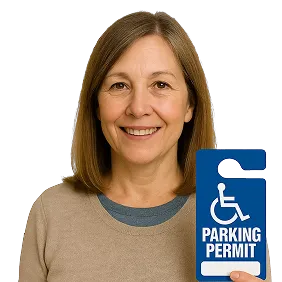

How to Get a Handicap Placard for Your Elderly Parent
 by Areeba Imran
Last updated:


Getting a handicap placard for elderly parent can make the difference between your mom or dad staying active and slowly withdrawing from daily life. If walking from distant parking spots causes pain, shortness of breath, or balance problems, a disability parking permit removes that barrier. But here’s what stops most adult children: they don’t know if their parent qualifies, how to start the conversation without causing offense, or what the application process actually requires.
This guide shows you how to recognize qualifying mobility signs, approach the topic with respect, and complete the senior handicap parking application step by step. You’ll learn whether you can apply on your parent’s behalf, what medical documentation you need, and how services like Parking MD connect your parent with licensed physicians for fast evaluations. We’ll also cover the difference between temporary and permanent placards so you choose the right option.
By the end, you’ll know precisely how to help your aging parent get the handicap placard for elderly parent they need without the confusion or pushback.
Signs Your Elderly Parent May Qualify for a Handicap Placard
Getting a handicap placard for elderly parent starts with knowing the signs. Your parent may qualify if they show clear mobility challenges. A licensed doctor makes the final call. But you can spot warning signs early.

Watch for these key indicators. They signal that your parent might need parking help.
Difficulty Walking Long Distances
Your parent qualifies if they can’t walk more than 200 feet without stopping. That’s about two-thirds of a football field. Many seniors need breaks after just 100 feet.
Pain, weakness, or fatigue often force frequent stops. Your parent might lean on shopping carts for support. They may avoid stores with large parking lots. These behaviors show limited walking tolerance.
Does your parent skip errands because parking is too far? That’s a red flag. A Handicap Placard can restore their independence. It gives them access to closer spaces.
Heart, Lung, or Other Conditions That Limit Mobility
Mobility issues aren’t always visible. Heart disease can make walking exhausting. Lung conditions like COPD cause severe shortness of breath. Oxygen dependency qualifies your parent automatically.

Other qualifying conditions include:
-
Severe arthritis affecting joints and movement
-
Neurological disorders like Parkinson’s or MS
-
Vision impairments that make walking unsafe
-
Chronic fatigue from kidney disease or cancer treatment
These conditions limit how far your parent can safely walk. Parking MD connects you with licensed doctors who evaluate these medical needs. They determine if your parent meets state requirements.
Balance Problems or the Need for Mobility Aids
Does your parent use a cane, walker, or wheelchair? That’s a strong indicator they qualify. Balance disorders make long walks dangerous. Falls become more likely with distance.
Watch for these signs:
-
Holding walls or furniture while walking
-
Needing another person’s arm for stability
-
Using leg braces or orthopedic devices
-
Avoiding uneven surfaces or curbs
Mobility aids show your parent needs closer parking. They reduce fall risk and conserve energy for daily tasks.
Temporary vs. Permanent Mobility Limitations
Your parent might need short-term or long-term help. Temporary permits work for post-surgery recovery. They cover injuries or conditions expected to improve within six months.
Permanent placards suit chronic conditions. These last longer than six months with no expected improvement. Arthritis, heart disease, and COPD typically qualify for permanent permits.
Not sure which type fits your parent’s needs? Sign Up Today to get a medical evaluation. A doctor will assess their condition and recommend the right permit type. Most applications process within 24 to 48 hours.
”I’m Not Disabled”: How to Talk to Your Parent About a Placard
Many adult children face resistance when suggesting a handicap placard for elderly parent. Your parent might say, “I’m not disabled” or “I don’t need that yet.” This reaction stems from fear of losing independence, not stubbornness.
The key is reframing the conversation around what they gain, not what they lose. A Handicap Placard for Elderly parents helps them keep doing what matters most.
Focus on What the Placard Lets Them Keep Doing
Don’t lead with limitations. Start with activities your parent values. The placard makes it easier to attend church, visit grandchildren, or shop without exhaustion.
Frame it this way: “This could help you keep going to your book club without the parking lot tiring you out first.” You’re not saying they can’t walk far anymore. You’re showing how the placard removes barriers to activities they enjoy.
Tie the disability parking permit for seniors to specific goals. If your parent loves gardening, explain how saving energy in parking lots means more energy for their hobby. If they attend medical appointments, show how closer parking reduces stress before important visits.
A Handicap Placard Doesn’t Mean Giving Up Independence
Address the core fear directly. Using an accommodation isn’t the same as surrendering independence. The Americans with Disabilities Act created these tools to increase mobility, not limit it.

Your parent might worry that accepting help means they’re giving up. The opposite is true. The placard helps them maintain the activities that define their independence. It’s a tool for staying active, not a symbol of decline.
Explain that millions of active seniors use placards. These aren’t people who’ve given up. They’re people who’ve found a smart way to conserve energy for what matters most.
Let Your Parent Stay in Control of the Decision
Never treat your parent like a child. They remain the applicant and decision-maker throughout the process. You can help with paperwork, but this is their choice.
Offer to research options or Skip the DMV wait by using online services. Then step back. Let them decide when they’re ready.
Some parents need time to accept the idea. That’s okay. Plant the seed and revisit later. The goal is helping them see the placard as a tool for maintaining their lifestyle, not a label they must accept.
How to Get a Handicap Placard for an Elderly Parent
Getting a handicap placard for an elderly parent involves five clear steps. Each state has its own rules, but the process follows a similar pattern. You’ll need to check eligibility, get medical certification, complete forms, submit paperwork, and use the placard correctly.
Start early to avoid delays. Most applications take 2-4 weeks to process. Having all documents ready speeds things up.
Step 1: Check Your Parents’ State Eligibility Requirements
Each state sets its own rules for disability parking permits. According to the California DMV, qualifying conditions include limited walking ability, need for mobility devices, or severe health conditions affecting movement. Your parent must meet at least one of these criteria.
Common qualifying conditions include:
-
Can’t walk more than 200 feet without stopping to rest
-
Needs a wheelchair, walker, cane, or crutches
-
Has lung disease or a heart condition limiting mobility
-
Uses portable oxygen
-
Has severe arthritis or a neurological condition
Fees vary by state. Some states offer free permits, while others charge $5-15. Check your state’s DMV website for exact costs and requirements.
Step 2: Get the Required Medical Certification
A licensed healthcare provider must certify your parent’s condition. This includes doctors, nurse practitioners, physician assistants, or chiropractors in most states. The provider completes a medical certification form explaining why your parent needs parking accommodation.
Many families now use telehealth services like Parking MD to complete this step online. This saves time and eliminates the need for an in-person doctor visit. The online evaluation connects your parent with a licensed physician who reviews their condition and completes the required certification.
The medical form asks about:
-
Specific mobility limitations
-
Expected duration of the condition
-
Whether the disability is temporary or permanent
-
Medical diagnosis supporting the need.
Keep copies of all medical documentation. You may need them for renewals or if questions arise later.
Step 3: Complete the State Handicap Placard Application
Download the application from your state’s DMV website. The form has two sections: one for the applicant and one for the healthcare provider. Your parent fills out personal information, including name, address, driver’s license number, and contact details.
The healthcare provider section requires:
-
Provider’s name and license number
-
Medical practice information
-
Certification of disability
-
Provider’s signature and date
Double-check all information before submitting. Errors cause delays and may require resubmission. Make sure signatures are original, not photocopied.
Some states let you apply online through their DMV portal. The Illinois Secretary of State offers digital applications that process faster than mail submissions. Check if your state provides this option.
Step 4: Submit the Application to the Appropriate State Agency
Most states accept applications through their Department of Motor Vehicles, Bureau of Motor Vehicles, or Motor Vehicle Division. Submission methods vary by state. You can mail the completed application, submit it online, or visit a local office in person.
Mail submissions take the longest to process. Online applications typically process within 1-2 weeks. In-person visits may provide temporary permits for immediate use while your permanent placard is processed.
Include payment if required. Some states accept checks, money orders, or credit cards. Keep your receipt as proof of submission.
Step 5: Receive and Properly Use the Placard
Once approved, your parent receives the placard by mail. It comes with an ID card and instructions for proper use. The placard hangs from the rearview mirror when parked in designated spaces.

Your parent must be in the vehicle to use the placard. It can’t be loaned to others. Remove it while driving to avoid obstructing the windshield.
The placard works in any state, not just where it was issued. It provides access to marked handicap spaces and often includes meter exemptions. Check local rules, as some cities have specific restrictions.
Store the placard away from direct sunlight when not in use. Heat can fade the expiration date and damage the permit. Replace it immediately if it becomes unreadable.
Can I Apply for a Handicap Placard for My Parent?
You can’t apply for a handicap placard for elderly parent under your own name. The person with the qualifying disability must be the applicant. Your parent needs to be listed as the permit holder, not you.

That said, you can help with nearly every step of the process. Many adult children and caregivers assist their aging parents in getting disability parking permits. You just can’t be the named applicant unless you have legal authority to act on their behalf.
Your Parent Is Usually the Applicant
The disability parking permit for seniors must be issued in your parent’s name. They’re the person with the mobility limitation. The permit stays with them, not with you or your vehicle.
This rule protects the system from misuse. It ensures permits go to people who actually need accessible parking. Your parent’s name appears on the application and the permit itself.
What a Son, Daughter, or Caregiver Can Help With
You can assist with many practical tasks. These include researching your state’s requirements, scheduling medical appointments, and helping complete paperwork. You can also provide transportation to appointments and submit documents where permitted.
For example, you might drive your parent to their doctor for the medical certification. You can fill out forms with them and mail the application to the DMV. In states like Pennsylvania, you can even submit documents on their behalf at the DMV office.
Many families find online services helpful for the medical evaluation step. This eliminates the need for in-person doctor visits when mobility is already limited.
When Someone Else Can Legally Act for Your Parent
Some situations allow you to apply as an authorized representative. These include having power of attorney, being a court-appointed guardian, or serving as a legal conservator. You’ll need documentation proving your legal authority.
According to caregiver application questions answered, requirements vary by state. Some states accept notarized authorization forms. Others require court documents or power of attorney paperwork.
If your parent can’t sign due to cognitive decline or physical limitations, legal authority becomes necessary. Contact your state DMV to learn what documentation they accept. Never forge your parents’ signature or apply under false pretenses.
Does My Parent Need an In-Person Appointment?
The answer depends on your state’s laws and your parent’s specific condition. Many states now allow telehealth evaluations for disability parking permits. This option saves time and reduces stress for seniors with mobility challenges.
When Medical Certification May Be Available Through Telehealth
Telehealth works well for many common conditions. Your parent can get certified online if their mobility limitation is well-documented. Chronic conditions like arthritis, heart disease, or lung problems often qualify for remote evaluation.
Online services connect your parent with licensed physicians who can review medical records. The doctor assesses whether the condition meets state requirements for a disability parking permit for seniors. Most evaluations take 15-20 minutes and happen from home.
To see if your state allows remote certification, check the NCDMV guidelines or your local DMV website. Many states adopted telehealth options in recent years to improve accessibility.
When an In-Person Evaluation May Be Necessary
Some situations require face-to-face assessment. Your parent needs an in-person visit if their condition requires a physical examination. New diagnoses without prior medical records typically need direct evaluation.
Complex mobility issues may also require in-person assessment. The doctor might need to observe gait, balance, or range of motion directly. State regulations vary on what conditions qualify for remote certification.
According to the step-by-step placard application process, providers must verify they can properly evaluate your parent’s condition remotely. If they can’t, they’ll recommend an in-person appointment.
What to Have Ready Before the Appointment
Preparation speeds up the certification process. Gather these items before your parents’ evaluation:
-
Valid government-issued ID or driver’s license
-
Current medical records showing diagnosis and treatment
-
List of mobility limitations and how they affect daily activities
-
Names and dosages of current medications
-
Contact information for treating physicians
Some states require specific forms to be completed before the appointment. Download your state’s application from the DMV website in advance. This reduces delays and helps your parent get their handicap placard for elderly parent faster.
The process is simpler than most people expect. Having documents ready ensures smooth certification without multiple appointments.
Conclusion
Getting a handicap placard for an elderly parent doesn’t have to be complicated. You now know how to spot qualifying conditions. You understand how to have productive conversations about mobility needs. You’ve learned the application steps and documentation requirements. You also know whether you can apply on their behalf.
The process starts with an honest assessment of your parents’ mobility. If they struggle with walking distances, talk to their doctor. Many healthcare providers can now certify disability parking permit for seniors through telehealth visits. This saves your parents an extra trip.
Don’t wait until a fall or injury forces the conversation. Start today by checking your state’s requirements. Schedule that doctor’s appointment if your parent qualifies. The right handicap placard for an elderly parent gives them access to the places they love without unnecessary physical strain.
Parking MD connects you with licensed physicians who can evaluate your parent’s eligibility online. Get certified fast and help your parent maintain their independence.
Frequently Asked Questions
How far does my parent need to be unable to walk to qualify for a handicap placard?
Your parent qualifies if they can't walk more than 200 feet without stopping to rest. That's roughly two-thirds of a football field. Many seniors need breaks after just 100 feet due to pain, weakness, or fatigue. If your parent leans on shopping carts for support or avoids stores with large parking lots, these behaviors show limited walking tolerance. A licensed doctor makes the final determination based on your parent's specific condition and mobility challenges.
Can heart or lung conditions qualify my elderly parent for a disability parking permit?
Yes, heart and lung conditions often qualify your parent even when mobility issues aren't visible. Heart disease can make walking exhausting, while lung conditions like COPD cause severe shortness of breath. If your parent uses oxygen, they qualify automatically. Other qualifying conditions include severe arthritis, neurological disorders like Parkinson's or MS, vision impairments that make walking unsafe, and chronic fatigue from kidney disease or cancer treatment. These conditions limit how far your parent can safely walk between parking spots and building entrances.
Does using a cane or walker mean my parent qualifies for a handicap placard?
Using a cane, walker, or wheelchair is a strong indicator your parent qualifies. These mobility aids show your parent needs closer parking to reduce fall risk and conserve energy. Other qualifying signs include holding walls or furniture while walking, needing another person's arm for stability, using leg braces or orthopedic devices, and avoiding uneven surfaces or curbs. Balance disorders make long walks dangerous, and falls become more likely with distance. A doctor evaluates these factors to determine if your parent meets state requirements for a disability parking permit.
What's the difference between temporary and permanent handicap placards for seniors?
Temporary permits work for post-surgery recovery, injuries, or conditions expected to improve within six months. Permanent placards suit chronic conditions that last longer than six months with no expected improvement. Arthritis, heart disease, and COPD typically qualify for permanent permits because these conditions don't resolve over time. If you're unsure which type fits your parent's needs, a licensed doctor can assess their condition during a medical evaluation and recommend the right permit type based on whether their mobility limitation is short-term or ongoing.
Can I apply for a handicap placard on behalf of my elderly parent?
Yes, adult children can help their elderly parents through the application process. You can gather the required medical documentation, schedule doctor appointments, and submit paperwork on your parent's behalf. The application requires a licensed physician to certify your parent's qualifying condition, so your parent will need a medical evaluation. Services like Parking MD connect your parent with licensed physicians for fast evaluations, making the process easier for families. The doctor assesses your parent's mobility limitations and completes the medical certification portion of the application.
What medical documentation do I need to get a handicap placard for my elderly parent?
You need a licensed physician to evaluate your parent's condition and certify they meet state requirements for a disability parking permit. The doctor must document specific mobility limitations, such as inability to walk more than 200 feet without rest, use of mobility aids, or qualifying medical conditions like heart disease, COPD, or severe arthritis. The physician completes the medical certification section of your state's application form. This certification confirms your parent's condition limits their mobility and qualifies them for closer parking access. No placard is issued without this medical documentation from a licensed doctor.

Meet the author
Areeba Imran
I am a healthcare professional and seasoned medical writer with 13+ years of experience across health, wellness, and clinical content. My work focuses on delivering trustworthy, evidence-based information that empowers readers to make informed decisions. With a keen interest in innovation and evolving areas of patient care, I bring a modern perspective to today's healthcare setup.
Get an Accessible Parking Permit Evaluation in Minutes.