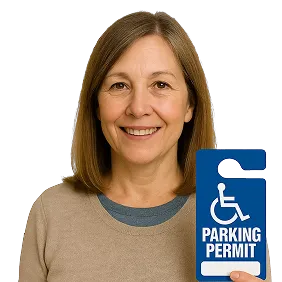

Disability Parking Placard: What It Is, Who Qualifies, and How to Get One (All 50 States)
 by Nida Hammad
Last updated:


A disability parking placard is a state-issued permit that allows people with qualifying disabilities to park in designated accessible spaces closer to building entrances. This guide covers everything: what a disability parking placard is, who qualifies, disability parking placard requirements in all 50 states, the correct application form for your state, and the fastest way to get the medical certification you need to apply.
According to the CDC, more than 70 million U.S. adults — more than 1 in 4 — report having a disability. Many of them qualify for a disability parking placard and don’t know it. Many others know they qualify but assume getting one is complicated. It isn’t. This guide shows you exactly where to get a handicap placard and how to get it done.
What Is a Disability Parking Placard?
A disability parking placard — also called a disabled parking placard, handicap placard, or accessible parking permit — is a credential issued by your state’s motor vehicle agency (DMV, BMV, SOS, or MVA depending on your state) that grants a person with a qualifying disability specific parking privileges under federal ADA law.
The terminology varies by state. California calls it a “disabled person parking placard.” Texas calls it a “disabled parking placard.” New York uses “parking permit for people with disabilities.” All mean the same thing and provide the same core protections. The placard displays the International Symbol of Access — the blue wheelchair symbol — and is recognized in all 50 states.
What a disability parking placard provides:
- Access to any space marked with the International Symbol of Access at public and private facilities
- Free metered parking in most states — not universal, verify your state’s rules
- Extended time at time-limited parking spaces in most jurisdictions
- Reciprocity in all 50 states — a placard issued anywhere in the U.S. is honored nationwide
What it does NOT provide:
- Permission to park in fire zones, loading zones, or no-parking areas
- The right to use the placard when the permit holder is not present in the vehicle
Types of Disability Parking Placards

Permanent Disability Placard (Blue)
Issued for long-term or permanent conditions. Valid for 2 to 5 years depending on the state. Renewal may or may not require new medical certification. Most states issue permanent placards free of charge.
Common qualifying conditions include multiple sclerosis, ALS, limb amputation, severe arthritis, Class III or IV cardiac conditions, chronic lung disease, Parkinson’s disease, and legal blindness.
Temporary Disability Placard (Red or Orange)
Issued for short-term conditions expected to improve. Typically valid for 3 to 6 months. Renewable with new medical certification if the condition persists. Some states use orange rather than red — terminology varies.
Temporary disability placard common qualifying conditions include post-surgical recovery, broken bones, pregnancy complications, severe chemotherapy side effects, and acute injury.
Organizational Placard (Green)
Issued to organizations that regularly transport people with disabilities — such as assisted living facilities, medical transport services, or nonprofits. Issued to the organization rather than an individual.
Disability License Plates vs Placard
Both disability license plates and placards provide the same accessible parking privileges, but they work differently in practice. A plate is permanently attached to one vehicle, while a placard travels with the permit holder and can be used in any car they are driving or riding in — making it the more flexible option for passengers, caregivers, and anyone who uses more than one vehicle. Which one is right for you depends on how and where you travel most.
Who Qualifies for a Disability Parking Placard?
Individual states set their own disability parking placard requirements, but most follow the framework established by the Americans with Disabilities Act (ADA) and the Uniform Vehicle Code. The key standard across all states is functional impairment — the condition must substantially restrict your ability to walk safely through a parking area. A licensed healthcare provider must certify your condition on your state’s application form.
Mobility Limitations
- Cannot walk 200 feet without stopping to rest — the most common qualifying threshold nationwide
- Requires a cane, walker, wheelchair, crutches, or prosthetic device to walk
- Limb difference or amputation affecting walking ability
- Severe limitation due to arthritic, neurological, or orthopedic condition
Cardiovascular and Respiratory Conditions
- According to the American Heart Association, severe cardiac condition classified as Class III or IV — breathlessness or fatigue with minimal activity
- Lung disease limiting forced expiratory volume to less than 1 liter per second
- Arterial oxygen tension below 60 mm Hg at rest
- Dependence on supplemental oxygen
Neurological and Musculoskeletal Conditions
Multiple sclerosis, Parkinson’s disease, severe arthritis that significantly limits walking ability, and stroke-related disability are frequently certified under these criteria.
Visual Impairments
- Legal blindness — visual acuity of 20/200 or worse with correction
- Severely limited field of vision of 20 degrees or less
Invisible and Chronic Conditions
Many qualifying conditions are not visible to others. Placard holders are never required to justify their disability to strangers. Qualifying invisible conditions include:
- Fibromyalgia — qualifies when it prevents walking 200 feet without stopping to rest
- Lupus — many people with lupus do qualify, particularly those experiencing flares that affect mobility
- Chronic fatigue syndrome — extreme exhaustion that makes walking even short distances overwhelming
- COPD and severe asthma — when breathing limitation meets the respiratory threshold
- Severe neuropathy, complex regional pain syndrome, and chronic pain conditions affecting safe walking
Temporary Conditions
Post-surgical recovery, broken bones, pregnancy complications, and severe chemotherapy side effects can all qualify for a temporary placard while the condition persists.
Who can certify: A licensed physician (MD/DO), physician assistant (PA), nurse practitioner (NP), optometrist (for vision conditions), or chiropractor (accepted in many states) can complete the medical section of your disabled person parking placard application.
How to Get a Disability Parking Placard
Most people think getting a disability parking placard requires a DMV visit. In most states it doesn’t — and the medical evaluation, which is the most time-consuming step, can now be completed entirely online. Here is the standard process across all 50 states.

Step 1: Complete Your Medical Evaluation (Where to Get a Handicap Placard Started)
A licensed healthcare provider must evaluate your condition and certify that it meets your state’s qualifying criteria on the medical section of your disabled person parking placard application. This is the step most people get stuck on — scheduling a physician appointment can take weeks.
ParkingMD connects patients with licensed physicians in all 50 states for online evaluations, 7 days a week. The physician completes the medical certification section of your state’s form directly. Completed documentation is typically delivered within 24 to 48 hours.
Step 2: Download Your State’s Disability Parking Placard Application Form
Each state has its own disability parking placard application form. The most commonly requested forms are:
- California — Form REG 195
- Texas — Form VTR-214
- Florida — Form HSMV 83039
- New York — Form MV-664.1
- Pennsylvania — Form MV-145A
- Michigan — Form BFS-108
- Illinois — Secretary of State Persons with Disabilities Application
- Ohio — Form BMV 5754
- New Jersey — Form SP-41
- Massachusetts — RMV Disabled Parking Placard Application
All 50 states have their own forms. You can apply for a disability parking placard and find your state’s form using the full state-by-state guide.
Step 3: Submit to Your State Agency
Submission methods vary by state:
- Online: California, Connecticut, Washington, Michigan, Maryland, and Virginia offer online submission
- Mail-in: the most common method nationwide; most states accept mailed applications
- In-person: some states require first-time applicants to submit in person at the DMV or county clerk’s office
Processing time: 1 to 4 weeks after submission, depending on your state.
Cost: Varies state by state. Most states are free. New Jersey charges $4.
Step 4: Receive and Display Your Placard
- Your placard is mailed to the address on your application
- Hang it from your rearview mirror when parked — front facing the windshield so the expiration date is visible from outside
- Remove the placard before driving — most states require this by law
- Carry your state-issued ID with you when using accessible spaces
Disability Parking Placard Application Form and Process — All 50 States
Requirements, forms, fees, and submission methods vary by state. All form numbers verified June 2026 from official state agency sources.
| State | Verified Form Name & Number | Issuing Agency | Submission Method, Validity & Key Notes |
|---|---|---|---|
| Alabama | Form MVR 32-6-230 — Application for Disability Access Parking Credentials | County Licensing Offices (Alabama Dept. of Revenue) | Submit in person to local County Licensing Office. Permanent placard valid 5 years. Temporary valid 6 months. Physician, CRNP, or certified nurse midwife can certify. Free. |
| Alaska | Form 861 — Disability Parking Permit Application | Alaska DMV | Submit by email or in person at any DMV office. Permanent valid 5 years. Temporary valid 6 months. Wide range of providers can certify including PTs, OTs, chiropractors, podiatrists. Free. |
| Arizona | Form 96-0104 — Disabled Person Placard Application | Arizona Motor Vehicle Division (MVD) | Online submission available at servicearizona.com. Physician, NP, or PA must certify. Permanent valid 5 years. Free. |
| Arkansas | Form 10-336 — Disabled Person Parking Permit Application | Arkansas Department of Finance and Administration (DFA) | Submit to any Arkansas DFA Office. Physician must certify. Permanent valid 5 years. Temporary valid 6 months. Free. |
| California | Form REG 195 — Disabled Person Parking Placard Application | California DMV | Submit online at dmv.ca.gov, by mail, or in person. Permanent placards free; temporary placards $6 (may be waived). Renewable every 2 years. Physician, surgeon, chiropractor, optometrist, NP, or PA can certify. |
| Colorado | Form DR 2219 — Application for Disabled Persons Parking Privileges | Colorado DMV | Submit at any county motor vehicle office, by mail, or online. Permanent valid 5 years. Free. Physician, PA, or NP can certify. |
| Connecticut | Form B-225P (permanent) or B-225T (temporary) — Disability Parking Permit | Connecticut DMV | Online submission available at ct.gov/dmv. Physician, PA, or APRN must certify. Permanent valid 5 years. Free. |
| Delaware | Form MV-175 — Application for Disability Parking Permit | Delaware DMV | Submit by mail or in person. Physician must certify. Permanent valid 3 years. Under 85: in person; over 85: online. Free. |
| Florida | Form HSMV 83039 — Application for Persons with Disabilities Parking Permit | Florida DHSMV / County Tax Collector Offices | Submit to local county tax collector office. Physician, podiatrist, optometrist, PA, or APRN must certify. Permanent valid 4 years. Veterans with 100% permanent disability may use VA Form 27-333. Free. |
| Georgia | Form MV-9D — Persons with Disabilities Parking Permit Application | Georgia Department of Revenue / County Tag Offices | Submit in person at local county tag office. Physician must certify. Permanent valid 4 years. Free. |
| Hawaii | Form PA-3 — Disabled Person Parking Placard Application | Hawaii Disability and Communication Access Board (DCAB) | Submit by mail to DCAB. Physician or APRN with Hawaii license must certify. Permanent valid 6 years — longest validity in the U.S. Temporary valid 6 months. Free. |
| Idaho | Form ITD 3392 — Disabled Parking Permit Application | Idaho Transportation Department (ITD) | Submit by mail or at any DMV office. Physician, PA, NP, or chiropractor can certify. Permanent valid 5 years. Free. |
| Illinois | Form VSD 62 — Persons with Disabilities License Plate/Placard Application | Illinois Secretary of State | Submit by mail or at a Secretary of State facility. Physician, APN, PA, optometrist, or chiropractor can certify. Permanent valid 4 years. Exempt from meter fees statewide. Free. |
| Indiana | Form 42070 — Application for Disability Plate or Placard | Indiana BMV | Submit at any BMV branch or by mail. Physician, advanced practice nurse, chiropractor, or podiatrist can certify. Permanent valid 4 years. Free. |
| Iowa | Iowa Persons with Disabilities Parking Permit Application (no single form number — available at county treasurer offices) | Iowa County Treasurer Offices / Iowa DOT | Submit at county treasurer’s office or online at iowadot.gov. Physician must certify. Permanent valid 2 years. Free. |
| Kansas | Form TR-175 — Application for Disabled Person Placard | Kansas DMV / County Treasurer | Submit by mail to Kansas DMV or at any county treasurer’s office. Physician or optometrist must certify. Permanent valid 5 years. Free. |
| Kentucky | Form TC 96-182 — Application for Disabled Person Parking Placard or Plate | Kentucky Transportation Cabinet / County Clerk | Submit at County Clerk’s office. Physician, PA, APRN, chiropractor, or optometrist can certify. Permanent valid 4 years. Free. |
| Louisiana | Form DPSMV2039 — Application for Special License Plate or Placard | Louisiana Office of Motor Vehicles (OMV) | Submit at any OMV or regional office. Physician must certify. Permanent valid 4 years. Free. |
| Maine | Form BMV-56 — Application for Disability Parking Privileges | Maine BMV | Submit by mail or at any BMV branch. Physician, PA, or NP must certify. Permanent valid 4 years. Free. |
| Maryland | Form VR-210 — Application for Disability Parking Placard or License Plate | Maryland MVA | Submit online at mva.maryland.gov, by mail, or in person. Physician, PA, CRNP, or chiropractor can certify. Permanent valid 5 years. Free. |
| Massachusetts | RMV Disability Parking Placard Application (download from mass.gov/rmv) | Massachusetts RMV (Registry of Motor Vehicles) | Submit by mail to MassDOT RMV. Physician, PA, or APRN must certify. Permanent valid 5 years. Free. |
| Michigan | Form BFS-108 — Disability Parking Placard Application | Michigan Secretary of State (SOS) | Online submission available at michigan.gov/sos. Physician, PA, or NP must certify. Permanent valid 4 years. Free. |
| Minnesota | Form PS2017 — Application for Disability Certificate | Minnesota Driver and Vehicle Services (DVS) | Submit by mail or at a deputy registrar. Physician, PA, or APRN must certify. Permanent valid 6 years. Free. |
| Mississippi | Application for Persons with Disabilities License Plate or Windshield Placard (available at county tax collector) | Mississippi County Tax Collector Offices | Submit at any county tax collector’s office. Physician must certify. Permanent valid 4 years. Free. |
| Missouri | Form 1776 — Application for Disabled Person Parking Certificate | Missouri Department of Revenue / Local License Offices | Submit at local license office or by mail. Physician or optometrist must certify. Permanent valid 3 years. Free. |
| Montana | Montana Disability Parking Placard Application (available at county treasurer) | Montana County Treasurer Offices | Submit by mail or at any county treasurer’s office. Physician, PA, or NP must certify. Permanent valid 4 years. Free. |
| Nebraska | Form TR-72 — Application for Disabled Person Parking Certificate | Nebraska County Treasurer Offices | Submit at county treasurer’s office. Physician, PA, or NP must certify. Permanent valid 5 years. Free. |
| Nevada | Form VP-238 — Application for Persons with Disabilities Parking Permit | Nevada DMV | Submit by mail or in person at any DMV office. Physician, PA, or APRN must certify. Permanent valid 5 years. Free. |
| New Hampshire | Form DSMV 450 — Application for Disability Parking Plates or Placard | New Hampshire DMV | Submit at any DMV office or by mail. Physician, PA, APRN, or chiropractor must certify. Permanent valid 5 years. Free. |
| New Jersey | Form SP-41 — Application for a Disability Parking Placard | New Jersey MVC | Submit at any MVC agency. Physician, PA, or APN must certify. Permanent valid 5 years. $4 fee — the only state with a fee. |
| New Mexico | Form MVD-10007 — Disabled Parking Placard Application | New Mexico MVD | Submit at any MVD field office or by mail. Physician, PA, or NP must certify. Permanent valid 4 years. Free. |
| New York | Form MV-664.1 — Application for Parking Permit for People with Disabilities | New York DMV | Submit at any DMV office or by mail. Physician, PA, or NP must certify. Permanent valid 5 years. Free. |
| North Carolina | Form MVR-37 — Application for Special Registration Plates and Parking Permits | North Carolina DMV / License Plate Agencies | Submit at any NCDMV license plate agency. Physician, PA, or NP must certify. Permanent valid 5 years. Free. |
| North Dakota | Form SFN 2895 — Application for Disability Parking Permit | North Dakota DOT / County Auditor Offices | Submit at local county auditor’s office or DOT. Physician must certify. Permanent valid 5 years. Free. |
| Ohio | Form BMV 5754 — Application for Disability Placards and/or License Plates | Ohio BMV / County BMV | Submit at county BMV or by mail. Physician, chiropractor, or optometrist must certify. Permanent valid 4 years. Free. |
| Oklahoma | Form 797 — Special License Plate/Placard Application | Oklahoma DPS / Tag Agents | Submit at any licensed tag agent. Physician must certify. Permanent valid 4 years. Free. |
| Oregon | Form 735-0076 — Application for Disabled Person Parking Permit | Oregon DMV | Submit by mail or at any DMV office. Physician, PA, or NP must certify. Permanent valid 4 years. Free. |
| Pennsylvania | Form MV-145A — Application for Persons with Disability Plate or Placard | Pennsylvania PennDOT / County Treasurer | Submit at county treasurer’s office or online at dmv.pa.gov. Physician, PA, or CRNP must certify. Permanent valid 5 years. Qualifying conditions include: inability to walk 200 feet without stopping, reliance on mobility aids, lung disease, Class III/IV cardiac condition, legal blindness, loss of use of one or both legs. Free. |
| Rhode Island | Form RI DMV 155 — Application for Disabilities Parking Placard | Rhode Island DMV | Submit at DMV headquarters or regional offices. Physician, PA, or APRN must certify. Permanent valid 3 years. Free. |
| South Carolina | Form SCDMV TI-006 — Application for Disability License Plate or Parking Placard | South Carolina DMV | Submit at any DMV branch or by mail. Physician, PA, or APRN must certify. Permanent valid 5 years. Free. |
| South Dakota | Form MV-092 — Application for Persons with Disability Parking Permit | South Dakota County Treasurer Offices | Submit at county treasurer’s office — print and have physician complete. Physician must certify. Permanent valid 3 years. Free. |
| Tennessee | Form RV-F1316501 — Application for Disabled Parking Placard or Specialty License Plate | Tennessee County Clerk Offices | Submit at any county clerk’s office. Physician, chiropractor, or optometrist must certify. Permanent valid 5 years. Free. |
| Texas | Form VTR-214 — Application for Persons with Disabilities Parking Placard and/or License Plate | Texas DPS / County Tax Assessor-Collector | Submit at any county tax assessor-collector’s office or by mail. Physician, PA, or APRN must certify. Permanent valid 5 years. Free. |
| Utah | Form TC-842 — Application for Disabled Person Parking Permit | Utah DMV / Driver License Division | Submit at any DMV driver license office or by mail. Physician, PA, or APRN must certify. Permanent valid 5 years. Free. |
| Vermont | Form VD-119 — Application for Persons with Disabilities Special Parking Permit | Vermont DMV | Submit at any DMV office or by mail. Physician, PA, or NP must certify. Permanent valid 5 years. Free. |
| Virginia | Form MED-10 — Medical Certification for Special Parking Privileges | Virginia DMV | Submit online at dmv.virginia.gov or at any DMV customer service center. Physician, PA, or LCSW must certify. Permanent valid 5 years. Free. |
| Washington | Disabled Parking Permit Application (online only — available at dol.wa.gov) | Washington Department of Licensing (DOL) | Submit online at dol.wa.gov or by mail. Physician, PA, ARNP, chiropractor, optometrist, or podiatrist can certify. Permanent valid 5 years. Free. |
| West Virginia | Form DMV-17-BL — Application for Persons with Disabilities Parking Placard | West Virginia DMV | Submit at any DMV office or by mail. Physician, PA, or APRN must certify. Permanent valid 5 years. Free. |
| Wisconsin | Form MV3034 — Application for Disability Plates/Placards | Wisconsin DMV | Submit through your physician online or in person at any DMV. Physician, chiropractor, PA, or APRN must certify. Permanent valid 4 years. Free. |
| Wyoming | Form WYDOT MV-8002 — Application for Disabled Person Parking Permit | Wyoming DOT / County Clerk Offices | Submit at any county clerk’s office. Physician must certify. Permanent valid 5 years. Free. |
New Jersey is the only state with a fee ($4). All 49 other states issue disability parking placards free. Always download the current version of your state’s form directly from the official agency website before applying.
How to Ask Your Doctor for a Handicap Placard
This is one of the most common questions people have — and the answer is simpler than most expect. You do not need a referral, a specialist, or a specific type of appointment. Your primary care physician can certify your condition for a disability parking placard in most states.
What to say to your doctor:
Be direct and specific about how your condition affects your ability to walk. Your physician needs to certify functional limitations, not just a diagnosis. Come prepared with:
- The specific functional limitation — for example: “I cannot walk 200 feet without stopping to rest due to [your condition],” or “I rely on a cane/walker to walk safely”
- Your state’s application form — print it and bring it to the appointment so the physician can complete the medical section on the spot
- Any relevant medical records or recent test results that document your condition
If your primary care physician is familiar with your condition and its impact on your mobility, the certification can usually be completed at a routine appointment. If you want to avoid the wait, ParkingMD connects you with a licensed physician online who is trained to evaluate exactly these types of disability parking placard requirements — 7 days a week, results in 24 to 48 hours.
Where to Use a Disability Parking Placard
A disability parking placard is valid at any space marked with the International Symbol of Access — the blue wheelchair symbol on a permanently mounted sign above parked vehicle height. The ADA requires accessible parking spaces at virtually all public facilities: shopping centers, hospitals, government buildings, restaurants, hotels, and private businesses.
Disabled parking placard rules — what applies everywhere:
- Valid in all 50 states — a placard issued in any U.S. state is honored nationwide
- Valid in any vehicle the permit holder is using, as the driver or as a passenger
- Free metered parking in most (not all) states — confirm your state’s rules, especially when traveling
- Extended time at time-limited spaces in most jurisdictions
Rules that apply everywhere — no exceptions:
- The placard is only valid when the named permit holder is present in the vehicle
- Do not lend the placard to family members when you are not in the vehicle
- Remove the placard before driving — enforcement officers can cite you for obstructed view
- Expired placards cannot be used, even by the named holder
Renewing or Replacing Your Disability Parking Placard
Renewal timelines vary by state — permanent placards are typically valid for 2 to 5 years. Only a few states automatically send renewal reminders, so tracking your expiration date is your responsibility.
- Permanent placard renewal: most states require a renewal application but not always new medical certification
- Temporary placard renewal: new medical certification is typically required each time
- Lost or stolen placard: contact your state DMV. Most states issue replacements with the same expiration date as the original
Disability Parking Placard Rules and Misuse
Disabled parking placard rules are enforced by local police, parking enforcement officers, and in some cities, trained civilian volunteers. Enforcement officers routinely run placard numbers against registration databases during parking lot sweeps.
Penalties for misuse:
- Fines range from $250 to $1,000 or more for a first offense in most states
- Repeat violations are classified as misdemeanors in many states — potential jail time applies
- States may confiscate the placard and deny future renewals for confirmed misuse
- Making false statements to obtain a placard is fraud — a criminal offense in all 50 states
Frequently Asked Questions
What is the easiest way to get a handicap placard?
The fastest path is completing the medical evaluation online through ParkingMD, which connects you with a licensed physician in your state, available 7 days a week, with completed medical certification typically delivered in 24 to 48 hours. Once you have the signed form, submit the disability parking placard application to your state DMV by mail or online. In most states no DMV visit is required.
How do you ask your doctor for a handicap placard?
Tell your physician specifically how your condition limits your walking, for example, that you cannot walk 200 feet without stopping to rest, or that you rely on a cane or walker. Bring your state's printed application form to the appointment so the medical section can be completed on the spot. Your doctor certifies your functional limitation; the DMV makes the final decision on the placard. If you want to skip the appointment wait, ParkingMD physicians evaluate disability parking placard requirements online and complete the certification the same day or next business day.
Does lupus qualify for a disability parking placard?
Yes, lupus can qualify. If lupus prevents you from walking 200 feet without stopping to rest, or significantly limits your ability to walk safely through a parking area due to joint pain, muscle weakness, or extreme fatigue, you likely meet the qualifying threshold. Lupus alone is not automatically qualifying — a licensed physician must evaluate and certify your specific functional limitations. Many people with lupus do qualify, particularly those experiencing flares that affect mobility.
What qualifies for a handicap placard in PA?
In Pennsylvania, qualifying conditions include: inability to walk 200 feet without stopping to rest, inability to walk without an assistive device (cane, crutch, brace, prosthetic), severe lung disease (FEV1 less than 1 liter), use of portable oxygen, Class III or IV cardiac condition, severe arthritic or neurological limitation affecting walking, or legal blindness. Apply using Form MV-145A at your county treasurer's office or at dmv.pa.gov.
Where do you get a handicap placard?
Disability parking placards are issued by each state's motor vehicle agency — the DMV, BMV, Secretary of State, MVA, or DOT depending on your state. You do not get a placard from the federal government, from your physician, or from any third-party service. ParkingMD and similar telehealth services complete the medical certification step only — you then submit that certification with your state's disabled person parking placard application directly to your state agency.
How long does it take to get a disability parking placard?
There are two stages. First, the medical evaluation: with an online evaluation through ParkingMD, completed certification is typically delivered within 24 to 48 hours. Second, DMV processing: after you submit the completed application, most states process and mail your placard within 1 to 4 weeks. Start early if you need a placard for a specific surgery or treatment date.
Is a disability parking placard valid in other states?
Yes. Any disability parking placard issued by a U.S. state is honored in all 50 states. Federal ADA reciprocity ensures your California placard works in Texas and vice versa. Note that meter parking exemptions and time extension rules vary by jurisdiction — check local rules when traveling.

Meet the author
Nida Hammad
With over 5 years of experience in accessibility content, I create clear resources on handicap parking permits, state requirements, and applications.
Get an Accessible Parking Permit Evaluation in Minutes.