
What Is a Handicap Placard? (And How ParkingMD Can Help)
 by Nida Hammad
Last updated:


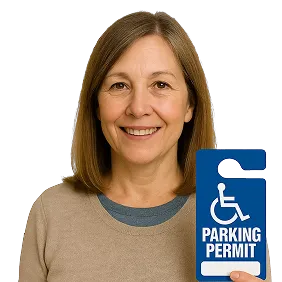
A handicap placard is a hanging placard, or in some cases a specialized license plate, that a state DMV issues to a person with a qualifying medical condition. It’s also commonly called a disability parking permit, and both terms refer to the same document. It allows the vehicle to park in accessible spaces marked with the International Symbol of Access, spaces that are wider, closer to building entrances, and designed to make getting in and out of a vehicle easier.
Handicap placards exist because walking, standing, and getting around a parking lot can be genuinely difficult or dangerous for millions of people. Placards are used by people with permanent mobility conditions, people recovering from surgery, people managing heart or lung disease, and people whose disability isn’t visible at all. You do not need to use a wheelchair to qualify, and you don’t need to look disabled for your condition to be real.
Once a state DMV issues your placard, it works nationwide. Every state honors valid placards issued by any other U.S. state under federal accessibility standards that govern how accessible parking spaces must be designed and enforced. That means a placard from Ohio works the same way in Arizona, Florida, or anywhere else you drive.
Accessible parking isn’t a niche accommodation. According to the Centers for Disease Control and Prevention, mobility disability affecting one in seven adults makes it the most common type of functional disability among U.S. adults. That’s a large population navigating grocery store lots, medical office parking, and downtown streets every day, and it’s part of why federal accessibility rules were written to ensure consistency no matter which state issued the placard or where it’s being used.
Federal accessibility standards don’t determine who qualifies for a placard, that’s left to each state. What federal law does control is how accessible spaces themselves must be built and marked, covered in federal accessible parking design standards published by the U.S. Department of Justice. That distinction matters because it’s the reason a placard earned in one state carries the same basic parking privileges in every other state, even though the medical criteria used to issue it can look different depending on where you applied.
**Getting your medical certification doesn’t have to mean weeks of waiting on a doctor’s office schedule. Start Your Evaluation and complete the medical portion of your application from home.
Temporary vs. Permanent Handicap Placards
States generally issue two categories of placard, and the difference matters for how long yours will last and what you’ll need to do to keep it valid.
Temporary placards
They are usually red or orange and are issued when a condition is expected to improve. Common reasons include recovery from surgery, a broken bone, late-stage pregnancy complications, or a short-term flare of a chronic condition. Duration varies by state, but most temporary placards run three to six months, and many states allow a renewal if the condition hasn’t resolved by the expiration date. A physician typically has to specify an expected recovery window on the certification form, and that estimate is what determines how long the temporary placard stays valid.
Permanent placards
They are typically blue and are issued for conditions that aren’t expected to improve, such as spinal cord injury, multiple sclerosis, or long-term cardiac disease. Renewal periods differ significantly by state. Some states renew permanent placards every two years, others every four to six years, and a handful require updated physician certification at every renewal while others only ask for it if your condition has changed. It’s worth marking your renewal date as soon as your placard arrives, since a lapsed permanent placard generally has to go through the same certification process as a first-time application.
| Placard Type | Color | Typical Duration | Renewal Certification Needed? |
|---|---|---|---|
| Temporary | Red or orange | 3 to 6 months | Yes, at every renewal |
| Permanent | Blue | 2 to 6 years, depending on state | Varies by state |
Who Qualifies for a Handicap Placard?

Eligibility isn’t based on a diagnosis alone. It’s based on how much that diagnosis limits your ability to walk or move safely, which is why every state application asks a physician to certify functional impact, not just a condition name.
The Functional Limitation Standard
The most widely used eligibility benchmark, appearing in states from Colorado to Florida to New York, is the inability to walk 200 feet without stopping to rest or without the use of an assistive device. This standard focuses on real-world function. A condition may qualify if it causes this kind of functional limitation, regardless of what the diagnosis is called.
This distinction matters. Having a diagnosis like arthritis or diabetes does not automatically mean you qualify. What matters is whether that diagnosis, in your specific case, limits your ability to walk safely and independently. That determination is always made by a licensed physician, not by an online form or a checklist.
Mobility Conditions
Conditions affecting the joints, spine, or limbs are among the most common reasons people apply. This includes severe arthritis, chronic back pain, spinal stenosis, amputation or loss of limb function, and recovery from joint replacement surgery. These conditions may qualify if they cause difficulty walking 200 feet, require a cane, walker, or wheelchair, or create a fall risk in open spaces like parking lots.
Fibromyalgia and chronic fatigue conditions also fall into this category for some applicants, since sustained walking can trigger significant pain or exhaustion even without a visible mobility aid. What a physician looks for isn’t the diagnosis name on its own. It’s whether the documented symptoms, pain levels, or joint limitations translate into a real, measurable difficulty covering the distance of a typical parking lot.
Cardiovascular Conditions
Heart and circulatory conditions can limit mobility just as significantly as an orthopedic injury, even when they aren’t visible. Several states, including New York, specifically reference Class III or Class IV cardiac limitations using American Heart Association functional classification as a qualifying standard. Congestive heart failure, coronary artery disease, and conditions causing chronic shortness of breath or fatigue on exertion may qualify if a physician documents that walking distances safely is compromised.
Peripheral artery disease and severe hypertension with related complications can also factor into a cardiovascular determination. Because these conditions often involve exertional symptoms rather than constant, visible impairment, documentation from a cardiologist or treating physician, describing how far a person can walk before symptoms occur, tends to carry significant weight in the certification decision.
Neurological Conditions
Neurological disorders often affect balance, coordination, and endurance in ways that make crossing a parking lot genuinely hazardous. This category includes multiple sclerosis, Parkinson’s disease, peripheral neuropathy, stroke recovery, and other conditions affecting motor control. A neurological condition may qualify if it causes balance instability, muscle weakness, or a documented risk of falling.
Dementia and other cognitive-motor conditions are handled with particular care. Several states require a physician to confirm not just a diagnosis, but specifically how the condition limits safe, independent walking, since cognitive impairment alone doesn’t automatically translate into the kind of functional limitation these programs are designed to address.
Temporary Conditions: Pregnancy and Post-Surgery
Pregnancy alone is not a qualifying condition in most states. However, pregnancy-related complications, such as pelvic instability, severe edema, or a physician-ordered mobility restriction, may qualify for a temporary placard. Some states, including Florida, use a separate application specifically for expectant mothers, requiring a physician’s signature confirming the mobility-limiting complication.
Recovery from major surgery, including joint replacement, spinal surgery, and cardiac procedures, commonly qualifies for a short-term placard while healing is underway. The same is true for recovery from a serious injury, such as a broken hip or leg fracture, where mobility is expected to improve but is significantly limited in the meantime. In these cases, a physician typically specifies an expected duration on the certification form, which determines how long the temporary placard remains valid.
Conditions That May Qualify for a Handicap Placard
-
Severe arthritis or chronic joint pain
-
COPD or other lung disease limiting oxygen intake
-
Class III/IV cardiac conditions
-
Multiple sclerosis, Parkinson’s disease, or stroke recovery
-
Amputation or loss of limb function
-
Recovery from major surgery
-
Pregnancy complications affecting mobility, when documented by a physician
Every condition on this list, and every condition not listed here, is evaluated individually. A physician reviews your specific circumstances and makes the final determination on your state’s certification form. No condition guarantees approval on its own.
This is also why two people with the same diagnosis can have different outcomes. One person’s arthritis might be well-managed and cause minimal walking difficulty, while another’s causes daily pain that makes 200 feet genuinely hard to cover. The certification process exists to capture that difference, which is part of why a physician’s individualized assessment, rather than a fixed list of diagnoses, sits at the center of every state’s eligibility rules.
Curious whether your own situation fits the pattern? **Read Patient Reviews** from people who went through this exact evaluation process, or continue reading to see how the requirements shift depending on where you live.
How Handicap Placard Rules Vary by State
The 200-feet functional standard shows up in many states, but the exact language, the list of qualifying conditions, and who is allowed to sign the certification form differ from state to state. Some states are notably stricter than others, and a few accept certification from a wider range of licensed professionals.
In California, the state’s handicap placard requirements accept certification from physicians, chiropractors, optometrists, physician assistants, nurse practitioners, and certified nurse midwives, based on eligibility rules set out in California’s DMV disability placard criteria, which include loss of use of a limb, a diagnosed disease that substantially impairs mobility, or an inability to move without an assistive device.
Texas defines disability more narrowly around visual acuity thresholds and mobility problems that substantially impair a person’s ability to move around, as laid out in the Texas DMV’s disabled parking placard rules, and its process runs through the county tax assessor-collector rather than a state DMV office directly.
Florida’s handicap placard requirements allow permanent permits valid for four years at no cost, while temporary permits are valid for up to six months and require a $15 fee, under Florida’s HSMV permit statute, with certification accepted from physicians, osteopathic physicians, chiropractors, and advanced practice nurses.
New York’s handicap placard requirements use a detailed list of qualifying impairments defined in New York DMV’s severe disability criteria, including Class III or IV cardiac conditions under American Heart Association standards, neuromuscular dysfunction, and lung disease measured by spirometry, and permits can only be issued through a local city, town, or village clerk rather than the DMV itself.
Under Colorado’s mobility impairment standard, eligibility specifically calls out the inability to walk 200 feet without needing to stop and rest, as well as respiratory conditions measured by forced expiratory volume or arterial oxygen levels, and the state also offers a separate remuneration-exempt placard for people whose disability limits their ability to reach or operate a parking meter.
These differences aren’t just bureaucratic details. They affect real decisions, like whether your chiropractor can sign your certification form, whether your permit needs renewing every two years or every six, and whether you apply through a state DMV, a county tax office, or your local town clerk. Some states, like New York and Texas, route applications through local or county offices rather than a centralized DMV, which can catch first-time applicants off guard if they assume every state works the same way.
Because these details shift by state, it’s worth checking your own state’s specific requirements before you apply. Every ParkingMD state page breaks down local qualifying conditions, the exact certification form your state uses, and how long approval typically takes.
The Application Process for a Handicap Placard

Getting a handicap placard involves two separate steps: a medical evaluation and a DMV submission. Understanding both helps you avoid the most common delays, and knowing what to expect at each stage can save you a wasted trip or a rejected form.
Step 1: Medical Evaluation.
A licensed physician, or in many states a physician assistant, nurse practitioner, chiropractor, or optometrist, needs to review your condition and determine whether it meets your state’s functional limitation standard. This can happen during a regular appointment, or through a telehealth evaluation where you describe your condition and, when relevant, share existing medical records. The provider will typically ask how far you can walk before needing to stop, whether you use an assistive device, and how your condition has been diagnosed and treated.
Step 2: Physician Certification.
If the provider agrees your condition qualifies, they complete and sign your state’s specific certification form. This isn’t a rubber stamp. The physician is making a clinical judgment, and they may decline to certify if the documentation doesn’t support a qualifying functional limitation. This is a required legal step in every state; there is no way to obtain a placard without it. Most states also require the certification to be dated within a specific window, often 12 months, of when you submit your application.
Step 3: DMV or Local Agency Submission.
Once certified, the signed form goes to the appropriate office. This varies by state: some use a centralized DMV, others route through county tax offices, and a few, like New York, only accept applications through local municipal clerks. You’ll typically also need a copy of your driver’s license or state ID, and in some states, a small fee for temporary permits specifically (permanent permits are free in most states).
Step 4: Placard Issued.
Once the submitting office processes your application, your placard is either handed to you directly, mailed to your address, or made available for pickup. Processing at this stage is where timelines vary most, since it depends on whether your state offers online submission, how backlogged the local office is, and whether any part of the application needs correction.
The medical evaluation portion, when done through a telehealth service, commonly takes 24 to 48 hours from submission to signed certification. From there, processing time at the DMV or local agency ranges from same-day issuance to two to four weeks, depending on the state and whether you apply online, by mail, or in person. The slowest part of the traditional process is almost always step one: getting in front of a provider who can complete the certification in the first place.
Why Choose ParkingMD for Handicap Placard Evaluation
The hardest part of getting a handicap placard usually isn’t the DMV paperwork. It’s getting in front of a doctor who can sign off on the medical certification in the first place, especially when the condition that qualifies you is the same condition making it hard to get to appointments.
Removing the Barriers That Slow People Down
A traditional path to certification often means scheduling an appointment weeks out, arranging transportation to an office that may not be easy to access, and taking time off work or coordinating care for someone else just to have a five-minute conversation with a provider. For someone whose mobility is already limited, the very requirement meant to grant them accessible parking can end up depending on a car ride, a waiting room, and a flight of stairs. ParkingMD’s online evaluation removes each of those steps. You complete an intake describing your condition, connect with a licensed physician in your state by phone or video, and the appointment happens wherever you are, whether that’s your living room, your car during a lunch break, or a hospital bed during recovery.
Physician Legitimacy
Every evaluation is conducted by a licensed physician (or another provider type your state authorizes) who reviews your documented condition and makes an independent clinical determination. This is the same certification requirement every state DMV enforces, whether the appointment happens in a clinic or on a video call. A ParkingMD physician can decline to certify an application that doesn’t meet your state’s standard, just as an in-person provider would. The physician, not ParkingMD, makes the final decision on your eligibility, and that decision is based on the same functional limitation standard your state DMV requires from any certifying provider.
HIPAA-Compliant by Design
Every evaluation happens through a platform built to meet the federal HIPAA telehealth requirements that establish standards for protecting patients’ protected health information across all telehealth services. That means your medical history, condition details, and evaluation records are handled with the same HIPAA privacy and security rules that apply to any covered health care provider, whether you’re being seen in person or online. Records are encrypted, access is limited to your care team, and nothing about the process trades privacy for speed.
Speed, Without Skipping the Medical Standard
Most patients who complete an evaluation receive their signed certification within 24 to 48 hours. That’s a meaningful difference from the weeks it can take to get a routine appointment through a general practitioner’s office, particularly for patients managing a condition that makes travel or waiting rooms difficult in the first place. The speed comes from a streamlined intake and provider network, not from a lower bar for approval. In line with federal truth-in-advertising requirements, there is no such thing as guaranteed approval; every application still goes through the same clinical review a state requires, and a physician has to independently confirm that your condition meets your state’s functional limitation standard, using the same evidence, symptom history, and clinical judgment an in-person doctor would apply.
Support Beyond the Certification
Because ParkingMD works across all 50 states, the platform can also help patients understand what a handicap placard actually costs in their state, how renewal timelines work, and what to do if a placard is lost or stolen. That matters because a signed certification is only the first half of the process. Knowing where to submit it, what fee (if any) applies, and how long the DMV or local office typically takes can prevent an otherwise-approved application from sitting in limbo.
If you’ve been putting off applying because the medical appointment felt like the hardest part, that’s the piece ParkingMD is built to simplify.
Conclusion
A handicap placard exists to make accessible parking available to anyone whose condition genuinely limits how far or how safely they can walk, and that group is much larger and more varied than most people expect. Whether your situation involves a mobility condition, a cardiovascular limitation, a neurological diagnosis, or a temporary recovery period, the path forward is the same: a physician reviews your specific circumstances against your state’s standard and, if it’s met, signs your certification.
That single requirement, a signed medical form, is usually what slows people down the most. Between coordinating transportation, taking time off work, and waiting weeks for an appointment opening, the medical step of a handicap placard application can end up taking far longer than the DMV paperwork that follows it. It doesn’t have to work that way. A handicap placard evaluation can happen from your couch instead of a waiting room, with a licensed physician reviewing your condition and, when it qualifies, delivering your signed certification in as little as a day or two.
Every state’s rules are a little different, from renewal timelines to which providers can sign your form, so it’s worth reviewing your specific state’s requirements alongside your own medical history before you apply. But the underlying question is the same everywhere, whether you call it a handicap placard or a disability parking permit: does your condition limit your ability to walk safely and independently.
If you think your condition might qualify, the only way to know for certain is to have it reviewed. **Start Your Evaluation** and let a licensed physician make that determination for you.
Frequently Asked Questions
What is the easiest way to get a handicap placard?
The easiest way to get a handicap placard is through a telehealth evaluation. Instead of visiting a doctor's office in person, you can complete your evaluation online with a licensed physician. ParkingMD provides this service. You complete an intake form, have a telehealth call with a physician, and typically receive your signed certification within 24 to 48 hours. You then submit the certification to your state DMV to receive the physical placard. No in-person office visit required.
Who is eligible for a handicap placard in PA?
In Pennsylvania and all other states, eligibility is based on functional limitation, not diagnosis. You may qualify for a handicap placard if your condition causes you to be unable to walk 200 feet without rest, unable to walk without an assistive device (cane, walker, crutches, wheelchair), or you have a severe heart or respiratory condition. Many conditions may qualify: arthritis, mobility impairments, neurological disorders, cardiovascular disease, and others. A licensed physician evaluates your individual case based on functional limitation, not diagnosis alone.
Do I need to be in a wheelchair to get a handicap placard?
No. Many qualifying conditions are invisible, including arthritis, heart disease, and lung conditions. What matters is whether your condition limits your ability to walk safely, not whether you use a wheelchair. A physician determines this based on your specific circumstances.
How long does it take to get a handicap placard?
Timelines vary by state, but the medical certification step through an online evaluation commonly takes 24 to 48 hours. DMV or local agency processing after that ranges from same-day to a few weeks, depending on your state's system.
Can I use my handicap placard in another state?
Yes. Placards issued by any U.S. state are honored nationwide under federal accessibility standards, though some states have additional local rules, such as metered parking exemptions, that only apply within that state.
Does pregnancy qualify for a handicap placard?
Pregnancy alone typically does not qualify. Pregnancy-related complications that limit mobility, such as pelvic instability or physician-ordered activity restriction, may qualify for a temporary placard if a provider documents the functional limitation.
What's the difference between a temporary and permanent placard?
Temporary placards (usually red or orange) are issued for conditions expected to improve, typically lasting three to six months. Permanent placards (usually blue) are for long-term conditions and are valid for several years, depending on the state.
Who can sign my handicap placard certification form?
This depends on your state. Most accept physicians, and many also accept physician assistants, nurse practitioners, chiropractors, or optometrists, depending on the type of condition being certified.
Does having a qualifying condition guarantee I'll be approved?
No. A physician independently reviews your documented condition against your state's functional limitation standard before signing certification. Having a condition on a qualifying list is not the same as automatic approval.
Can a family member or caregiver use my handicap placard?
A placard is issued to the person with the qualifying condition, and it can be used any time that person is a driver or a passenger in the vehicle. It cannot be used by someone else driving alone without the placard holder present, and doing so can result in fines in most states.
What happens if my handicap placard is lost or stolen?
Most states allow you to request a replacement through the same office that issued your original placard. Depending on the state, you may need to file a police report for a stolen placard, and some states charge a small replacement fee for lost temporary permits while replacing permanent placards at no cost.

Meet the author
Nida Hammad
With over 5 years of experience in accessibility content, I create clear resources on handicap parking permits, state requirements, and applications.
Get an Accessible Parking Permit Evaluation in Minutes.