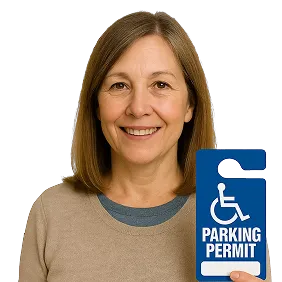

Temporary Handicap Placard for Travel, Events & Recovery
 by Areeba Imran
Last updated:


A temporary handicap placard gives you the same parking access as a permanent permit. It’s designed for short-term mobility issues like surgery recovery or injury. You can park in designated accessible spots while you heal.
Most people don’t know they qualify for this help. You might think your condition isn’t serious enough. Or you’re confused about how to apply. The process seems complicated when you’re already dealing with pain or limited movement.
This guide breaks down what a temporary disability parking permit provides and who can get one. You’ll learn how long does a temporary handicap placard last and whether you can extend it if recovery takes longer. We’ll also cover the application steps and explain the difference between temporary vs permanent handicap permit options.
Let’s start with what these placards actually do for you.
What Is a Temporary Handicap Placard?
A temporary handicap placard is a parking permit issued by state DMVs for people with short-term mobility limitations. These placards provide the same parking privileges as permanent permits but expire after a set period aligned with your expected recovery timeline.

State DMVs issue these permits for qualifying medical conditions, not just convenience. You need a doctor’s certification showing your mobility impairment meets state requirements. The placard grants access to designated handicap spaces while you recover from surgery, injury, or temporary medical conditions.
Temporary vs. Permanent Handicap Placards
Understanding the difference between temporary and permanent permits helps you apply for the right type. Both provide identical parking access, but they serve different medical situations.

| Feature | Temporary Placard | Permanent Placard |
|---|---|---|
| Duration | 6 months to 1 year | 2-5 years (varies by state) |
| Eligibility | Short-term mobility impairments | Long-term or permanent disabilities |
| Renewal | Requires new medical certification | May require periodic recertification |
| Expiration | Fixed date based on recovery timeline | Longer validity period |
Temporary placards work best for post-surgical recovery, pregnancy complications, or injuries expected to heal. Permanent placards serve people with chronic conditions like severe arthritis, heart disease, or neurological disorders.
According to California DMV placard requirements, temporary permits expire within six months unless your doctor certifies a longer recovery period. Most states follow similar guidelines to prevent misuse of temporary permits.
Red vs. Blue Handicap Placards: What’s the Difference?
Many states use color coding to distinguish temporary from permanent placards. Red typically indicates temporary disability, while blue signals permanent status. However, this system varies across states.
The Red vs Blue distinction helps parking enforcement officers quickly identify permit types. Some states use different colors entirely or rely on expiration dates rather than color coding.
Here’s what you need to know about placard colors:
-
Red placards usually expire within 6-12 months.
-
Blue placards remain valid for 2-5 years, depending on state rules.
-
Both colors provide identical parking privileges nationwide.
-
Color systems aren’t standardized across all 50 states
Don’t assume red always means temporary. Check your state’s specific DMV guidelines for accurate information. Some states use purple for veterans or green for special transportation vehicles.
The expiration date matters more than color. Always verify your placard’s validity before parking in designated spaces. Expired placards can result in fines even if your condition persists.
What Conditions Qualify for a Temporary Handicap Placard?
Temporary handicap placard eligibility centers on functional mobility limitations, not just medical diagnoses. States evaluate your ability to walk specific distances, need for rest periods, and balance issues. The focus is on how your condition affects daily movement and parking access.
According to Missouri temporary placard qualifications, most states require you to demonstrate you can’t walk 200 feet without stopping to rest. This standard applies whether you have a broken bone, recent surgery, or another temporary condition. Your doctor must certify that your mobility limitation meets state criteria.
Broken Bones and Temporary Injuries
Fractures and significant leg or foot injuries often qualify for temporary disability parking permits. These injuries substantially restrict your ability to walk safely. Common qualifying injuries include ankle fractures, leg breaks, hip fractures, and foot injuries requiring a non-weight-bearing status.
The severity matters more than the specific bone involved. For instance, a broken toe might not qualify if you can still walk 200 feet. However, a fractured femur that requires crutches for three months typically meets eligibility requirements.
Your doctor evaluates how the injury limits your mobility. They consider factors like:
-
Distance you can walk without pain or risk
-
Whether you need assistive devices
-
Expected recovery timeline
-
Risk of further injury from extended walking
Surgery and Post-Operative Recovery
Many surgical procedures create temporary mobility limitations that qualify for placards. Joint replacements, spinal surgeries, and cardiac procedures often restrict walking ability during recovery. Your surgeon can certify your need based on post-operative restrictions.

Recovery periods vary by procedure type. Hip replacement surgery might require a placard for 8-12 weeks. Cardiac surgery patients may need parking accommodation for 6-8 weeks while building stamina. Your doctor determines the appropriate duration based on your specific recovery progress.
Post-operative complications can extend your need for a temporary handicap placard after surgery. If healing takes longer than expected, your doctor can request an extension. This ensures you maintain parking access throughout your full recovery period.
Temporary Use of Crutches, Walkers, or Wheelchairs
Using an assistive device doesn’t automatically qualify you for a placard. The underlying mobility limitation and state criteria determine eligibility. Your doctor must certify that your condition, not just the device use, meets functional requirements.
That said, conditions requiring these devices often do qualify. If you need crutches because you can’t bear weight on your leg, you likely meet the walking distance limitation. Wheelchair users who can’t walk 200 feet without the chair typically qualify.
The key question is whether your condition limits mobility enough to meet state standards. Parking MD connects you with licensed physicians who evaluate your specific situation. They determine if your assistive device use reflects a qualifying mobility limitation.
Other Short-Term Mobility Limitations
Beyond injuries and surgery, other temporary conditions may qualify. Pregnancy complications that restrict walking ability can meet eligibility requirements. Severe arthritis flares, temporary balance disorders, and acute back pain episodes may also qualify if they limit your mobility sufficiently.
Respiratory conditions requiring portable oxygen often qualify for temporary placards. Heart conditions causing shortness of breath with minimal exertion may meet criteria. Neurological conditions affecting balance or coordination can qualify during acute phases.
Your doctor evaluates each condition individually. They consider how it affects your ability to walk safely and the expected duration. Recovery may be temporary, but losing access to everyday activities doesn’t have to be part of it. Getting proper parking accommodation helps you maintain independence during challenging times.
See if you qualify for a temporary placard by consulting with a licensed physician who can evaluate your specific mobility limitations and recovery timeline.
How Long Does a Temporary Handicap Placard Last?
A temporary handicap placard typically lasts between 6 months and 1 year. The exact duration depends on your state’s regulations and your doctor’s assessment of your recovery timeline. This makes temporary permits ideal for post-surgery recovery or short-term mobility issues.
Temporary Placard Duration Depends on Your State
Each state sets its own rules for how long temporary disability parking permits remain valid. Some states issue 6-month permits, while others allow up to 12 months. A few states even offer shorter 3-month options for very brief recovery periods.
According to Florida temporary disability permits, the state issues temporary placards for up to 6 months based on physician certification. Texas offers temporary permits for up to 8 months. California allows temporary placards for up to 6 months with possible renewal.
The state-by-state placard comparison shows that New York issues temporary permits for up to 6 months. Illinois provides temporary placards for 6 months to 1 year. Michigan allows temporary permits for up to 6 months with renewal options.
Services like Parking MD help you connect with licensed physicians who understand your state’s specific duration requirements. They can certify your expected recovery timeline and recommend the appropriate permit length.
Does the Expiration Date Depend on Your Condition?
Yes, your medical condition directly affects your placard’s expiration date. Your physician evaluates your mobility limitations and estimates how long you’ll need parking accommodation. This assessment determines the permit duration that your state DMV approves.
For hip replacement surgery, doctors typically certify 3-6 months of recovery time. Broken leg injuries might require 2-4 months of temporary parking access. Pregnancy complications could need permits lasting through delivery and postpartum recovery.
Your doctor must document the expected recovery timeline on your application. The DMV uses this medical certification to set your placard’s expiration date. If your condition improves faster than expected, you should stop using the permit.
What Happens When a Temporary Placard Expires?
Once your temporary placard expires, you must stop using it immediately. Using an expired permit can result in fines ranging from $250 to $1,000 in most states. You’ll also lose access to designated handicap parking spaces.
If you still need parking accommodation after expiration, you have three options. You can apply for a temporary handicap placard extension if your state allows it. You can submit a new temporary permit application with updated medical certification. Or you can apply for a permanent blue placard if your condition has become long-term.
The renewal process requires new medical documentation from your doctor. Some states limit how many times you can renew a temporary permit. After maximum renewals, you must either recover or transition to a permanent permit.
Can You Extend a Temporary Handicap Placard?
Recovery doesn’t always follow the timeline your doctor predicted. Your temporary handicap placard might expire before you’re ready to give up accessible parking. You can’t just assume you can renew an expired placard like a driver’s license.

The process varies by state. Some states let you extend your current permit. Others require you to start over with a new application. Understanding these differences helps you maintain parking access without gaps.
Extension vs. Renewal vs. New Application
These three terms sound similar but mean different things. An extension continues your current permit beyond its original expiration date. A renewal issues a new permit using the same process you used before. A new application means starting the entire process from scratch.

Why does this matter? Because states use different terms for the same process. One state might call it a renewal when they actually require a full new application. Another might offer true extensions that simply update your expiration date.
Here’s what each process typically involves:
-
Extension: Updates your current permit’s expiration date with minimal paperwork
-
Renewal: Issues a new permit number but uses simplified documentation
-
New Application: Requires complete medical certification and full application forms
Most states don’t offer true extensions for temporary disability parking permits. Instead, they require either renewal or new application processes. According to the Massachusetts Registry of Motor Vehicles, you must submit a new application with updated medical certification if your temporary disability continues beyond the placard’s validity period.
Check your state’s DMV website for exact terminology. Search for phrases like “temporary placard extension” or “renewing temporary handicap permit.” The specific words they use tell you which process applies to you.
Texas Temporary Placard Extensions Require a New Application
Texas doesn’t offer extensions or simplified renewals for temporary placards. If your disability continues past your placard’s expiration date, you must submit a completely new application.
The Texas Department of Motor Vehicles requires fresh medical certification from your doctor. You’ll complete the same application form you used originally. The $5 fee applies again, just like your first application.
This means you should start the process 30-45 days before your current placard expires. Don’t wait until the last minute. Processing takes 1-3 weeks in Texas, and you can’t legally use an expired placard while waiting for your new one.
What if you need parking access during the gap? Some Texas DMV offices provide temporary permits while processing your new application. Call your local office to ask about this option before your current placard expires.
How to Get a Temporary Handicap Placard
Getting a temporary handicap placard involves four clear steps. Each state manages its own process, but the basic requirements remain similar nationwide.
Check Your State’s Eligibility Requirements
Start by verifying your state’s specific criteria for temporary disability parking permits. Each state sets its own rules for qualifying conditions and documentation needs. Most states require you to prove limited mobility affecting your daily activities.
According to the Wisconsin Department of Transportation, applicants must demonstrate they can’t walk 200 feet without stopping to rest. Other states use similar distance thresholds but may vary slightly. Common qualifying conditions include post-surgical recovery, broken bones, severe arthritis, and pregnancy complications.
Visit your state’s DMV website to find exact eligibility criteria. Look for the disability parking section to download current requirements. This saves time and prevents application delays from missing information.
Get the Required Medical Certification
Schedule an appointment with your healthcare provider to assess your mobility limitations. Your doctor must complete the medical certification section of your state’s application form. They’ll evaluate your condition and provide an expected recovery timeline.
Telehealth services now offer convenient alternatives to in-person visits. These online evaluations connect you with licensed physicians who can certify your need for a temporary disability parking permit. The process takes less time than traditional office visits and works well for people with limited mobility.
Your healthcare provider will document your specific condition and explain why you need parking accommodation. They’ll also estimate how long you’ll need the placard based on your recovery timeline.
Complete Your State’s Placard Application
Download the official application form from your state’s DMV website. Fill out all required sections with accurate personal information. You’ll need your driver’s license number, current address, and contact details.
Double-check every field before submitting. Errors or missing information cause processing delays. Most applications ask for your vehicle information, though the placard transfers between vehicles when you’re present.
Attach your completed medical certification to the application. Some states require additional documentation, like proof of residency. Review your state’s checklist to ensure you include everything needed.
Submit Your Application and Wait for Processing
Submit your completed application through your state’s preferred method. Many states now accept online submissions for faster processing. Others require mail or in-person delivery to your local DMV office.
Processing times typically range from 2 to 4 weeks for complete applications. Online submissions often process faster than mailed forms. Some states provide temporary permits or receipts for immediate use while processing your permanent placard.
Track your application status through your state’s DMV portal if available. Contact the DMV if you don’t receive your placard within the expected timeframe. Get your parking placard through a streamlined online process that connects you with licensed physicians quickly.
Keep your confirmation number and application copy for your records. You’ll need these if questions arise during processing. Most states send your placard by mail to the address on your application.
Conclusion
A temporary handicap placard gives you parking access when mobility challenges make walking difficult. You now know what conditions qualify, how long placards last, and when extensions apply. The application process requires medical certification from a licensed provider and submission to your state DMV.
Start by checking your state’s specific requirements for temporary disability parking permits. Each state sets its own duration limits and renewal rules. Most temporary permits last six months to one year. If your recovery takes longer, you can request an extension or apply for a new temporary handicap placard before yours expires.
Don’t let mobility limitations keep you from accessing the parking you need. Connect with a healthcare provider who can evaluate your condition and complete the required certification. Parking MD streamlines this process by connecting you with licensed physicians online, so you can get your evaluation done quickly without leaving home.
Got Travel Plans This Summer? Get Started on Temporary Handicap Placard!
Frequently Asked Questions
How long does a temporary handicap placard last?
A temporary handicap placard lasts between six months and one year, depending on your state and recovery timeline. Most states follow California's model, which sets a six-month expiration unless your doctor certifies you need a longer recovery period. The expiration date is fixed based on when your medical condition is expected to improve. You can't use the placard after it expires, even if your recovery takes longer than expected. If you need more time, you must apply for a renewal with new medical certification from your doctor.
What is the difference between a temporary and permanent handicap permit?
Temporary permits last six months to one year for short-term mobility issues like surgery recovery or injury. Permanent permits last two to five years and serve people with chronic conditions like severe arthritis or heart disease. Both provide identical parking access to designated handicap spaces. The main difference is duration and eligibility. Temporary permits require fixed expiration dates based on your recovery timeline. Permanent permits have longer validity periods and may need periodic recertification. You need different medical documentation for each type based on whether your condition is short-term or long-term.
Do red and blue handicap placards have different parking privileges?
No, red and blue handicap placards provide identical parking privileges nationwide. The color difference helps parking enforcement officers quickly identify whether a permit is temporary or permanent. Red typically indicates temporary disability with six to twelve month expiration. Blue signals permanent status valid for two to five years. However, this color system isn't standardized across all fifty states. Some states use different colors entirely or rely on expiration dates instead of color coding. The expiration date matters more than color when determining if your placard is valid.
Can I renew my temporary handicap placard if my recovery takes longer?
Yes, you can renew your temporary handicap placard if your recovery takes longer than expected. You need to submit a new application with updated medical certification from your doctor. The doctor must verify that your mobility impairment still meets state requirements and provide a new expected recovery timeline. You can't simply extend the existing placard past its expiration date. Each renewal requires fresh documentation showing your current medical condition. If your condition becomes permanent rather than temporary, you should apply for a permanent placard instead of repeatedly renewing a temporary one.
Who issues temporary handicap placards?
State DMVs issue temporary handicap placards for people with short-term mobility limitations. You can't get a placard without going through your state's Department of Motor Vehicles. The DMV requires a doctor's certification showing your mobility impairment meets state requirements before approving your application. Your doctor must verify the medical condition and provide an expected recovery timeline. The DMV then issues the placard with an expiration date aligned to when you should recover. Private organizations or medical offices can't issue these permits directly. Only state DMVs have authority to grant official handicap parking privileges.
What medical conditions qualify for a temporary handicap placard?
Temporary handicap placards are designed for short-term mobility issues like surgery recovery, injury, or temporary medical conditions. Post-surgical recovery qualifies when it limits your ability to walk. Pregnancy complications that affect mobility can qualify for temporary permits. Injuries expected to heal within six to twelve months are eligible. You need a doctor's certification proving your condition meets your state's mobility impairment requirements. The condition must be temporary, not permanent or chronic. If you have severe arthritis, heart disease, or neurological disorders, you should apply for a permanent placard instead since those are long-term conditions.

Meet the author
Areeba Imran
I am a healthcare professional and seasoned medical writer with 13+ years of experience across health, wellness, and clinical content. My work focuses on delivering trustworthy, evidence-based information that empowers readers to make informed decisions. With a keen interest in innovation and evolving areas of patient care, I bring a modern perspective to today's healthcare setup.
Get an Accessible Parking Permit Evaluation in Minutes.