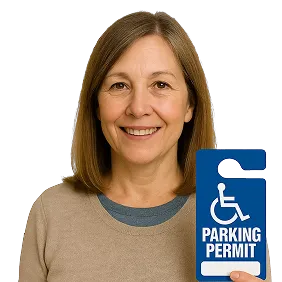

Disability Parking Permit for Amputation
 by Areeba Imran
Last updated:


Amputation affects more than 2 million Americans. Each person faces unique mobility challenges that go far beyond the physical loss. Your ability to walk, balance, and move safely changes after limb loss. Even with a prosthetic, you might struggle with distance, stability, or energy levels, making parking access matter. Many people think amputation automatically qualifies them for a handicap placard, but eligibility really depends on how the limb loss affects your daily function.
This guide walks you through the evaluation process. You’ll learn what physicians assess for amputation mobility limitations and how different amputation types affect placard eligibility. We’ll show you the exact steps to apply, what documentation you need, and how to handle state-specific requirements. Whether you’re adjusting to life with a prosthetic leg or supporting someone who is, you’ll get clear answers about when amputation qualifies for accessible parking.
What Is Amputation and How Does It Affect Mobility?
Amputation is the surgical removal of a limb or part of a limb. It happens most often due to trauma, vascular disease, diabetes complications, or cancer. For many people, losing a limb changes how they move through the world. Walking becomes harder. Balance shifts. Even simple tasks require more effort.

The type of amputation matters. Lower limb amputations directly affect walking ability and balance. Upper limb amputations can affect mobility indirectly by limiting the use of assistive devices like canes or walkers. Each case is different, but the functional impact is what determines whether someone qualifies for accessible parking.
Types of Amputation That Impact Walking
Not all amputations affect walking the same way.
-
Below-knee amputations remove the lower leg but preserve the knee joint. This often allows for better prosthetic control and balance.
-
Above-knee amputations remove the leg above the knee, which makes walking more difficult and requires more energy.
-
Partial foot amputations remove toes or part of the foot. These can affect balance and gait, even though the leg remains intact. According to the National Center for Biotechnology Information, lower extremity amputations create distinct mobility challenges based on the level of limb loss.
-
Bilateral amputations, where both legs are lost, create the most severe mobility limitations.
Each type brings its own set of challenges. Some people adapt quickly with a prosthetic. Others face long-term balance problems, pain, or reduced endurance. The level of amputation and the person’s overall health both play a role in how much mobility is affected.
How Prosthetics Change Mobility Requirements
A well-fitted prosthetic can restore some walking ability. That said, it doesn’t replace the function of a natural limb. Walking with a prosthetic requires more effort. Your body uses more energy to move. Balance becomes harder to maintain, especially on uneven surfaces.
Research from PMC shows that walking with a prosthetic leg demands more oxygen and cardiovascular effort than walking with intact limbs. This means shorter walking distances and more frequent rest breaks. Even with a prosthetic, many amputees can’t walk 200 feet without stopping.
Prosthetics also require regular adjustments. Weight changes, skin irritation, and socket fit issues can all affect how well the device works. When a prosthetic doesn’t fit right, walking becomes painful or unsafe. This is why many amputees still qualify for accessible parking, even after they’ve been fitted with a prosthetic.
Common Mobility Challenges After Limb Loss
Balance is one of the biggest challenges. Losing a limb shifts your center of gravity. This makes it easier to fall, especially when turning or walking on slopes. Many amputees use a cane or walker for added stability, even with a prosthetic.
Endurance is another issue. Walking short distances can feel exhausting. Your body works harder to compensate for the missing limb. This leads to fatigue, breathlessness, and muscle strain. Over time, these challenges can limit how far you can walk safely.
Pain is also common. Phantom limb pain, residual limb pain, and joint pain from altered gait patterns all affect mobility. When walking causes pain, people naturally walk less. This can lead to deconditioning, which makes mobility even harder. Understanding qualifying medical conditions for accessible parking can help amputees get the support they need to stay active and independent.
Does Amputation Automatically Qualify You for a Handicap Placard?
Amputation alone doesn’t guarantee a handicap placard after amputation. Most states don’t approve placards based on diagnosis. They look at how the amputation affects your ability to walk, stand, and move safely. This is a functional assessment, not a medical label.
At Parking MD, we help people understand this distinction every day. Many assume a below-knee amputation placard eligibility is automatic. It’s not. What matters is whether you can walk 200 feet without stopping, whether you need assistive devices, and whether walking puts you at risk.
What State Agencies Actually Evaluate
State DMV offices review specific functional criteria. According to the California Department of Motor Vehicles, eligibility depends on documented mobility limitations rather than the amputation itself. They ask whether you can walk a typical parking lot distance safely.
Here’s what agencies typically evaluate:
-
Walking distance before you need to stop and rest
-
Whether you use a prosthetic leg, cane, walker, or wheelchair
-
Balance stability and fall risk during walking
-
Whether walking causes pain, breathlessness, or unsafe conditions
-
How the amputation affects your ability to use mobility aids
Lower extremity amputations usually meet these standards. Walking with a prosthetic leg often limits distance and stability. Upper extremity amputations are less predictable. They may qualify if they prevent you from using a cane or walker, or if they affect your balance enough to make walking unsafe.
Functional Limitations vs. Diagnosis
A diagnosis tells what happened. Functional limitations show how it affects you. States care about the second part. You might have an above-knee amputation but walk well with a prosthetic. Or you might have a partial foot amputation that makes every step painful and unstable.

The Americans with Disabilities Act establishes that accessible parking serves people with mobility impairments that substantially limit walking. This means your physician must document specific limitations, not just the amputation type.
Examples of functional documentation include:
-
You can’t walk more than 100 feet without severe pain
-
You need to stop and rest after 50 feet due to prosthetic discomfort
-
You require a wheelchair for distances over 200 feet
-
Walking without a mobility aid puts you at high risk of falling
-
Your amputation prevents safe use of a cane or crutches
When Amputation Meets Eligibility Standards
Most states approve disability parking permits for people with amputations when the amputation makes walking harder. Below-knee amputations usually qualify because they limit how far you can walk and affect your balance. Even with a good prosthetic, most people cannot walk as far or as safely as before.
Above-knee amputations almost always qualify. Walking with a prosthetic takes much more energy, balance becomes harder, and you’re more likely to fall. States look at these functional limits.
Upper-extremity amputations are reviewed case-by-case. If you lost an arm and cannot use a cane for balance, or if the amputation changes how you walk or stand in a way that limits walking, you may qualify. Your doctor will evaluate whether your limb loss meets your state’s parking criteria.
Your doctor must certify that your amputation creates a real mobility limit. This certification is what your state DMV reviews. Without it, your application will not be approved, no matter what type of amputation you have.
Common Types of Amputation and Placard Eligibility
Not all amputations affect mobility the same way. Some limit walking distance and balance right away. Others create challenges that build over time. Understanding how different transtibial and transfemoral amputation levels affect daily movement helps you know whether you might qualify for a handicap placard after amputation.
At Parking MD, we work with people recovering from limb loss every week. Many assume their amputation automatically qualifies them. It doesn’t. What matters is how much the amputation limits your ability to walk safely.
Below-Knee Amputation (Transtibial)
Below-knee amputations remove part of the leg below the knee joint. Even with a prosthetic leg, this type of amputation affects gait and balance. Walking takes more effort. Uneven surfaces become harder to manage.
Most people with below-knee amputations qualify for a placard. The reason is simple: walking long distances strains the residual limb. Balance becomes less stable. Fatigue sets in faster than it did before the amputation.
Above-Knee Amputation (Transfemoral)
Above-knee amputations create more severe mobility limitations. You lose the knee joint, which plays a big role in balance and walking efficiency. Prosthetics help, but they don’t restore full function.
People with above-knee amputations almost always meet eligibility standards. Walking requires more energy. Balance is harder to maintain. Long parking lot walks can be unsafe, especially on wet or uneven pavement.
Partial Foot and Toe Amputations
Partial foot amputations vary widely in how they affect walking. Losing part of your foot changes weight distribution. This can cause pain, instability, or difficulty with balance.
Toe amputations alone rarely qualify unless they cause serious balance problems or chronic pain. Losing one or two toes may not limit walking enough to meet state standards. Losing multiple toes or part of the forefoot often does.
Your physician will assess how much the amputation affects your ability to walk 200 feet or stand for extended periods. If you need custom orthotics or experience pain with every step, you may qualify.
Upper Extremity Amputations
Upper extremity amputations don’t directly affect your legs. But they can still qualify you for a placard in certain situations. If you need a cane, walker, or crutches for another condition, losing an arm or hand can make those devices unsafe to use.
Bilateral upper extremity amputations almost always meet eligibility criteria. Without hands or arms, you can’t safely use assistive devices. This makes walking longer distances much harder and more dangerous.
If you’re unsure whether your amputation qualifies, a licensed physician can evaluate your walking ability and help you understand your state’s specific requirements. You can apply online through a secure telehealth evaluation that reviews your mobility limitations and connects you with the right documentation.
For a deeper look, see transtibial and transfemoral amputation levels.
What Physicians Look for During Amputation Placard Evaluations
When you apply for a handicap placard after amputation, a physician must assess your functional mobility. They don’t just look at the fact that you had an amputation. They evaluate how it affects your daily walking ability.

The evaluation focuses on real-world limitations. Can you walk safely? How far can you go before you need to rest? Do you use a prosthetic, and does it work well for you?
Functional Walking Assessment
Physicians start by measuring how far you can walk without stopping. Most states use a 200-foot standard as the baseline. If you can’t walk that distance comfortably, you may qualify.
They also look at your walking speed and stability. Above-knee amputations and bilateral limb loss often create balance challenges. These increase your fall risk, which physicians document carefully.
Energy expenditure matters too. Walking with a prosthetic takes far more effort than walking with intact limbs. According to the VA amputation rehabilitation guidelines, this increased energy demand can limit how far you can safely travel.
Prosthetic Use and Limitations
If you use a prosthetic, your physician will ask detailed questions about it. How well does it fit? Do you experience pain while wearing it? Does it feel unstable when you walk?
Not everyone with an amputation uses a prosthetic. Some people rely on a wheelchair, crutches, or a walker instead. Your physician documents which assistive devices you use and why.
They also note any complications. Phantom pain, residual limb issues, and skin breakdown can all affect your mobility. These factors help determine whether you meet state-specific requirements for a placard.
Documentation Requirements
Your medical records must include specific details about your amputation. Physicians document the amputation level, the date of surgery, and your prosthetic fitting status.
They also record any ongoing complications. This might include chronic pain, poor wound healing, or difficulty adjusting to your prosthetic.
Some states require specific language about mobility limitations. Simply listing “below knee amputation” as a diagnosis isn’t enough. Your physician must explain how it limits your ability to walk or perform daily activities.
Application Process for Handicap Placard After Amputation
Getting a handicap placard after amputation follows a clear path. The process varies by state, but the core steps stay the same. You need medical certification, state forms, and DMV submission.
Most people complete the process in two to four weeks. Some states offer faster options through telehealth services. Here’s how to get your placard step by step.
Step 1: Get a Physician Evaluation
Your doctor must evaluate your walking ability first. Schedule an appointment with your primary care physician, orthopedic surgeon, or physiatrist. They need to know your amputation details and current mobility status.
The physician checks how far you can walk safely. They also assess whether you use a prosthetic leg or other mobility aids. This evaluation determines if you meet your state’s eligibility criteria for a placard versus a plate based on your needs.
Some states accept telehealth evaluations for qualified patients. Parking MD connects you with licensed physicians who can complete this step remotely. This option works well if traveling to a doctor’s office is difficult.
Step 2: Complete State-Specific Forms
Each state has its own application form. Your physician must fill out the medical certification section. This part confirms your mobility limitation meets state standards.
According to New York disability parking law, applications go to your county, city, or town clerk, not the NY DMV. Illinois uses a two-tier system that separates different mobility impairment levels. Texas requires a new application for temporary placard extensions, not a renewal.
| State | Where to Submit | Processing Time |
|---|---|---|
| New York | County, city, or town clerk | 7-10 business days |
| Texas | County tax assessor-collector office | 2-3 weeks |
| Illinois | Secretary of State office or by mail | 10-14 business days |
| Pennsylvania | PennDOT driver license center or by mail | 4-6 weeks |
Get the correct form for your state before your appointment. This saves time and prevents delays.
Step 3: Submit to Your State DMV or Local Clerk
Once your doctor signs the form, submit it to the right agency. Most states use the DMV, but some use local clerks. Include any required fees with your application.
Processing times range from one to four weeks. Some states process faster than others. Check your state’s website for current wait times.
Step 4: Receive and Use Your Placard
You’ll get either a temporary or permanent placard. Temporary placards work for recovery periods after surgery. Permanent placards cover long-term mobility limitations from amputation.
Hang your placard from your rearview mirror when parked. Remove it before driving. Display rules vary by state, so read your approval letter carefully.
Conclusion
Amputation affects mobility differently for each person. Your handicap placard eligibility depends on how your situation limits walking distance, balance, and safety. Some people adapt quickly with prosthetics; others face ongoing challenges requiring accessible parking. Physicians evaluate your functional limitations, not just the amputation.
They assess walking distance, stability, and daily activity levels to determine eligibility. Your state’s requirements guide what qualifies for a permit. If walking has become difficult or unsafe, consult a licensed physician. They can assess whether your mobility limitations meet your state’s criteria and help you explore your options. Parking MD connects you with physician evaluations and guides you through the application process.
Ready to see if you qualify? Start with our physician-guided eligibility evaluation today. You’ll get clear answers about your specific situation and what to expect next.
Frequently Asked Questions
What types of amputation affect walking ability the most?
Above-knee amputations create the most walking difficulty. They remove the leg above the knee joint. This makes balance harder and requires more energy to walk. Below-knee amputations preserve the knee, which allows better prosthetic control. Bilateral amputations, where both legs are lost, create the most severe mobility limits. Partial foot amputations affect balance and gait even though the leg stays intact. The level of limb loss directly determines how much your walking ability changes.
Can you get a handicap placard if you have a prosthetic leg?
Yes, you can still qualify even with a prosthetic. Walking with a prosthetic leg demands more energy than walking with natural limbs. Many people can't walk 200 feet without stopping, even after they're fitted. Prosthetics don't replace natural limb function. They require more effort to use and make balance harder to maintain. Your doctor evaluates how the prosthetic affects your actual walking distance and stability. If you can't walk safely without frequent rest, you likely qualify for accessible parking.
Why does walking with a prosthetic require more energy?
Your body uses more oxygen and cardiovascular effort when walking with a prosthetic. Research shows this increased demand leads to shorter walking distances. You need more frequent rest breaks compared to walking with intact limbs. The prosthetic doesn't move naturally like your original leg did. Your muscles work harder to control balance and movement. This extra effort means you tire faster. Even a well-fitted prosthetic can't match the efficiency of a natural limb.
How does double amputation affect parking placard eligibility?
Double amputation creates the most severe mobility limits. Losing both legs makes walking extremely difficult or impossible. Most people with bilateral amputations use wheelchairs for mobility. This automatically qualifies them for accessible parking. Even with prosthetics on both legs, balance becomes very hard to maintain. The energy required to walk increases dramatically. Your doctor will document these severe functional limits. Double amputation cases typically meet all medical criteria for a handicap placard without question.
What mobility problems do amputees face besides walking distance?
Balance is one of the biggest challenges after limb loss. Your center of gravity shifts when you lose a limb. This makes falls more likely, especially when turning or walking on slopes. Many amputees need a cane or walker for stability. Prosthetics require regular adjustments for proper fit. Weight changes and skin irritation affect how well the device works. When a prosthetic doesn't fit right, walking becomes painful or unsafe. These issues all affect your ability to walk safely from distant parking spots.
Does a below-knee amputation qualify for accessible parking?
It can, depending on your functional limits. Below-knee amputations preserve the knee joint, which helps with prosthetic control. However, you still face balance problems and reduced endurance. Your doctor evaluates whether you can walk 200 feet without stopping. They also assess your stability and fall risk. Many people with below-knee amputations qualify because walking still requires more effort than normal. The prosthetic doesn't restore full function. Your specific case depends on how the amputation affects your daily mobility.
How do doctors evaluate amputation for handicap placard approval?
Doctors assess your actual walking ability and functional limits. They measure how far you can walk without stopping or resting. They evaluate your balance and risk of falling. Your doctor considers whether you use assistive devices like canes or walkers. They document how the amputation affects your daily activities. The evaluation includes your prosthetic fit and any pain or discomfort. Your physician must certify that you meet state requirements for accessible parking. This medical documentation becomes part of your placard application.
What is the main reason amputation qualifies someone for a placard?
The inability to walk 200 feet without stopping is the main qualifier. This distance limit appears in most state requirements for accessible parking. Amputation affects your endurance, balance, and energy levels. Even with a prosthetic, many people can't safely walk from distant parking spots. Your body works harder to move, which means you tire faster. The functional impact matters more than the amputation itself. If limb loss prevents you from walking that distance safely, you likely qualify for a handicap placard.

Meet the author
Areeba Imran
I am a healthcare professional and seasoned medical writer with 13+ years of experience across health, wellness, and clinical content. My work focuses on delivering trustworthy, evidence-based information that empowers readers to make informed decisions. With a keen interest in innovation and evolving areas of patient care, I bring a modern perspective to today's healthcare setup.
Get an Accessible Parking Permit Evaluation in Minutes.