Table of content
how to apply for disabled parking placard in texas

How to Apply for Disabled Parking Placard in Texas: A Complete Walkthrough

by Nida Hammad
Last updated: January 25, 2026
Medically reviewed by: Rebecca Owens, MSW, LCS
Fact Checked
fact-check
Share article:

Key Takeaways

  • Texas offers temporary and permanent disabled parking placards, plus specialty license plates for qualified individuals
  • The VTR-214 form Texas must be completed by a licensed physician and submitted to your county tax office
  • Texas disabled parking permit requirements include having a qualifying medical condition that significantly impairs mobility
  • Temporary placards are valid for up to six months, while permanent placards last four years
  • No application fees are charged for disabled parking placards in Texas
  • You can apply in person at your county tax assessor-collector’s office with proper documentation
  • Misuse of handicap placards can result in fines up to $500 and potential criminal charges

Navigating daily tasks becomes significantly more challenging when mobility limitations affect your life. Fortunately, Texas provides disabled parking placards and plates to help residents with qualifying disabilities access convenient parking spaces. If you’re wondering how to apply for disabled parking placard in Texas, this comprehensive guide walks you through every step of the Texas handicap placard application process, ensuring you understand the requirements, documentation, and procedures involved.

Understanding Texas Disabled Parking Placards

Texas offers several options for individuals with disabilities who need accessible parking accommodations. The Texas Department of Motor Vehicles (TxDMV) oversees the disabled parking placard program, which provides both temporary and permanent solutions based on your specific medical situation.

Types of Disabled Parking Credentials in Texas

Temporary Placards: These are issued for short-term disabilities or medical conditions expected to improve within six months. Temporary placards display an expiration date and must be renewed if your condition persists beyond the initial period.

Permanent Placards: If you have a long-term or permanent disability that significantly impacts your mobility, you qualify for a permanent placard valid for four years. These placards must be renewed before expiration to maintain your parking privileges.

Disabled License Plates: Texas also offers specialty license plates for individuals with permanent disabilities who prefer a plate designation over a hanging placard. These plates provide the same parking privileges and remain valid as long as you own the vehicle.

Texas Disabled Parking Permit Requirements

Before starting your Texas disability placard application, you must meet specific eligibility criteria established by state law. The Texas disabled parking permit requirements are designed to ensure that accessible parking spaces are reserved for those who genuinely need them.

Qualifying Medical Conditions

To get handicap permit Texas authorization, you must have one of the following conditions certified by a licensed physician:

  • Inability to walk 200 feet without stopping to rest
  • Inability to walk without assistance from a brace, cane, crutch, wheelchair, prosthetic device, or another person
  • Lung disease requiring portable oxygen
  • Use of a wheelchair for mobility
  • Cardiac condition classified as Class III or Class IV according to the American Heart Association standards
  • Severe limitation in the ability to walk due to arthritic, neurological, or orthopedic conditions
  • Legal blindness

A licensed medical professional, including physicians, chiropractors, podiatrists, physician assistants, or advanced practice registered nurses, must verify your condition and complete the medical certification section of your application.

The VTR-214 Form Texas: Your Application Document

The cornerstone of your disabled parking placard application is the VTR-214 form Texas, officially titled “Application for Disabled Parking Placard.” This form serves as both your application and the medical certification document required by the state.

Completing the VTR-214 Form

The form consists of two main sections:

Applicant Information Section: You’ll provide your personal details, including your full name, address, date of birth, and driver license or identification number. You’ll also indicate whether you’re applying for a temporary or permanent placard.

Medical Certification Section: This portion must be completed by your licensed healthcare provider. They’ll certify your qualifying condition, indicate the severity of your disability, and specify whether your condition is temporary or permanent. For temporary conditions, they’ll estimate the duration.

Your healthcare provider’s signature and medical license number are required to validate the certification. Most medical offices are familiar with this form, but you can download it in advance from the TxDMV website to streamline your appointment.

Step-by-Step Guide: How to Apply for Disabled Parking Placard in Texas

step by step guide on how to apply for disabled parking placard in texas

Now that you understand the requirements and documentation, let’s walk through the actual application process to get handicap permit Texas approval.

Step 1: Obtain Medical Certification

Schedule an appointment with your licensed physician or qualified healthcare provider. Discuss your mobility limitations and request that they complete the medical certification section of the VTR-214 form. Bring the downloaded form to your appointment, or ask if your provider’s office has copies available.

Your healthcare provider will assess your condition, determine if you meet the qualifying criteria, and complete their section of the form. This typically happens during a regular office visit, though some providers may require a specific evaluation appointment.

Step 2: Complete Your Portion of the Application

After your healthcare provider completes their section, carefully fill out the applicant information portion of the VTR-214 form. Double-check all information for accuracy, as errors can delay processing. Sign and date the form where indicated.

Step 3: Submit Your Application

Take your completed VTR-214 form to your county tax assessor-collector’s office. Each Texas county has designated offices that process disabled parking placard applications. You must apply in person at a county office, mail applications are not accepted for initial placard requests.

Bring a valid form of identification, such as your Texas driver license or state-issued ID card. The office staff will review your application, verify your documentation, and issue your placard on the spot if everything is in order.

Step 4: Receive Your Placard

Once approved, you’ll receive your disabled parking placard immediately. There is no fee for disabled parking placards in Texas, making this service accessible to all qualifying residents regardless of financial circumstances.

Your placard will include an identification number and expiration date. For temporary placards, the expiration date corresponds to your healthcare provider’s estimated recovery timeline, not exceeding six months. Permanent placards expire four years from the issue date.

Important Rules and Regulations

Understanding how to properly use your Texas handicap placard application credential is crucial for compliance and avoiding penalties.

Proper Placard Usage

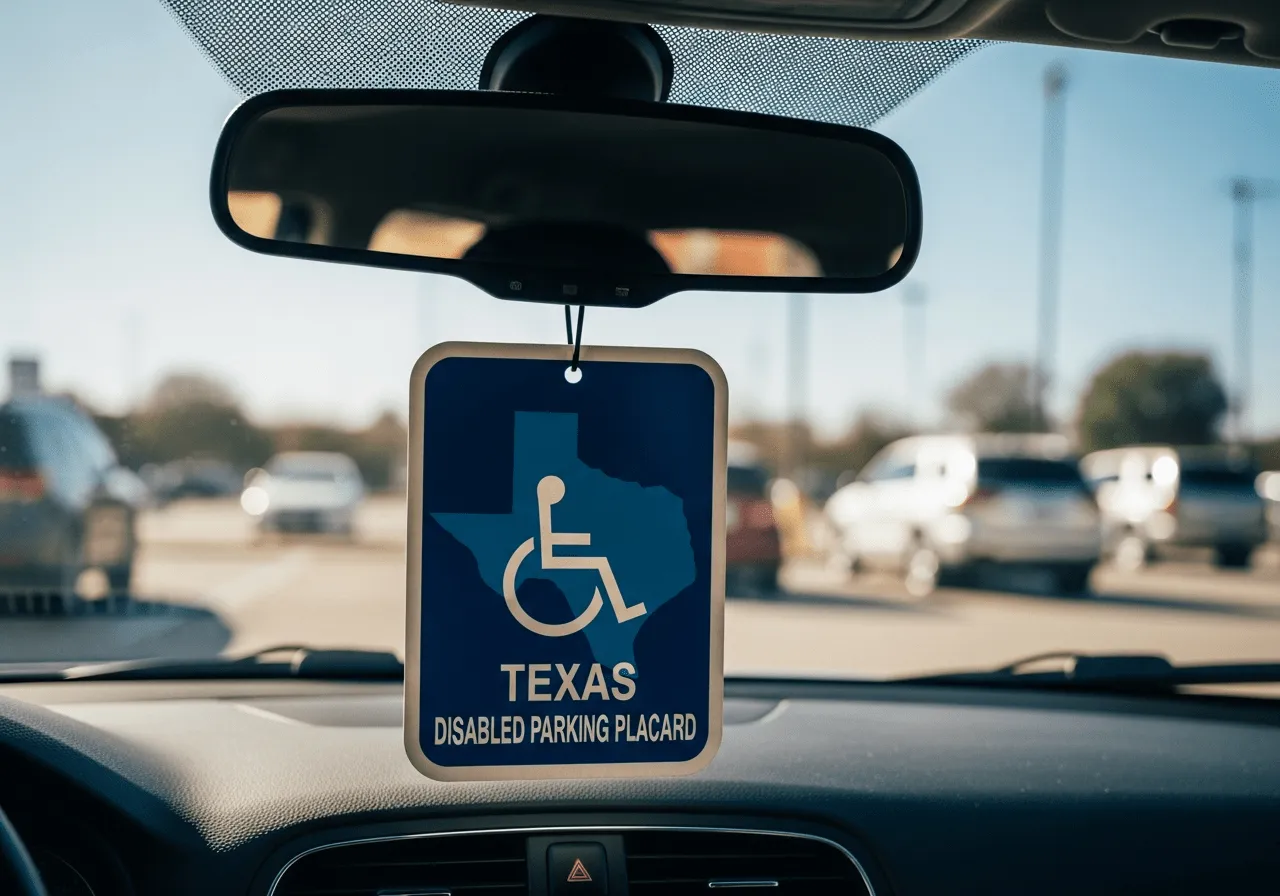
  • Display your placard by hanging it from your vehicle’s rearview mirror whenever parked in a designated accessible space
  • Remove the placard when driving, as it can obstruct your view
  • Only the person to whom the placard is issued may use it, family members cannot use your placard when you’re not present
  • The placard is valid in any vehicle you’re traveling in as a driver or passenger

Parking Privileges

Your Texas disabled parking placard allows you to:

  • Park in designated accessible parking spaces marked with the International Symbol of Access
  • Park without time limits at metered spaces (though you must still pay at pay-and-display lots unless otherwise posted)
  • Access loading zones designated for people with disabilities

Penalties for Misuse

Texas law imposes serious penalties for disabled parking placard misuse. Violations include fines ranging from $500 to $1,250, and fraudulent use can result in criminal charges. Law enforcement actively monitors accessible parking spaces and can verify placard legitimacy through the state database.

Renewing Your Texas Disabled Parking Placard

texas disabled parking permit requirements for renewing process

Disabled parking credentials don’t last forever. Understanding the renewal process ensures uninterrupted access to accessible parking.

Temporary Placard Renewal

If your temporary condition extends beyond the initial six-month period, you’ll need a new medical certification from your healthcare provider. Complete a new VTR-214 form with updated medical information and submit it to your county tax office following the same process as your initial application.

Permanent Placard Renewal

Permanent placards expire every four years. Texas sends renewal notices approximately 60 days before expiration to the address on file. The renewal process requires a new medical certification confirming your condition remains qualifying. Complete a fresh VTR-214 form and submit it to your county office before your current placard expires.

Some counties may offer streamlined renewal procedures for permanent placard holders, but medical recertification is always required to ensure continued eligibility.

Disabled License Plates as an Alternative

While placards offer flexibility to use any vehicle, some individuals prefer the permanence and convenience of disabled license plates.

Advantages of Disabled Plates

  • No need to hang and remove a placard each time you park
  • Plates stay with the vehicle and don’t require transfer between cars
  • Available in various specialty plate designs
  • Provide the same parking privileges as placards

Applying for Disabled Plates

The application process for disabled license plates follows similar requirements as placards. You’ll complete the VTR-214 form with medical certification, but you’ll also need to provide your vehicle registration information and pay standard license plate fees (though the disability designation itself carries no additional charge).

Disabled plates are vehicle-specific, unlike placards which can move between vehicles. If you regularly drive multiple vehicles, a placard might be more practical.

Special Considerations and Resources

Temporary Visitors to Texas

If you have a valid disabled parking placard or license plate from another state, Texas recognizes it under interstate reciprocity agreements. You can legally use designated accessible parking spaces throughout Texas while visiting or temporarily residing in the state.

Additional Assistance

Third-party services can help facilitate the application process, though they typically charge fees for services you can complete yourself for free through your county office. Evaluate whether convenience services align with your needs and budget.

Common Application Mistakes to Avoid

Successfully navigating the Texas handicap placard application process means avoiding common pitfalls:

  • Incomplete medical certification: Ensure your healthcare provider completes every required field and includes their license number and signature
  • Expired identification: Bring current, valid ID to your county office appointment
  • Incorrect application type: Clearly indicate whether you need temporary or permanent credentials
  • Missing signatures: Both you and your healthcare provider must sign the VTR-214 form
  • Applying at the wrong office: Submit applications to your county tax assessor-collector’s office, not DMV field offices

Frequently Asked Questions

How long does it take to get a disabled parking placard in Texas?

If your VTR-214 form is properly completed with valid medical certification, you’ll receive your placard immediately upon approval at your county tax office. The entire in-office process typically takes 15-30 minutes.

Can I apply for a disabled parking placard online in Texas?

Initial placard applications must be submitted in person at your county tax assessor-collector’s office. However, some counties may offer online renewal options for existing placard holders with permanent disabilities.

How much does a disabled parking placard cost in Texas?

Texas does not charge fees for disabled parking placards. The service is provided free of charge to all qualifying residents. However, you may incur costs from your healthcare provider for the medical examination and form completion.

Can my family member use my disabled parking placard when I’m not in the car?

No. Texas law requires that the person to whom the placard is issued must be present in the vehicle, either as the driver or passenger, for the placard to be legally used. Allowing others to use your placard without your presence is considered fraudulent use and subject to penalties.

What happens if I lose my disabled parking placard?

Contact your county tax assessor-collector’s office immediately to report a lost or stolen placard. You can request a replacement placard, though some counties may charge a small replacement fee. Reporting lost placards prevents fraudulent use.

Do I need a new placard if I move to a different county in Texas?

Your disabled parking placard remains valid if you move within Texas, but you should update your address with the county tax office. When your placard expires and you need renewal, apply through your new county of residence.

Can I have both a disabled parking placard and disabled license plates?

Yes, Texas allows individuals to have both credentials simultaneously. This can be useful if you drive multiple vehicles—using disabled plates on your primary vehicle and a placard for other vehicles you occasionally drive.

Meet the author
Nida Hammad
I am a professional writer with over five years of experience creating clear, engaging, and well-researched content. I specialize in mobility and accessibility topics, helping readers understand handicap parking permits and related regulations in simple, easy-to-follow language. Currently, I write for Parking MD, where I focus on producing accurate, trustworthy guides to help individuals navigate the handicap parking permit application process with confidence.

Get an Accessible Parking Permit Evaluation in Minutes.
Start Now
women-holding-permit-card
References

Expert Review Behind Our Articles

Health advice can feel overwhelming, but at ParkingMD, we keep it simple, accurate, and reliable. Each article is shaped by trusted medical sources and then reviewed by licensed healthcare professionals who bring real-world experience to every detail. Their insight ensures what you read isn’t just medically correct, but it is also meaningful, practical, and designed to help you make smarter choices for your well-being.
Reviewed by
Rebecca Owens, MSW, LCS
Rebecca Owens is a licensed clinical social worker who assists clients navigating the process of obtaining disability services and mobility-related accommodations. She is passionate about empowering people to advocate for themselves and ensuring that care and accommodations are both practical and compassionate.
rebecca msw
Written by :
Nida Hammad
Last Updated :
January 25, 2026

Related Articles

View All Articles

Having a hard time to decide?

Chat with your favorite AI chat assistant or book a schedule a quick consultation with our
support team to find out how ParkingMD can help you get your handicap parking permit with ease!