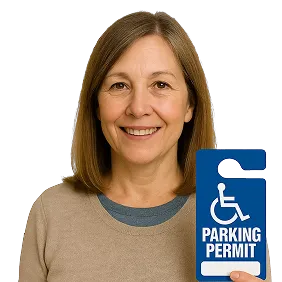
Handicap Placard for Dementia Patients: A Caregiver's Guide
 by Nida Hammad
Last updated:


You’re already managing medications, appointments, confusion, and the emotional weight of caring for someone with dementia. And then it hits you: parking lots have become genuinely dangerous. Your loved one wanders toward moving cars. They get disoriented fifty feet from the entrance. What should be a quick errand turns into a stressful ordeal, every single time.
Most caregivers don’t know this until they find out by chance. A handicap placard is available for dementia patients.
You can apply for one on their behalf. You don’t need to wait until things get worse. You don’t need a mobility scooter or a wheelchair to qualify.
This guide covers what you need to know. It explains if dementia qualifies. It shows how the caregiver application process works. It lists the documents you will need. It also explains how to get physician certification without adding another appointment to your busy schedule. By the end, you’ll know exactly what to do and in what order.
Does Dementia Qualify for a Handicap Parking Permit?
Yes. Dementia qualifies for a disability parking permit in all 50 states. Understanding why it qualifies helps you build a stronger case when you apply.
It also helps you feel confident during the process. You will be less likely to second-guess if your situation is serious enough.
Most states evaluate placard applications based on functional limitation, not just diagnosis. What that means in practice: the DMV wants to know how the condition affects safe movement. It is not just what is written on a chart. This is good news for dementia caregivers, because dementia often affects daily outings, even if the person looks fine.
For dementia, there are two qualifying pathways worth understanding.
The first is physical mobility limitation. As dementia progresses, it frequently causes balance problems, coordination issues, increased fatigue, and difficulty walking. These are the same mobility limitations that qualify any other applicant, regardless of what’s causing them.
The second pathway, and the one that’s often overlooked, is safety risk in parking environments. Some states clearly see that cognitive conditions can pose real dangers in parking lots. Issues like disorientation, wandering, not recognizing moving vehicles, and poor hazard awareness are key concerns. Virginia’s DMV, for example, specifically names Alzheimer’s disease as a qualifying condition under this safety-risk standard. That framing applies across the country, even in states that don’t spell it out so explicitly.
And here’s something caregivers worry about unnecessarily: your loved one doesn’t need to be in late-stage dementia to qualify. Early and mid-stage dementia can absolutely meet the eligibility criteria, particularly under the safety-risk pathway. If parking lot navigation has become unsafe or genuinely difficult, that’s what matters.
Alzheimer’s disease is a form of dementia, so both terms apply equally here. For placard purposes, they are treated the same way.
According to the Alzheimer’s Association’s 2025 facts and figures, nearly 12 million family members provided unpaid care to people with Alzheimer’s or other dementias in 2024. Most of those caregivers are navigating exactly this kind of logistical challenge every single day, often without knowing what resources they’re actually entitled to access.
Who Actually Applies — the Patient or the Caregiver?
This is where a lot of caregivers get confused, so let’s make it completely clear.
The placard is issued in the patient’s name. Not yours. Your loved one with dementia is the permit holder, you are the person who facilitates the application on their behalf. That distinction matters legally, but it doesn’t make the process harder for you.
Caregivers apply on behalf of patients all the time. It’s expected and fully accommodated in every state’s DMV process. Fill out the application with the patient’s details. Arrange the physician’s certification. Then, submit everything to the DMV. Your loved one typically doesn’t need to appear at the DMV in person, which is a genuine relief when you’re managing someone with a cognitive condition.
Once the placard is issued, there’s one rule that catches caregivers off guard: the placard can only be used when the patient is in the vehicle. Full stop. You can’t use it to run an errand while your loved one stays home. You can’t use it because you’re heading out to pick them up. It is valid only when they are physically present in the car with you.
This matters because misuse carries real consequences. Fines can run into the hundreds of dollars, and in some states the placard can be revoked entirely. The system exists to protect people who genuinely need these spaces, and enforcement does happen. So understanding this rule upfront protects both you and your loved one.
What this means for you: keep the placard in the vehicle you use most for trips together. Only display it when they are in the car. If multiple family members take turns driving your loved one to appointments or outings, the placard travels with the patient, not with any particular car or driver.
It’s also worth knowing that a placard (the hanging tag) is more flexible than a disability license plate for caregiving situations. Plates stay on one vehicle. A placard moves between vehicles, which makes it a much better fit when the patient rides in different cars with different family members.
What Documentation You’ll Need for a Handicap Placard for Dementia
Good news: the documentation requirements aren’t complicated. Most states need two core things, and everything else is supplemental.

First, a completed DMV disability parking application form. Every state makes this available on their DMV website, and most are straightforward one or two page forms. You fill it out with the patient’s information. Then sign it as the patient, if they can and want to. Or sign it as their authorized caregiver or legal representative. If your loved one has a healthcare proxy or power of attorney in place, that documentation may be relevant here depending on your state’s rules.
Second, physician-signed medical certification. A licensed physician needs to confirm the patient’s diagnosis and explain how it affects their mobility or safety. This is the section that officially tells the DMV your loved one qualifies. It doesn’t need to be a lengthy narrative, in most states it’s a standard section on the application form itself that the physician completes and signs.
Beyond those two core documents, it helps to have the following ready before you start:
The patient’s valid photo ID , a driver’s license or state-issued ID works in most states. Some states also require proof of residency, such as a utility bill or a document showing the patient’s current address. And while it’s not always required upfront, having supporting medical records on hand is genuinely useful. Neurologist diagnosis letters, clinical notes, or prescription records tied to the dementia diagnosis help the certifying physician complete the certification.
One thing worth knowing clearly: in most states, the disability parking placard itself is issued at no charge. The only real cost is the physician certification step, either in an office visit or online evaluation. There is no DMV fee for the placard in most states. With a permanent condition like dementia, you will not pay for a temporary placard. A temporary placard expires in six months.
Understanding what the full eligibility and application process looks like before you begin will save time. It will also reduce back-and-forth and help prevent small errors that cause returns.
How to Get the Physician Certification Done Without the Hassle
This is the step that stalls most caregivers. Not the DMV form. Not the eligibility question. The physician certification, specifically, the time and logistics required to get a doctor to sign off on it.
Getting a separate appointment is exhausting. Waiting for an open slot is exhausting. Taking a loved one with dementia to the office is exhausting.
It feels exhausting before it even starts. And if your loved one’s specialist has a long wait list, you could be looking at weeks just to get into the office.
Here’s what many caregivers don’t realize: the certifying physician doesn’t have to be the patient’s neurologist or specialist. Any licensed physician who has knowledge of the diagnosis can complete the certification. That opens up more options than most people think.
And it doesn’t have to happen in person at all.
A licensed physician can review the patient’s existing medical records and complete the required DMV certification form remotely. That’s exactly how ParkingMD works. You upload your supporting documents and diagnosis records you already have. A licensed physician reviews everything. Then we deliver your completed DMV-ready forms, often the same day. No new appointment. No waiting room. No trying to explain to your loved one why you’re at yet another doctor’s office.
For dementia caregivers specifically, this matters more than it might for other applicants. You’re not just avoiding inconvenience. You’re avoiding a process that can be genuinely distressing for someone with a cognitive condition. An unfamiliar office, new faces, questions they struggle to answer, a waiting room full of noise and movement, none of that needs to happen just to get a certification form completed.
| Factor | Traditional Doctor Visit | Online Evaluation with ParkingMD |
|---|---|---|
| Time to complete | 1-3 weeks (scheduling + appointment) | Same day in most cases |
| In-person visit required | Yes | No — fully remote |
| Who reviews records | Your loved one’s physician | Licensed physician reviews uploaded records |
| Turnaround on DMV forms | Days to weeks after visit | Instant digital delivery |
| Cost | Office visit copay or fee | Affordable flat fee |
| Available in all 50 states | Varies by provider | Yes |
ParkingMD has helped more than 33,000 patients get their placard certification done. Forms are accepted by DMVs in all 50 states, and the process is fully HIPAA-compliant. If the physician determines that the patient doesn’t qualify, you get your money back.
Step-by-Step: How to Apply Once You Have the Certification
Once the physician certification is in hand, the rest of the process is straightforward. Here’s exactly how it goes.
-
Get your state’s DMV disability parking application form. Every state makes this available on their DMV website. Some states allow you to complete the entire application online. Others require a paper form submitted by mail or in person. A quick search for your state name plus “disability parking placard application” will take you directly to the right page.
-
Fill out the applicant section using the patient’s information. Use their legal name, address, and ID number exactly as they appear on their government-issued ID. If your loved one cannot sign, check your state’s rules for authorized representative signatures. Most states allow this, especially when a caregiver or legal representative manages the application.
-
Attach the completed physician certification. If you used ParkingMD, this is the form they deliver to you digitally. Print it, attach it to the application, and you’re ready to submit. If you went through your loved one’s own doctor, attach whatever signed certification form they completed.
-
Submit to the DMV. Depending on your state, you can submit by mail, in person at a local DMV office, or online. Mailing is often the easiest option for caregivers, since it doesn’t require bringing your loved one along. Keep a copy of everything you submit.
-
Receive the placard. Most states process applications and mail the placard within one to two weeks of receiving a complete application. Some states allow same-day pickup at a local DMV office if you prefer to apply in person. Once it arrives, fill in the patient’s name on the back if required by your state, and keep the accompanying ID card in the vehicle.
For a progressive condition like dementia, the placard will almost always be a permanent permit. It will not be a temporary one. Permanent placards are typically renewable every two to four years depending on the state, not every six months like a temporary permit. And once issued, disability placards are valid in all 50 states, so your loved one’s parking access doesn’t change if you travel or move.
One practical tip: take a photo of the completed application and all supporting documents before you mail anything. If something gets lost or the DMV has a question, you’ll have everything on hand without needing to track it down again.
Renewing a Dementia Patient’s Handicap Placard
Dementia is a permanent, progressive condition. So once you’ve gone through the application process the first time, renewal is generally simpler, and there’s no question about ongoing eligibility.

Most permanent placards require renewal every two to four years. Your state DMV will typically send a reminder notice when renewal is approaching. Renewal usually requires updated physician certification confirming the condition is ongoing, along with a new application form. For dementia, this updated certification is not going to be a difficult conversation with any physician.
The renewal process is like the original application. Like the initial certification, the doctor can sign off remotely through ParkingMD. No new in-person appointment required. Many states now offer online renewal for the DMV submission, so you can renew from home.
If your loved one’s condition changes significantly between renewals, for example, if they develop additional mobility limitations, it may be worth noting those changes when the certification is completed. More documented limitations generally makes renewal smoother, not harder.
One final note that caregivers sometimes need to hear: if your loved one passes away, the placard should be returned to the DMV. It cannot be transferred to another person or retained for personal use. Most states have a simple return process, and some allow it by mail.
Conclusion
Getting a handicap placard for a dementia patient is a practical step that helps right away. It makes daily life easier. Walks are shorter. Arrivals are safer. It reduces physical and mental stress. It also cuts down on confusion before you enter the door.
The process is simpler than most caregivers expect once you know two key points. Dementia can qualify under mobility and safety-risk standards. You can complete the full application for your loved one. They do not need to visit a DMV office. They may not need another medical appointment.
If you’re ready to get this sorted, ParkingMD can handle the physician certification the same day, no office visit, no waiting weeks. See if your loved one qualifies and get the DMV-ready forms delivered instantly. You’re already doing enough.
Frequently Asked Questions
Can a person with dementia get a handicap placard?
Yes. Dementia qualifies for a disability parking permit in all 50 states. Eligibility is based on how the condition affects mobility or safety, not the diagnosis label alone. Both physical limitations (balance, fatigue, gait problems) and cognitive safety risks (disorientation, wandering, poor hazard awareness in parking environments) are valid qualifying grounds. A caregiver can apply on the patient’s behalf without the patient needing to appear at the DMV.
Does Alzheimer's qualify for a handicap parking permit?
Alzheimer’s disease qualifies for a handicap parking permit. It’s a form of dementia and is treated the same way for placard purposes. Some state DMVs, including Virginia’s, explicitly name Alzheimer’s as a qualifying condition. The certification is completed by a licensed physician and submitted to your state DMV along with the standard application form. Early-onset Alzheimer’s qualifies under the same criteria as any other stage.
Can a caregiver use a handicap placard for a dementia patient?
A caregiver can use the placard while transporting the dementia patient, but only when the patient is physically present in the vehicle. The placard is issued in the patient’s name. Using it when the patient isn’t in the car — even for a quick errand — is considered misuse and can result in fines or permanent revocation of the permit. The placard moves between vehicles freely, so any family member driving the patient can display it.
What documentation is needed for a handicap placard for dementia?
You’ll need a completed state DMV disability parking application form and a physician-signed medical certification confirming the diagnosis and its impact on mobility or safety. It also helps to have the patient’s photo ID and supporting medical records ready (diagnosis letters, clinical notes, prescription records). In most states, the placard itself is issued at no charge — the main cost is the physician certification step.
Is dementia considered a disability for parking purposes?
Yes. Under the Americans with Disabilities Act, a disability is defined as a physical or mental impairment that substantially limits a major life activity. Dementia meets this standard. State DMV programs use the ADA definition as their foundation and recognize cognitive conditions that affect safe mobility — including the ability to navigate parking environments without disorientation or danger.
How do I get a handicap placard for my elderly parent?
You apply on their behalf using their information. Download your state’s DMV disability parking application form, arrange physician certification (which can be completed remotely through ParkingMD using existing medical records), and submit the completed paperwork to your state DMV. Your parent typically doesn’t need to appear in person. The placard is issued in their name and can be used in any vehicle they ride in, by any driver who is transporting them.

Meet the author
Nida Hammad
With over 5 years of experience in accessibility content, I create clear resources on handicap parking permits, state requirements, and applications.
Get an Accessible Parking Permit Evaluation in Minutes.