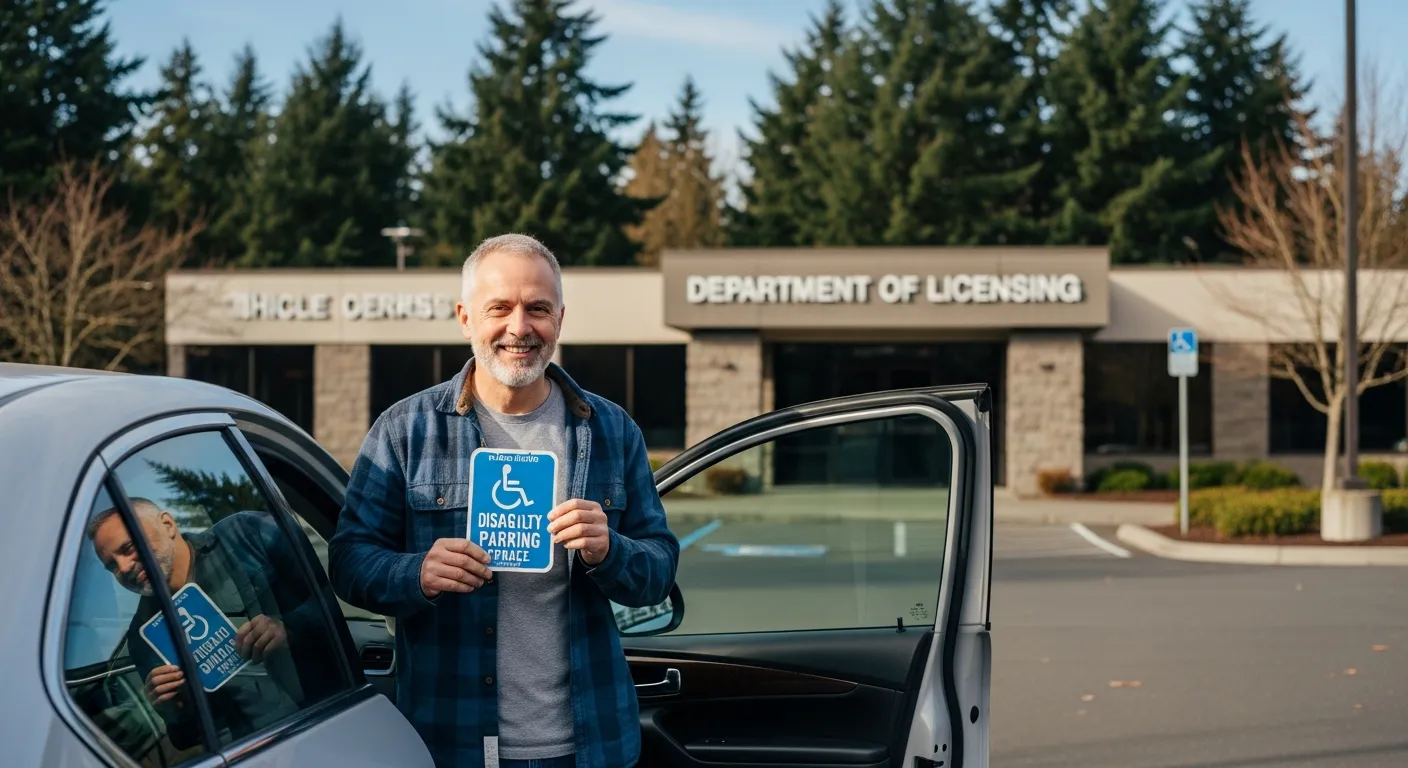
Waiting Months for a Handicap Placard? Michael Found a Faster Way
 by Alisha Shabbir
Last updated:


Michael had a primary care provider. He had a qualifying condition. He had every reason to believe getting a disability parking permit would be straightforward.
It wasn’t.
“Painless process that works as advertised, way better than traditional method of making an appointment with primary care provider waiting two months for said appointment. Received my signed paperwork including all Washington required applications and prescriptions in exactly five days after approval.”
Two months versus five days. That’s the gap between what Michael’s primary care office could offer and what a telehealth evaluation delivered. Here’s why that gap exists, and what Washington patients need to know about it.
Why Getting a Handicap Placard Through Your Doctor Takes So Long
A disability parking placard isn’t elective. If you can’t walk 200 feet without stopping, or you depend on an assistive device, or your lung disease or cardiac condition limits your mobility, the placard exists so you can function in public spaces safely.
But from a primary care office’s perspective, a parking permit form isn’t urgent. It doesn’t compete with chest pain, lab results, or post-surgical follow-ups. It sits in a pile. Michael’s experience, waiting two months for an appointment that exists specifically to fill out paperwork, is one of the most common reasons patients look for an alternative.
The issue isn’t that the doctor doesn’t care. The issue is that the system isn’t built for this.
Washington’s Dual-Document Requirement for Disability Parking Permits
Michael’s review includes a detail that matters more than it might seem: he received “all Washington required applications and prescriptions.”
Washington is one of the few states that requires two separate documents for a disability parking permit. Most states use a single form where both the patient and the physician complete their respective sections. Washington’s Department of Licensing (DOL) requires:
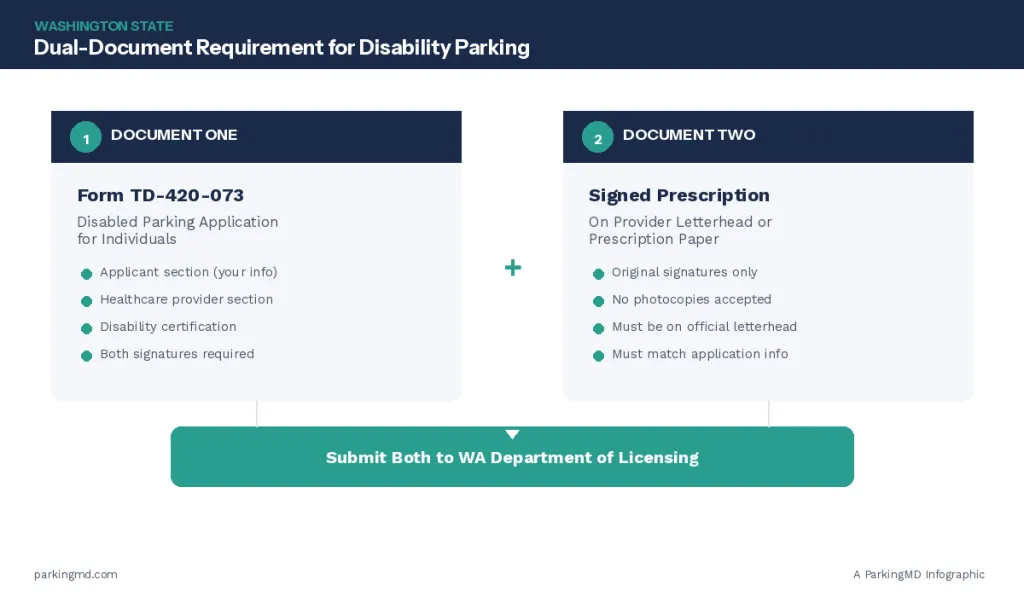
That second requirement, the separate prescription, is where things break down in a traditional office. A doctor who fills out parking permit forms once or twice a year may not realize Washington needs both documents. The application alone isn’t enough. A missing prescription means a rejected submission, and you’re back to square one.
Michael received both documents, correctly completed, in five days. That’s what happens when the physicians handling your paperwork do this every day.
How Michael Got His Washington Handicap Placard in 5 Days
Michael’s process through ParkingMD followed these steps:
-
Online intake — submitted his medical records and qualifying condition details through the secure platform.
-
Online evaluation — a licensed Washington physician reviewed his documentation and conducted the evaluation.
-
Signed paperwork delivered — received both his completed TD-420-073 application and the required signed prescription. Five days from approval to paperwork in hand.
-
DOL submission — brought the completed documents to a vehicle licensing office (or mailed them to the DOL Special Plate Unit in Olympia) to receive his placard.
Steps 1 through 3 happened without Michael leaving his home. Step 4 is the only part that required an in-person visit or a stamp.
Washington State Permit Requirements at a Glance
| Detail | Washington |
|---|---|
| State form | TD-420-073 (Disabled Parking Application for Individuals) |
| Additional requirement | Original signed prescription on letterhead or prescription paper |
| Submit to | Any vehicle licensing office or by mail to DOL (PO Box 9043, Olympia, WA 98507) |
| Permanent placard validity | 5 years |
| Temporary placard validity | Up to 12 months (non-renewable; new application required if disability persists) |
| Qualifying providers | Licensed physician (MD/DO), registered nurse practitioner, physician assistant |
| Free metered parking | Yes, in most municipalities (check local posted signs) |
| Renewal process | DOL sends renewal notice 45 days before expiration; healthcare provider must complete the provider section and provide a new prescription |
Why Washington Disability Parking Applications Get Rejected
Washington’s dual-document requirement creates a specific failure point that catches patients off guard.
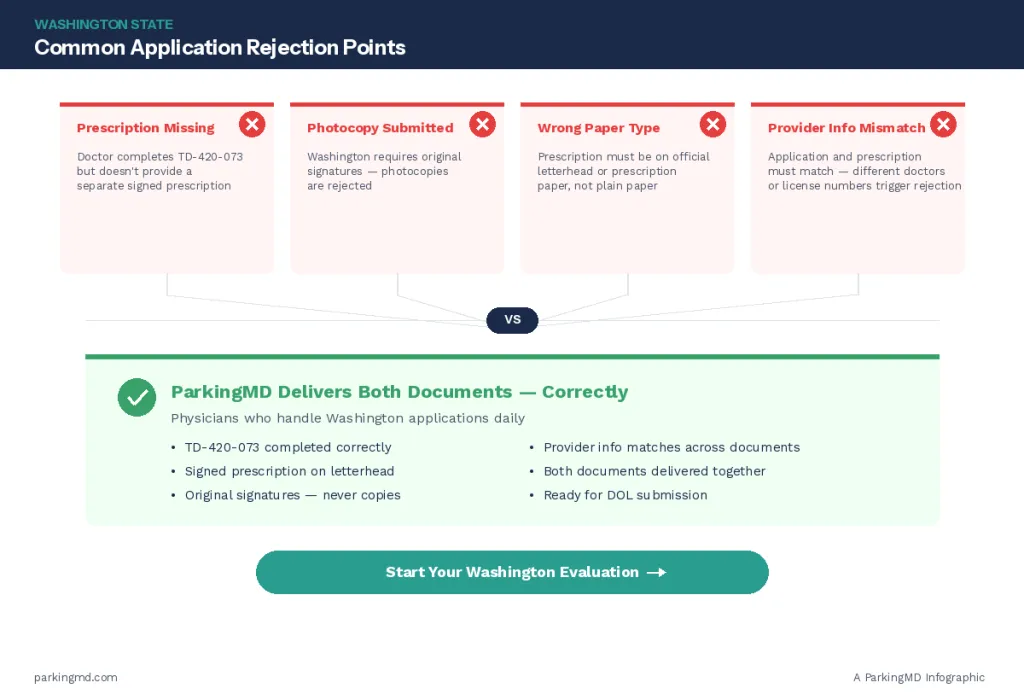
These aren’t edge cases. They’re predictable documentation errors that happen when a provider fills out Washington parking permit paperwork once or twice a year.
Michael didn’t have to worry about any of this. The physicians at ParkingMD handle Washington applications daily and deliver both documents together, correctly formatted and ready for DOL submission.
ParkingMD vs. Your Doctor’s Office
Here’s how the two routes compare side by side:
| Your Doctor’s Office | ParkingMD | |
|---|---|---|
| Scheduling | 2–12 weeks for an opening | Same-day or next-day |
| Location | In-person at the office | From home (video or phone) |
| Wait room | Yes | None |
| Physician familiarity with Washington’s dual-document requirement | Low — most don’t know about the separate prescription | High — completed daily |
| Risk of form errors | Higher (unfamiliar form, missing prescription) | Lower (specialized workflow) |
| Time to receive signed paperwork | Days to weeks after appointment | Typically 1–5 days |
| Total timeline | 4–12 weeks | 1–7 days |
| Cost structure | Co-pay + transportation + potential time off work | Flat evaluation fee |
| If paperwork is rejected by DOL | Back to doctor’s office to redo | Support team assists with corrections |
| Communication during process | Call the front desk, leave a message | Direct support throughout |
Get Your Washington Handicap Placard Today
Michael could have waited two months. He could have taken time off work, driven to the appointment, sat in a waiting room, and hoped his doctor knew about Washington’s separate prescription requirement.
Instead, he completed an online evaluation from home and had every document he needed in five days.
“Painless process that works as advertised.”
Frequently Asked Questions
Can I get a disability parking placard in Washington through telehealth?
Yes. Washington accepts medical certification from any licensed physician (MD/DO), registered nurse practitioner, or physician assistant — regardless of whether the evaluation was conducted in person or via telehealth. The provider must complete Form TD-420-073 and provide an original signed prescription.
What medical conditions qualify for a handicap placard in Washington?
Washington law covers several qualifying conditions: inability to walk 200 feet without stopping to rest, dependence on a mobility aid (cane, walker, wheelchair), severe limitations from arthritic, neurological, or orthopedic conditions, Class III or IV cardiac disease, lung disease with significantly restricted breathing, portable oxygen use, legal blindness with limited mobility, and acute sensitivity to automobile emissions.
Why does Washington require a separate prescription?
Unlike most states that use a single combined form, Washington's DOL requires both a completed application (TD-420-073) and an original signed prescription on the provider's letterhead or prescription paper. This is to independently verify medical necessity. Photocopies are not accepted.
Can I submit my Washington disability parking application by mail?
Yes. You can submit your completed application and original prescription to: Special Plate Unit, Department of Licensing, PO Box 9043, Olympia, WA 98507. You can also apply in person at any vehicle licensing office. Temporary permit applications can also be submitted online through the DOL website.
How long does a permanent handicap placard last in Washington?
Permanent placards are valid for 5 years. The DOL sends a renewal notice 45 days before expiration. At renewal, your healthcare provider must complete the provider section of the renewal notice and supply a new original signed prescription.

Meet the author
Alisha Shabbir
Hey, I'm Alisha and I help people understand disability parking laws and medical services. At ParkingMD, I write about state regulations, patient rights, and healthcare access to make confusing processes straightforward. I believe good information should be easy to find and understand. When I'm not researching state laws or writing guides, you'll find me reading and practicing mindfulness.
Get an Accessible Parking Permit Evaluation in Minutes.