Hip Replacement Recovery Is Hard Enough — Here's How to Park Right at the Door
 by Alisha Shabbir
Last updated:


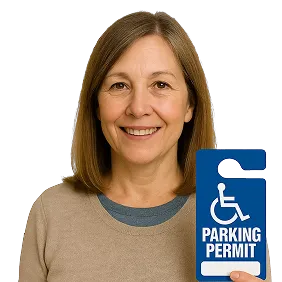
Hip surgery changes how you move through the world, at least for a while. Between physical therapy appointments, follow-up visits, and figuring out how to get groceries without overdoing it, the last thing you need is a parking situation that turns every errand into an ordeal. That’s exactly what a hip replacement placard is for.
The short answer to the question you’re probably here for: yes, hip replacement surgery qualifies for a handicap placard in all 50 states. The slightly longer answer covers what type you need, when to apply (sooner than you think), and how to get medical certification without waiting three weeks for your surgeon’s office to return a form. That’s what this guide walks through, step by step.
Does Hip Replacement Surgery Qualify for a Handicap Placard?
It does. Hip replacement is one of the most straightforward qualifying scenarios for a disability parking permit, whether you’re still in the planning stage or already in recovery.
The federal standard that most states model their eligibility rules on comes from 23 CFR Part 1235, the Uniform System for Parking for Persons with Disabilities. Under that regulation, a qualifying person is someone who cannot walk 200 feet without stopping to rest, or cannot walk without the use of a brace, cane, crutch, walker, wheelchair, or other assistive device. For most hip replacement patients in the weeks following surgery, both of those criteria apply simultaneously.
Hip replacement meets standard eligibility criteria for disabled parking permits because weight-bearing restrictions and required mobility aids are explicitly covered under every state’s DMV guidelines. What makes hip replacement particularly clear-cut is that the limitations are medically obvious and well-documented. A licensed physician reviewing your case can describe the functional impact, the mobility aids required, and the expected recovery window without ambiguity. That documentation is exactly what the DMV needs to issue your placard.
There’s also a secondary qualifying factor worth knowing about. According to NIH’s arthritis and musculoskeletal research institute, osteoarthritis is the most common reason people need hip replacement surgery. That underlying joint disease doesn’t disappear once the procedure is done. Depending on how recovery goes and whether mobility limitations persist after the acute healing period, the underlying condition can support a longer-term or even permanent placard rather than just one tied to the surgery itself.
One thing to keep in mind: you don’t need to be in a wheelchair or completely unable to walk to qualify. If walking distance is painful, requires a mobility aid, or creates a fall risk, you meet the standard.

Temporary or Permanent Placard After Hip Replacement Surgery?
Most hip replacement patients qualify for a temporary placard, though patients with bilateral replacements or persistent underlying arthritis may qualify for the longer-term option. Recovery typically takes 6 to 12 weeks before walking without mobility aids becomes realistic, and most temporary placards are valid for up to 6 months, which lines up well with that window.
| Factor | Temporary Placard | Permanent Placard |
|---|---|---|
| Best for | Post-surgical recovery period | Ongoing mobility limitation |
| Typical validity | 3 to 6 months (varies by state) | 2 to 5 years (varies by state) |
| Renewal process | New medical certification required | Varies; some states auto-renew |
| Hip replacement fit | Most patients | Bilateral cases, persistent arthritis |
| What gets documented | Surgery, expected recovery, mobility limits | Long-term functional impairment |
A permanent placard becomes relevant when the limitation is expected to continue after a reasonable recovery period. Bilateral hip replacement patients sometimes fall into this category. So do patients whose underlying hip disease is more extensive, where the joint replacement addresses the structural problem but walking tolerance remains significantly limited long-term.
Some patients start with a temporary placard and later transition to a permanent one when the certifying physician determines the functional limitation isn’t resolving on the expected timeline. That’s a normal path, and knowing it’s available is useful so you’re not caught off guard if recovery takes longer than planned.
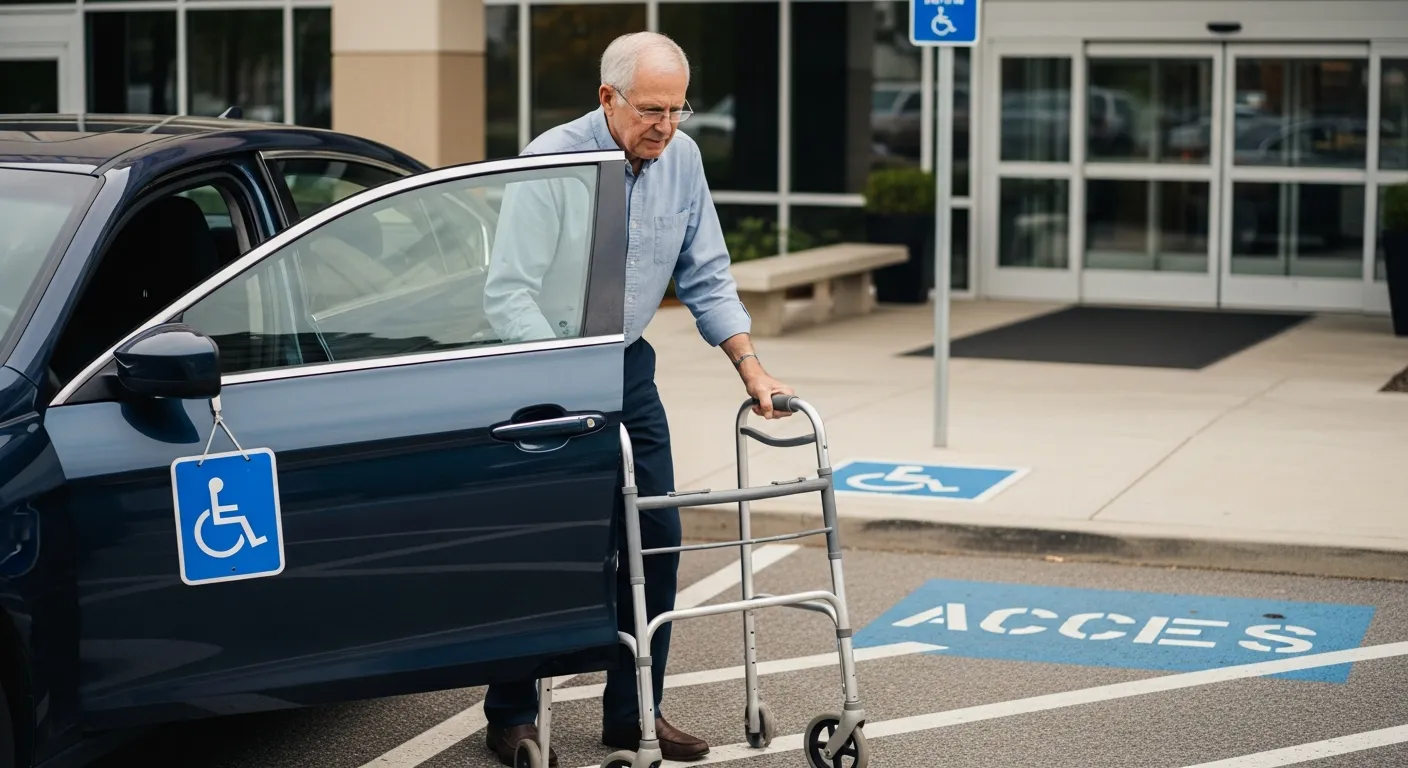
Under ADA guidelines for accessible parking, placards are assigned to the individual rather than to a specific vehicle. That means you can use yours in any car you’re riding in as a driver or passenger. During hip recovery, when you may not always be driving yourself, that flexibility matters quite a bit.
Should You Apply for Disability Parking Permit Before or After Surgery?
Before. That’s the clear recommendation, and the reason is simple.
DMV processing times vary significantly by state and how you submit. Mail-in applications can take two to four weeks. In-person submissions may be faster, but they require a trip to a DMV office, which is a real obstacle when you’re preparing for major surgery or have just come home from it. If you wait until after discharge and then try to get certification, you’re looking at a gap where you’re already limited but don’t yet have the placard that would help.
The ideal sequence is to get medical certification completed before your surgery date, submit the DMV application while you’re still pre-op, and have the placard arrive around the time of your procedure or shortly after. The first weeks of recovery are typically the most mobility-restricted, and that’s exactly when accessible parking does the most work.
Your surgeon can complete the certification portion before the operation. They know the procedure, the expected recovery trajectory, and the mobility limitations you’ll face. Getting that paperwork signed pre-operatively is entirely standard practice and takes the scramble out of the post-op period.
If your surgery is already done and you’re in recovery without a placard, don’t worry. The process is still available to you. Some states offer in-person same-day issuance, and using a telehealth service for medical certification can get documentation into your hands within 24 to 48 hours rather than weeks.

How to Get Your Hip Replacement Placard
The process has four steps. The one that creates the most delays, by a significant margin, is step one.
Step 1: Get medical certification
This is where most people lose time. The traditional route involves scheduling an appointment with your surgeon or primary care physician, waiting for that appointment, having the form completed during the visit, and then waiting again for it to be returned. That process can stretch to three weeks or more, and that’s if the office completes forms at all. Some charge a separate administrative fee; others decline entirely.
A telehealth consultation with a board-certified physician licensed in your state completes the same certification in 24 to 48 hours. The physician reviews your condition and completes the correct DMV medical certification form for your state. The process is fully HIPAA-compliant and the documentation is accepted by DMVs in all 50 states.
Step 2: Download your state’s DMV application
Each state has its own form and specific requirements. Some require a physician signature; others accept nurse practitioners or physician assistants. Getting your state’s DMV handicap placard form right the first time matters more than most people realize, incorrect or outdated forms are one of the most common reasons applications are delayed or rejected. ParkingMD provides the correct, current state-specific form as part of the process.
Step 3: Submit your application
Options vary by state: in-person, by mail, or online where available. In-person is typically the fastest. If you’re in post-op recovery, mailing may be more practical. The completed medical certification needs to accompany your application, so make sure both are ready before you submit.
Step 4: Receive your placard
In-person submissions often result in same-day or next-day issuance. Mail-in applications average two to four weeks, sometimes longer during high-volume periods. If you applied before surgery, build this timeline into your planning so the placard arrives when you need it.

How Long Will You Actually Need the Placard?
Most patients need accessible parking most during the first 6 to 12 weeks post-surgery, when a walker or crutches are required and weight-bearing is restricted. As the National Library of Medicine’s patient health resource notes, by the time you go home from the hospital you should be able to walk with a walker or crutches without much help but full recovery takes anywhere from 2 months to a year.
That recovery window fits well with a standard temporary placard, which runs up to 6 months in most states. If your placard is issued for 6 months and you recover faster than expected, you simply stop using it. There’s no penalty for not using the full duration.
What if recovery takes longer? That’s what renewal is for. With a new medical certification confirming the limitation is ongoing, you can apply for another temporary placard. Or, if the situation warrants, your physician can document a longer-term functional impairment and support a transition to a permanent placard. The patients return to normal daily activities within 3 to 6 months, but outcomes vary based on age, overall health, and the severity of joint damage before surgery. If you’re outside that window, you’re not alone, and the process to document continued limitation is straightforward.
The placard is there for as long as you genuinely need it. There’s no expectation that you push yourself to recover faster because an expiration date is approaching.
Takeaway Note: Getting Your Placard Shouldn’t Add to Your Recovery Stress
Hip replacement is one of the most common major surgeries in the United States, and the mobility limitations that come with recovery are real, medically recognized, and covered by every state’s disability parking program. Getting a hip replacement placard isn’t complicated once you have certification in hand. The challenge is usually timing it so you’re not without accessible parking during the weeks when you need it most.
Apply before your surgery if you can. Get your certification from a board-certified physician who can turn it around fast. And let the placard do its job so you can focus on physical therapy and healing, which is where your energy belongs.
Frequently Asked Questions
Can I get a handicap placard after hip replacement surgery?
Yes. Hip replacement surgery qualifies for a temporary handicap placard in all 50 states. The mobility restrictions typical of recovery, required use of a walker or crutches and limited weight-bearing, meet the eligibility standard that most state DMVs follow. A licensed physician certifies the functional limitation on your state's DMV form, and you submit that with your application to the motor vehicle office.
How long does a handicap placard last after hip replacement?
Temporary placards are valid for up to 6 months in most states, though the exact duration varies. In some states, the physician specifies an end date based on the expected recovery period, which may be shorter than the maximum. If your mobility limitation continues past the expiration date, you can renew with a new medical certification confirming the ongoing restriction.
Do I qualify for a permanent handicap placard after hip replacement?
It depends on your situation. Most hip replacement patients use a temporary placard during recovery. A permanent placard may be appropriate if underlying osteoarthritis or bilateral joint disease results in ongoing mobility limitations that persist after a reasonable recovery period. A certifying physician can help determine which type fits your situation based on what your recovery actually looks like.
How do I get a handicap parking permit quickly after surgery?
The fastest route is telehealth medical certification. ParkingMD connects you with a board-certified physician for placard certification, with your state-specific documentation ready within 24 to 48 hours. Once you have the certification, submitting in-person to your DMV typically results in same-day or next-day issuance in most states.
What if my doctor won't fill out the paperwork?
It happens more than it should. Surgeon and primary care offices sometimes decline disability paperwork, charge administrative fees for forms, or have backlogs that run weeks. In those situations, a telehealth evaluation provides the same valid medical certification. The documentation meets the same legal standards and is accepted by DMVs in all 50 states.

Meet the author
Alisha Shabbir
Hey, I'm Alisha and I help people understand disability parking laws and medical services. At ParkingMD, I write about state regulations, patient rights, and healthcare access to make confusing processes straightforward. I believe good information should be easy to find and understand. When I'm not researching state laws or writing guides, you'll find me reading and practicing mindfulness.
Get an Accessible Parking Permit Evaluation in Minutes.