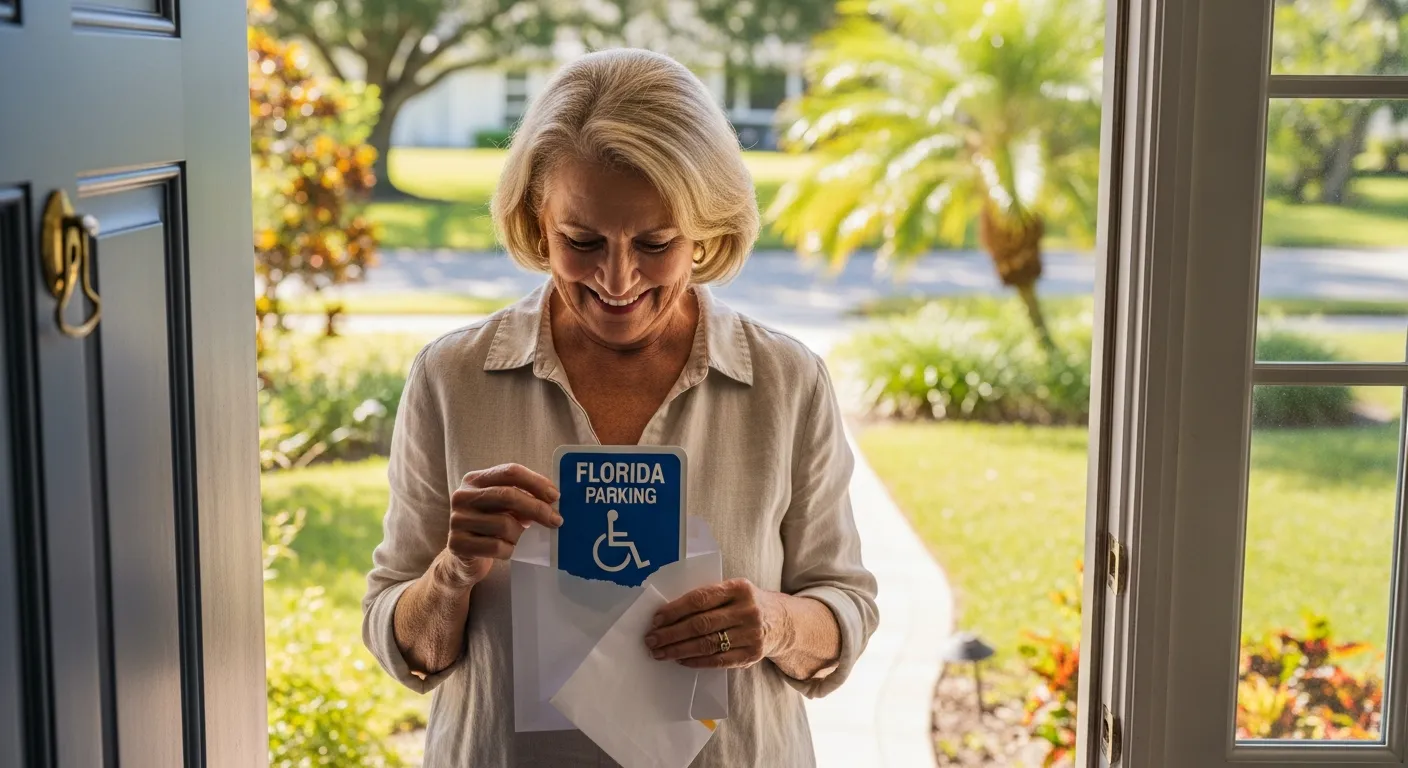
How Florida Patients Got Placards From Home
 by Alisha Shabbir
Last updated:


Florida is one of the most populous states in the country, with a high concentration of older adults managing chronic conditions, and a primary care system that is under significant pressure to keep up. The American Association of Medical Colleges projects a national physician shortage that will affect Florida acutely, particularly in retirement and coastal communities where demand for placard certifications is highest. For many patients, that means waiting weeks, sometimes longer, for an appointment slot that exists solely to obtain a physician’s signature on a government form.
Then there’s the submission step. Florida is one of the few states that routes disability parking applications through county tax collector offices rather than the DMV. Patients who don’t know this arrive at the wrong office. Some wait in line before being redirected. The signed HSMV 83039 goes to the county, not the DMV, and that detail alone delays more applications than it should.
These six Florida patients found a more direct route. Here’s what each of them experienced.
Why Getting a Handicap Placard in Florida Takes Longer Than It Should
The Medical Certification Bottleneck
Under Section 320.0848 of the Florida Statutes, a licensed provider must certify a patient’s qualifying condition on Form HSMV 83039 before a disability parking placard can be issued. The form itself is not complex but a provider who completes it once or twice a year may not know the specific requirements the county tax collector checks on submission.
A missing provider license number, an incomplete diagnosis description, or a name that doesn’t match the patient’s driver’s license exactly will result in the form being returned. The county doesn’t contact the provider to correct it, the form goes back to the patient, who returns to the provider’s office, and the queue starts over. For patients managing mobility-limiting conditions, each round trip is a cost the system doesn’t account for.
How Form HSMV 83039 Works
Florida’s HSMV 83039 is a two-section form. The patient completes their personal information, and the certifying provider completes the medical certification section, including their license number, the qualifying diagnosis, and a description of how the condition limits the patient’s ability to walk. Both sections must be complete and accurate before the county will issue a placard.
ParkingMD’s physicians complete HSMV 83039 certifications regularly. They know what the county tax collector’s office checks, and the form is completed correctly before it reaches the patient.

These Florida Patients Got Their Handicap Placard Faster With ParkingMD
1. Rick Sauls — Life-Changing Access, Starting With the Parking Spot
For Rick, the problem wasn’t the paperwork. It was what his condition was costing him before the placard arrived. The walk from a parking space to a store entrance had become a calculation, whether he could make it without running out of energy before he got inside. Everyday independence was contingent on parking proximity in a way most people never have to think about.
“Life changing! No more being worried I would not be able to get to the grocery store front before I gave out. They actually seem to want to help and they make the process fast and painless. Can’t recommend enough!”
— Rick Sauls, Verified Trustpilot Review
The placard didn’t change Rick’s diagnosis. It changed what that diagnosis prevented him from doing. If you’re unsure whether your condition qualifies under Florida law, review what medical conditions qualify for a handicap placard.
2. E C Yazici — Thorough Evaluation & Friendly Support
When a patient names the staff member who helped them and the physician who evaluated them, the interaction was personal enough to remember. Katie handled E C’s support side. Dr. Miller completed the evaluation.
“Katie was great the doctor was thorough I got my permit. Recommend everyone thinking about disability or in process this is just one thing you can get while pending social security. Dr Miller was quick.”
— E C Yazici, Verified Trustpilot Review
E C’s mention of a pending Social Security claim is relevant for patients in a similar position. SSDI and SSI applications involve a federal process with requirements far more demanding than a state placard, and the two are entirely independent. Getting the placard doesn’t affect the Social Security claim, and no federal determination is required first.
3. Joel Laureano — For a Disabled Veteran, the Fastest Route to Accessible Parking
Veterans in Florida face a specific version of the certification problem. VA scheduling varies by facility, and placard certifications are not prioritized against clinical needs. Florida is home to nearly 1.4 million veterans, many managing service-connected conditions that qualify for a placard, with VA documentation already in hand. The missing piece is a fast path to turning that documentation into a completed HSMV 83039.
“As a disabled vet this was the easiest and fastest way to get the forms completed. Recommend!”
— Joel Laureano, Verified Trustpilot Review
ParkingMD physicians hold active Florida licenses and can complete the HSMV 83039 based on existing VA documentation, without a new VA appointment or a separate civilian referral.
4. Christie S. — Less Expensive Than a Walk-In Clinic
Christie’s benchmark isn’t the ideal medical system, it’s the most practical alternative most Florida patients actually consider: a walk-in clinic. Walk-in visits work for placard certifications, but they carry a co-pay or deductible cost, waiting room time, and the real possibility the provider hasn’t seen an HSMV 83039 recently enough to complete it without errors.
“The whole process was simple and straightforward. It was even cheaper than going to a walk in clinic or paying a deductible percentage.”
— Christie S., Verified ParkingMD Review
The total cost of a walk-in visit, co-pay, transportation, time off, is often hundreds of dollars depending on the insurance plan, before factoring in a return trip if the form comes back with an error. ParkingMD’s flat evaluation fee frequently comes out lower when the full picture is added up, not just the line-item medical charge.
5. Wayne — Everything Handled Without Leaving Home
Florida’s geography makes remote care more than a convenience. Rural counties — Gilchrist, Lafayette, Liberty, Calhoun, and others — can mean long drives to reach a primary care provider, and for patients whose conditions make driving difficult, every required trip is a real cost.
“It’s super convenient because you could do everything remotely.”
— Wayne, Verified ParkingMD Review
The ParkingMD evaluation, physician review, and signed form delivery are entirely online. In most Florida counties, the final submission to the county tax collector can also be completed by mail, meaning some patients complete the entire process, start to finish, without leaving home.
6. Steve — What to Have Ready Before You Start
Steve’s review is the most operationally useful in this group for anyone who hasn’t yet started. The ParkingMD intake is straightforward, but the pace of the evaluation depends on one variable: whether the patient’s documentation is ready when they begin.
“Just make sure you have all your proof from your doctor’s to upload — whether they are x-rays, MRI scans or notes from your doctor about your conditions showing that it came from the doctor and it is about you. Get all your ducks in a row and everything will be fine.”
— Steve, Verified ParkingMD Review
The physician needs documentation that establishes the qualifying diagnosis, connects it to the patient, and describes the functional impact on mobility. For most patients, that evidence already exists in their medical records, it just needs to be gathered before starting the intake: physician notes, imaging results, relevant prescription history, and specialist records where applicable. One Florida-specific detail worth confirming beforehand: the name on the HSMV 83039 must match the patient’s driver’s license exactly, including middle initials. A mismatch is one of the most common reasons county tax collectors return applications.
Not sure whether your condition qualifies? Review the complete guide to getting a disabled parking permit in Florida before starting your intake.
Florida Disability Parking Permit: What to Know Before You Apply
Form HSMV 83039 is the only accepted certification form.
Florida does not accept certifications on out-of-state forms or on physician letterhead alone. The HSMV 83039 must be completed by a licensed Florida provider with their license number, the qualifying diagnosis, and a description of the patient’s mobility limitation. ParkingMD provides this form as part of every Florida evaluation.
Applications go to the county tax collector, not the DMV.
This is the most common point of confusion for Florida applicants. The Florida DMV does not process disability parking placard applications. Every application goes through the county tax collector’s office or an authorized tag agency. Most counties have websites with office locations, hours, and mail-in instructions. Find your county before you submit.
Placards expire on the holder’s birthday in the fourth year.
Florida sets expiration to the holder’s birthday in the fourth year after issuance. Renewal requires a new physician certification. The county will not process a renewal without an updated HSMV 83039.
Florida accepts a broad range of certifying providers.
Physician assistants, advanced registered nurse practitioners (ARNPs), chiropractors, and podiatrists can certify Florida applications in addition to MDs and DOs. ParkingMD’s physicians qualify under Florida’s standards.
| Florida Handicap Placard Requirements | Details |
|---|---|
| Required certification form | HSMV 83039 |
| Application submission | County Tax Collector or authorized tag agency |
| Permanent placard fee | No charge |
| Temporary placard fee | $15 |
| Permanent placard validity | 4 years, expiring on the holder’s birthday |
| Temporary placard validity | Up to 6 months |
| Eligible certifying providers | MD, DO, PA, ARNP, Chiropractor, Podiatrist |
| Telehealth certification | Accepted |
| Metered parking | Complimentary, statewide |
| Mail-in application | Available in most counties |
Submitting Your HSMV 83039: How Florida’s County System Works
Finding the Right Office
Florida has 67 counties, each with its own tax collector’s office handling disability parking placard applications. The submission process varies slightly by county, but the requirements are consistent: a completed HSMV 83039 signed by a licensed Florida provider, and the applicant’s valid Florida driver’s license or state ID.
Search for “[your county] tax collector disability parking permit” to find your county’s specific submission page, office hours, and mailing address.
Mail-In Submission
Most Florida counties accept mailed HSMV 83039 applications. Patients who cannot travel to the county office can mail the signed form to the tax collector’s mailing address. Permanent placards issued through mail-in applications are mailed back to the applicant. Confirm the mailing address and any specific requirements on your county’s website before sending.
Keep a Copy
Before submitting your signed HSMV 83039, make a copy. If the application is returned for a correction, having the original on hand speeds up the resolution and avoids unnecessary back-and-forth.
Get Your Florida Handicap Placard Without the Wait
Six patients, six different reasons the traditional route wasn’t working, and the same outcome: a correctly completed HSMV 83039 without an unnecessary trip to a waiting room. For Florida’s handicap placards, telehealth evaluations are accepted statewide. Most patients receive their signed form within 1 to 5 days.
Frequently Asked Questions
What conditions qualify for a handicap placard in Florida?
Florida's qualifying conditions under Section 320.0848 of the Florida Statutes include inability to walk 200 feet without stopping to rest, conditions requiring portable oxygen, Class III or IV cardiac disease, severe pulmonary disease, legal blindness, and other conditions that substantially impair mobility. Diabetes complications affecting walking, neurological conditions, orthopedic impairments, and post-surgical limitations can qualify depending on the documented functional impact. ParkingMD's intake confirms eligibility based on Florida's criteria before the evaluation begins.
Do I submit my Florida placard application to the DMV?
No. Florida processes all disability parking placard applications through county tax collector offices and authorized tag agencies, not the state DMV. Once you receive your signed HSMV 83039 from ParkingMD, locate your county tax collector's office to submit. Most counties also accept mail-in applications.
Can I renew my Florida placard through ParkingMD?
Yes. Renewal requires a new physician certification on an updated HSMV 83039. ParkingMD handles renewal evaluations the same way as initial applications.
What happens if my HSMV 83039 is rejected by the county tax collector?
Rejections typically result from incomplete provider section information — a missing license number, incomplete diagnosis description, or a name mismatch with the patient's ID. ParkingMD's support team assists with corrections so patients do not have to return to the provider and restart the process.
Can I mail my HSMV 83039 instead of going to the county tax collector in person?
Most Florida counties accept mailed HSMV 83039 submissions. Check your county tax collector's website for the mailing address and any specific requirements before sending.

Meet the author
Alisha Shabbir
Hey, I'm Alisha and I help people understand disability parking laws and medical services. At ParkingMD, I write about state regulations, patient rights, and healthcare access to make confusing processes straightforward. I believe good information should be easy to find and understand. When I'm not researching state laws or writing guides, you'll find me reading and practicing mindfulness.
Get an Accessible Parking Permit Evaluation in Minutes.