
Florida Residents: Get Your HSMV 83039 Signed Online — No DMV Trip Required
 by Nida Hammad
Last updated:


If you’re wondering how to get a disabled parking permit in Florida, understanding the eligibility requirements is your first step. Florida offers disabled parking accommodations to individuals with qualifying mobility impairments that substantially limit their ability to walk.
According to the Florida Highway Safety and Motor Vehicles (FLHSMV), eligible conditions include:
-
Inability to walk 200 feet without stopping to rest
-
Inability to walk without the assistance of another person, walker, cane, crutches, wheelchair, or other assistive device
-
Lung disease where forced expiratory volume is less than one liter in one second
-
Use of portable oxygen
-
Class III or Class IV cardiac condition
-
Severe limitation in ability to walk due to arthritic, neurological, or orthopedic condition
-
Legally blind individuals
-
Those who have lost use of one or both legs or feet
The florida disabled parking permit requirements are designed to ensure that those who genuinely need accessible parking can receive it. A licensed physician, advanced registered nurse practitioner, or physician assistant must certify your disability on the official application form.
Types of Disabled Parking Permits Available in Florida
Florida offers several options when you apply for handicap permit florida:
Temporary Disabled Parking Permits
Temporary permits are issued for short-term disabilities expected to last six months or less. These are ideal for individuals recovering from surgery, injuries, or temporary medical conditions that affect mobility. Temporary permits must be renewed if the condition persists beyond the initial issuance period.
Permanent Disabled Parking Permits
Permanent permits are available for those with lasting mobility impairments. These florida disability placards are typically valid for four years before requiring renewal. Permanent permits provide long-term parking convenience for individuals with chronic conditions.
Disability License Plates
Instead of a hanging placard, eligible Florida residents can request specialized license plates that display the International Symbol of Access. These plates offer the same parking privileges as placards and remain with the vehicle.
Organizational Permits
Organizations that regularly transport individuals with disabilities, such as nursing homes or medical transport services, can obtain organizational permits for their vehicles.
The HSMV 83039 Form: Your Application Foundation
The HSMV 83039 form is the official Florida application for disabled parking permits. This critical document requires completion by both the applicant and a certifying medical professional.
You can download the HSMV 83039 form directly from official sources. The form consists of two main sections:
Applicant Section: This portion requires your personal information, including:
-
Full legal name
-
Current Florida address
-
Driver license or ID card number
-
Contact information
-
Type of permit requested (temporary or permanent)
-
Whether you need a placard or license plate
Medical Certification Section: Your healthcare provider must complete this section, which includes:
-
Description of your qualifying disability
-
Whether the condition is temporary or permanent
-
Expected duration (for temporary disabilities)
-
Medical license number and signature
-
Date of certification
The medical certification is crucial for your florida handicap placard application. Without proper medical documentation, your application cannot be processed.
Step-by-Step: How to Get a Disabled Parking Permit in Florida

Step 1: Obtain Medical Certification
Schedule an appointment with your physician, advanced registered nurse practitioner, or physician assistant. Bring the HSMV 83039 form to your appointment and discuss your mobility limitations. Your healthcare provider will assess your condition and, if appropriate, complete the medical certification section of the form.
Step 2: Complete the Application
Fill out the applicant portion of the HSMV 83039 form completely and accurately. Double-check all information for accuracy, as errors can delay processing. Sign and date the form where indicated.
Step 3: Submit Your Application
You have several options for submitting your completed florida handicap placard application:
In Person: Visit your local county tax collector’s office with your completed form and valid identification. Many offices issue placards immediately upon verification of your application.
By Mail: Some counties accept mailed applications. Include your completed HSMV 83039 form and a copy of your driver license or ID card. Check with your specific county tax collector for mailing instructions.
Online: Certain Florida counties now offer online submission options for disabled parking permit applications. Check your county tax collector’s website for availability.
Step 4: Receive Your Permit
If applying in person, many counties issue placards immediately upon verification of your application. For mailed or online applications, expect to receive your permit within 2-3 weeks. Processing times vary by county but are generally efficient.
Important: There is no fee to obtain a disabled parking permit in Florida. The application process is completely free of charge.
Special Considerations for Florida Residents
Replacing Lost or Stolen Permits
If your florida disability placard is lost or stolen, you can request a replacement from your county tax collector’s office. A small replacement fee may apply. File a police report if your permit was stolen, as misuse by others can create legal complications.
Renewing Your Disabled Parking Permit
Permanent permits must be renewed before their expiration date, typically every four years. You’ll need to submit a new HSMV 83039 form with updated medical certification. Temporary permits can be extended if your condition persists beyond the original six-month period, but this requires new medical documentation.
Using Your Permit Correctly
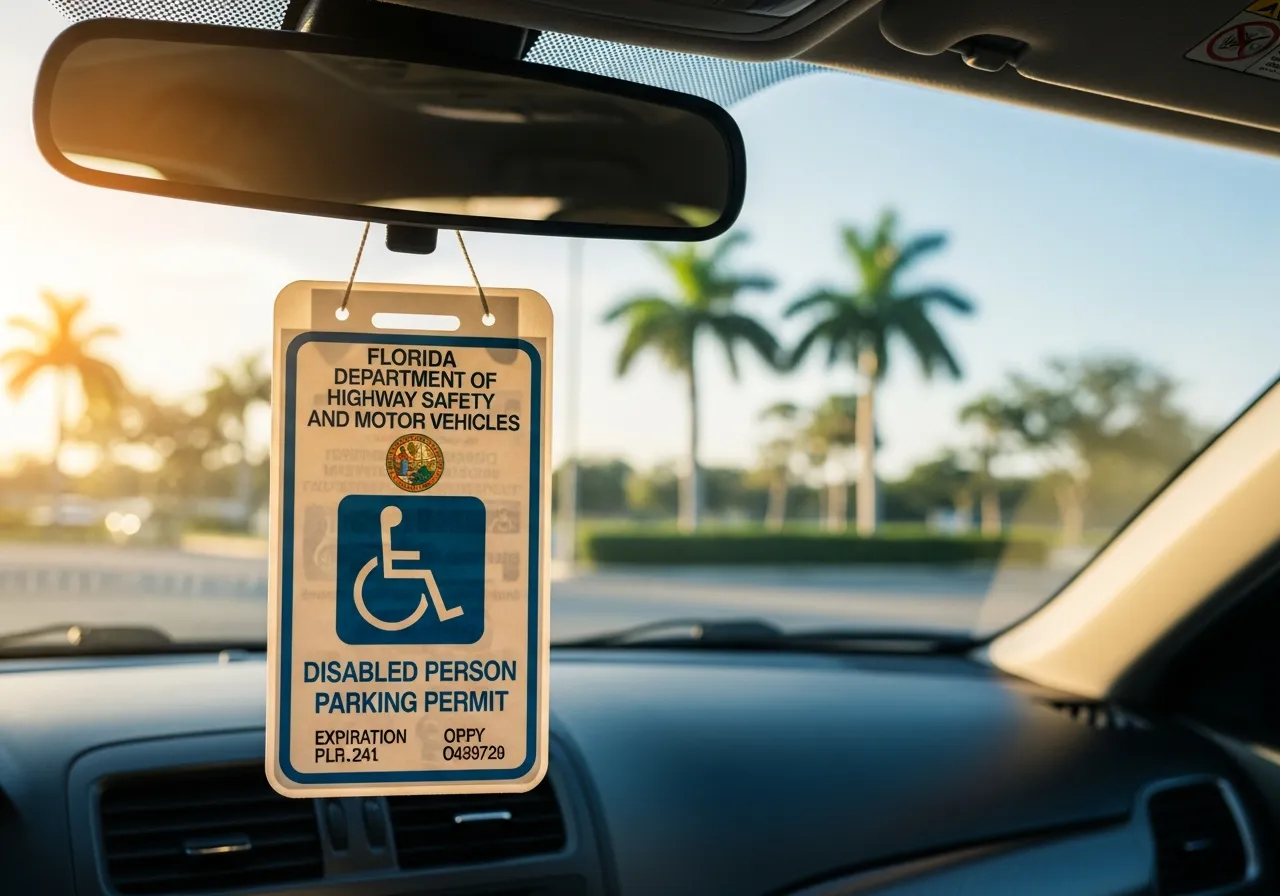
Florida law requires that the disabled individual be present in the vehicle, either as a driver or passenger, when using disabled parking spaces. The placard must be displayed hanging from the rearview mirror or placed on the dashboard in clear view.
Parking in designated disabled spaces is allowed in:
-
Public parking lots and garages
-
On-street metered parking (usually without time limits or fees)
-
Time-limited parking zones (extended time allowances)
Out-of-State Permits
Florida honors disabled parking permits from other states. Visitors with valid permits from their home state can legally use disabled parking spaces throughout Florida. However, Florida residents must obtain Florida-issued permits.
Legal Requirements and Penalties
Florida takes disabled parking seriously, and misuse carries significant penalties. Understanding the legal framework helps ensure compliance and protects the rights of those who genuinely need accessible parking.
Prohibited Actions
-
Using someone else’s disabled parking permit
-
Allowing others to use your permit when you’re not present
-
Altering or forging disabled parking permits
-
Parking in disabled spaces without a valid permit
-
Parking in access aisles (striped areas next to disabled spaces)
Penalties for Misuse
Violations can result in:
-
Fines up to $250
-
Community service hours
-
Towing of the vehicle
-
Revocation of the disabled parking permit
-
Criminal charges for permit fraud
Law enforcement officers and parking enforcement personnel actively monitor disabled parking spaces. Many jurisdictions use specialized enforcement teams to combat disability parking abuse.
Tips for a Smooth Application Process
Before Your Doctor’s Appointment
-
Download and review the HSMV 83039 form in advance
-
Prepare a list of your mobility limitations and how they affect daily activities
-
Bring documentation of your condition, such as medical records or test results
-
Confirm that your healthcare provider is authorized to certify disability (physician, ARNP, or PA)
When Completing the Form
-
Use black or blue ink for paper applications
-
Print clearly and legibly
-
Ensure all required fields are completed
-
Don’t sign the form before your medical provider completes their section
-
Make copies of the completed form for your records
At the Tax Collector’s Office
-
Bring valid photo identification
-
Arrive during non-peak hours if possible (mid-morning or early afternoon)
-
Have your completed HSMV 83039 form ready
-
Ask questions if you’re uncertain about any aspect of the process
-
Understand the expiration date and renewal requirements
After Receiving Your Permit
-
Sign the back of your placard immediately
-
Note the expiration date and set a reminder for renewal
-
Store the placard safely when not in use (not hanging from the rearview mirror while driving)
-
Keep the placard in your vehicle or with you when using accessible parking
-
Report lost or stolen permits promptly
Conclusion
Obtaining a disabled parking permit in Florida is a straightforward process designed to provide essential accessibility for individuals with qualifying mobility impairments. By understanding the florida disabled parking permit requirements, properly completing the HSMV 83039 form, and following the application procedures outlined in this guide, you can secure the parking accommodations you need.
Remember that the process is free, and county tax collector offices throughout Florida are available to assist you. Whether you need a temporary placard during recovery from surgery or a permanent permit for a chronic condition, Florida’s system ensures that eligible residents can access convenient parking that enhances their independence and quality of life.
Frequently Asked Questions
How long does it take to get a disabled parking permit in Florida?
If you apply in person with a completed HSMV 83039 form, you can often receive your placard the same day. Mailed applications typically take 2-3 weeks for processing and delivery.
Can I use my Florida disabled parking permit in other states?
Yes, Florida disabled parking permits are recognized throughout the United States under reciprocal agreements. You can legally use your Florida permit when traveling to other states.
Do I need to pay for a disabled parking permit in Florida?
No, there is no fee to obtain a disabled parking permit in Florida. The application process through county tax collector offices is free of charge. Replacement permits may have a small fee.
Can a chiropractor certify my disabled parking permit application?
No, Florida law requires certification by a licensed physician (MD or DO), advanced registered nurse practitioner (ARNP), or physician assistant (PA). Chiropractors are not authorized to certify disability for parking permits.
What's the difference between temporary and permanent disabled parking permits?
Temporary permits are issued for conditions expected to last six months or less and must be renewed if the disability persists. Permanent permits are for lasting conditions and are valid for four years before renewal.
Can I get a disabled parking permit for anxiety or mental health conditions?
Disabled parking permits in Florida are specifically for mobility impairments that affect your ability to walk. Mental health conditions alone typically don't qualify unless they result in physical mobility limitations that meet the state's criteria.
What happens if I'm caught misusing a disabled parking permit?
Misuse of a disabled parking permit can result in fines up to $250, community service requirements, vehicle towing, and revocation of the permit. Fraudulent use can lead to criminal charges.
How many times can I renew my temporary disabled parking permit?
You can renew your temporary permit as many times as necessary if your condition persists beyond six months, but each renewal requires updated medical certification from your healthcare provider.

Meet the author
Nida Hammad
With over 5 years of experience in accessibility content, I create clear resources on handicap parking permits, state requirements, and applications.
Get an Accessible Parking Permit Evaluation in Minutes.


![Handicap Placard in Maryland: Complete Guide [2026]](/_astro/t9b1cqsnhkeyjuhp8cnfr.CmyUYx2C_2gj1BS.webp)