Don't Let Missing Paperwork Block Your Placard — Here's Exactly What You Need
 by Alisha Shabbir
Last updated:


According to the U.S. Census Bureau, approximately 44.1 million Americans live with a mobility disability. For many of them, a disability parking permit is not a convenience but a daily necessity. Yet a significant number of applications face delays for one preventable reason: incomplete or missing medical documentation.
Why Medical Records Are Important for a Disability Parking Permit Application
Many people expect the doctor to simply confirm their diagnosis and sign the handicap placard form. But that’s not quite what happens.
What the physician is actually doing is certifying that your condition creates a specific functional limitation. For example: the inability to walk 200 feet without stopping to rest, the need for a cane or walker, or a heart or lung condition that makes walking risky. That’s the legal standard most states use. It’s about what your condition prevents you from doing safely, not just what it’s called.
Your medical records are the bridge between your diagnosis and that functional reality. Without them, the doctor relies entirely on what you describe in the interview, which takes longer and can introduce uncertainty. With them, the evaluation is faster and more straightforward.
Medical records support your disability parking permit application in several key ways:
-
They connect your diagnosis to your mobility limitation. Records translate your medical history into the functional language that state DMV eligibility criteria require.
-
They speed up the physician’s review. A doctor with recent visit notes or specialist letters can complete your evaluation much faster.
-
They reduce the chance of delays. Incomplete documentation is one of the most common reasons applications require follow-up.
-
They help with conditions that fluctuate. For conditions like MS, lupus, or chronic pain where symptoms vary day to day, records show the full picture that a single interview cannot.
-
They’re mandated in certain states. Some programs, like New York City’s PPPD, require independent medical documentation alongside the physician’s certification.
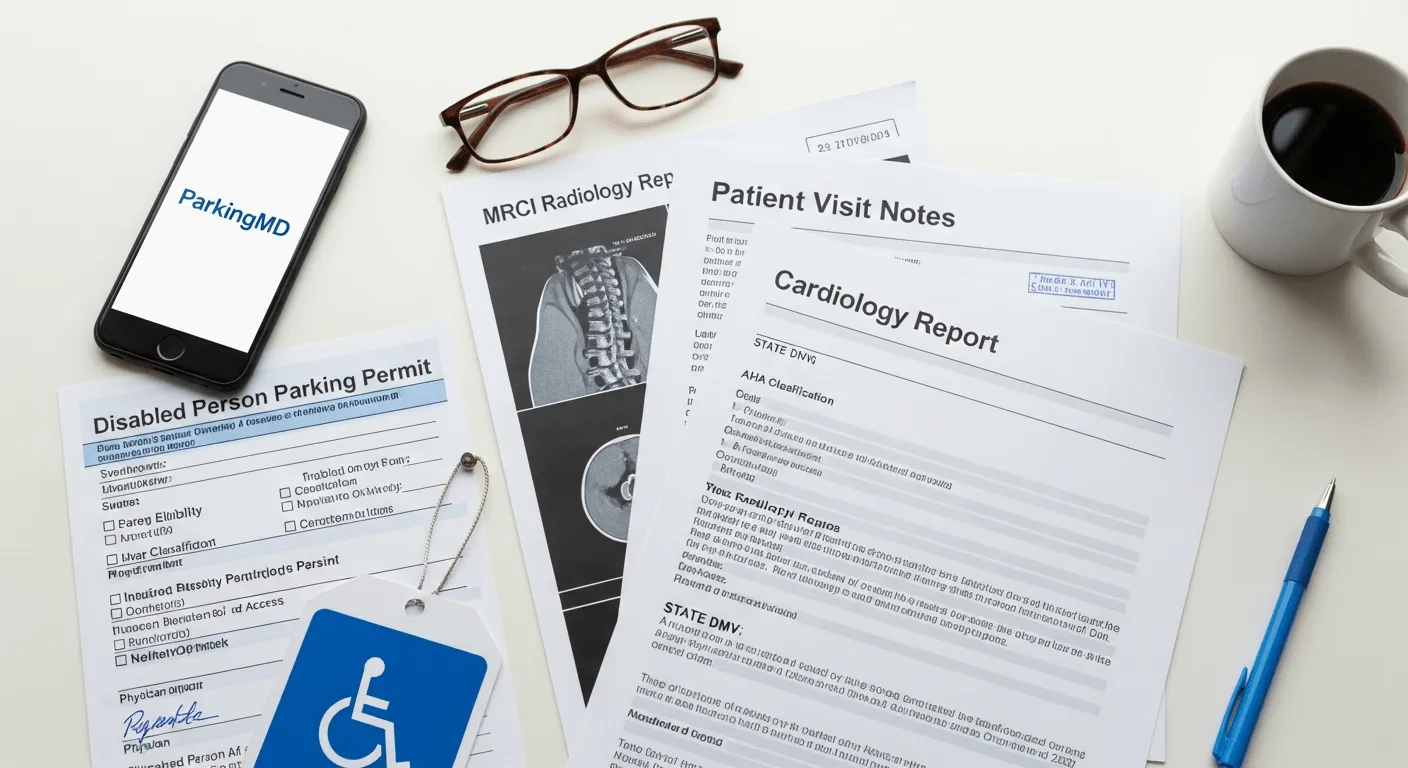
Key Medical Records You Need for Your Disability Parking Permit Application
Not all records carry the same weight. You want documentation that directly connects your condition to a mobility or safety limitation, not just proof that you have a diagnosis.

1. Recent visit notes (within the past 12 months):
Notes describing how far you can walk, whether you use assistive devices, and pain levels that limit movement. The more specific, the better.
2. Physical therapy records:
PT notes often contain the most precise functional assessments in your history: walking distance, balance, gait observations.
3. Imaging reports:
MRI or X-ray results for conditions like herniated discs, joint degeneration, or fractures provide objective supporting evidence.
4. Operative notes:
If you’ve had recent surgery, these describe the procedure and expected recovery limitations. This is especially useful when applying for a temporary placard after surgery or injury, where the physician must indicate a projected duration for the limitation.
5. Cardiology reports:
Most states reference the American Heart Association’s classification system. A report identifying Class III or Class IV severity does a lot of the work for the certifying physician.
6. Pulmonary function tests:
For lung conditions, many states look for a forced expiratory volume under one liter. A spirometry report directly addresses this.
7. Specialist letters:
A summary from your neurologist, rheumatologist, or other specialist carries significant weight and usually includes more detailed functional assessments.
8. Prescription records:
Ongoing prescriptions for pain management, disease-modifying medications, or oxygen use add important context about severity.
Here’s a quick reference for the most useful records by condition:
| Record Type | Most Useful For | What It Shows |
|---|---|---|
| Recent visit notes | All conditions | Ongoing treatment, functional status |
| Physical therapy notes | Orthopedic, neurological, post-surgery | Walking distance, documented limitations |
| Imaging reports | Back pain, arthritis, joint conditions | Structural evidence |
| Operative notes | Post-surgery applicants | Procedure details, recovery limitations |
| Cardiology reports | Heart conditions | AHA functional class, exertion limits |
| Pulmonary function tests | Lung/respiratory conditions | FEV1 measurements, oxygen dependence |
| Specialist letters | Complex or chronic conditions | Expert functional assessment |
What Physicians Evaluate During a Disability Parking Permit Certification
A diagnosis alone is not sufficient. Two people can share the same diagnosis and only one may qualify, because what the doctor assesses is the degree of functional limitation, not the condition name.
The certifying physician is specifically looking for these qualifying conditions:
-
Whether you can walk 200 feet without stopping to rest
-
Whether you need a cane, walker, wheelchair, or other mobility aid
-
Whether exertion creates a cardiac or respiratory risk (typically Class III or IV heart conditions, or FEV1 below one liter)
-
Whether a neurological or orthopedic condition significantly affects your ability to walk safely
-
Whether you depend on portable oxygen
Records that describe your limitations in these terms, not just your diagnosis, are what make a certification straightforward.
How to Request Your Medical Records for a Disability Parking Permit
Under the HIPAA Privacy Rule, you have a legal right to your records. Providers must respond within 30 days.
Here’s a simple approach you can use:
-
Contact the medical records department at the office of the provider who manages your qualifying condition.
-
Request visit notes from the past 12-24 months, plus any imaging reports or specialist summaries.
-
Organize what you receive with the most recent records on top.
You don’t need your entire medical history. A few pages of clear, relevant documentation will serve you far better than a disorganized stack. Documentation requirements vary by location, so reviewing disability parking permit requirements in your state before gathering records can save time.
Can You Apply for a Disability Parking Permit Without Medical Records?
Yes, in certain cases. Records strengthen your application, but they are not always required.
Many states allow certification based on a thorough clinical interview. What matters most is specificity. Instead of saying “I have pain when I walk,” describe it precisely: “I have to stop and rest after about 50 feet because of pain in my left knee, and I use a cane for stability on uneven ground.” The more clearly you describe your limitations, the more the physician has to work with.
If you don’t have recent records, even a single new visit that documents your current functional status can help before your evaluation.
How ParkingMD Can Help You Obtain Medical Certification Quicker
ParkingMD connects you with board-certified physicians who specialize in disability parking evaluations across all 50 states. Whether you have a complete file of recent records or very little documentation, the telehealth process is built to work around your situation. The physician reviews what you have, asks targeted questions about your functional limitations, and determines eligibility based on the same criteria your state DMV uses.
Evaluations are typically completed within 24-48 hours. Everything is handled online from home, with no in-office visits required. Your records and personal information are kept fully confidential under HIPAA. Once approved, ParkingMD provides the completed state DMV certification form, signed and ready to submit.
Ready to get started? Apply at ParkingMD today.

Frequently Asked Questions
How recent do medical records need to be for a disability parking permit application?
Most states don't set a hard expiration date on supporting records, but documentation from the past 12 months carries the most weight. Records older than two years may still be useful for permanent conditions, but a recent visit note that confirms your current functional status is always stronger. If your most recent records are several years old, scheduling a single updated appointment before your evaluation is worth considering.
What if my medical records don't specifically mention difficulty walking?
This is more common than you might expect. Many visit notes document a diagnosis but say nothing about how it affects daily mobility. If that's the case with your records, don't set them aside, bring them anyway, and be prepared to describe your limitations in detail during the evaluation. A physician can still certify based on what you report, and your records serve as supporting context even when they aren't explicit about walking ability.
Can a family member or caregiver request medical records on my behalf?
Yes. Under HIPAA, a person you designate as your personal representative has the same right to access your records that you do. This typically requires a signed authorization form, which your provider's office can supply. For older adults or anyone who finds the records request process difficult to manage alone, having a trusted family member handle this step is a practical and fully permitted option.
Can VA records be used for a disability parking permit application?
Yes, in most states. Veterans who receive care through the VA can use VA medical records to support their disability parking permit application the same way they would use records from a private provider. Some states also allow veterans with a service-connected disability rating of 100% to substitute a VA determination letter in place of a standard physician certification. If you're a veteran, it's worth checking your specific state's rules before your evaluation.
If I move to a different state, do I need new medical records to apply for a permit there?
Your existing medical records remain valid, they don't become outdated simply because you've moved. However, you will need to apply for a new permit in your new state, as placards are issued by individual states and are not transferable. The same records that supported your previous application can be submitted with your new one. If your condition has changed since you last applied, updated documentation reflecting your current status is always helpful.

Meet the author
Alisha Shabbir
Hey, I'm Alisha and I help people understand disability parking laws and medical services. At ParkingMD, I write about state regulations, patient rights, and healthcare access to make confusing processes straightforward. I believe good information should be easy to find and understand. When I'm not researching state laws or writing guides, you'll find me reading and practicing mindfulness.
Get an Accessible Parking Permit Evaluation in Minutes.