Handicap Placard for Elderly Parent
 by Nida Hammad
Last updated:


Helping a parent age with dignity means thinking about the small barriers that add up over time. One of the most practical things an adult child or caregiver can do is help secure a handicap placard for an elderly parent. A placard reduces walking distances, lowers fall risk, conserves energy, and makes everyday errands manageable again. Yet many families delay the process because they are unsure about eligibility, who can apply, or what paperwork is needed.
This guide answers every practical question about getting a handicap placard for an elderly parent, from qualifying conditions and medical records to caregiver rights and how the process can now be completed entirely online. If your parent is struggling to get from the car to the entrance of a grocery store, a medical appointment, or a family event, this guide is where to start.
Why Getting a Handicap Placard for an Elderly Parent Matters
Mobility challenges are not rare in older adults. They are statistically the norm. Older adults reported the highest disability prevalence of any age group, with 43.9% of people aged 65 and older living with a disability. When you narrow that to mobility specifically, the picture becomes even clearer. A study analyzing Behavioral Risk Factor Surveillance System data found that 41.7% of U.S. adults aged 65 and over reported having some form of disability, with 64.5% of those individuals specifically experiencing mobility disability, meaning roughly one in every four older adults in the United States faces challenges with mobility.
These numbers translate to real, daily struggles. A parent with arthritis, heart disease, or COPD may be able to drive or ride to a destination but genuinely cannot walk from a distant parking space to the entrance without pain, breathlessness, or serious fall risk. Mobility limitations in older adults have been associated with increased fall risk, hospitalization, decreased quality of life, and even mortality.
A disability parking permit does not replace medical care or physical therapy, but it removes one significant daily obstacle. It allows an elderly parent to remain active, independent, and included in family outings and errands rather than staying home because getting from the car to the door feels impossible. For families providing care, it also reduces the physical strain on the caregiver who would otherwise need to assist a parent across a long parking lot in all weather conditions.
Does Your Elderly Parent Qualify for a Handicap Placard for an Elderly Parent?

The most important thing to understand is that eligibility is based on functional limitation, not age or diagnosis name alone. The Americans with Disabilities Act sets federal accessibility standards, and each state builds its own permit criteria around similar core language.
A licensed physician, physician assistant, or registered nurse practitioner must determine if a person qualifies for disabled parking. A person may receive disabled parking privileges if they cannot walk 200 feet without stopping to rest, if their ability to walk is severely limited due to an arthritic, neurological, or orthopedic condition, or if they cannot walk without the use of a brace, cane, prosthetic device, or other assistive device.
For elderly parents, the key question is not what the condition is called. It is what the condition prevents them from doing safely. Two people can share the same diagnosis, but only one may qualify if only one has a meaningful walking or safety limitation. A physician will assess the degree of functional impairment, not just the diagnostic label.
Common Qualifying Conditions in Elderly Adults
Arthritis and orthopedic conditions are among the most frequently cited reasons elderly adults qualify for a handicap placard for an elderly parent. Severe joint pain in the hips, knees, or feet that limits walking distance or requires a cane or walker meets the standard in every state. Arthritic, neurological, or orthopedic conditions causing chronic pain or stiffness that affect walking or standing are recognized qualifying conditions for permanent handicap parking permits across multiple medical categories.
Cardiac and pulmonary conditions are the second major category. An elderly parent with congestive heart failure, Class III or IV heart disease, COPD, or severe emphysema may be unable to walk without experiencing dangerous shortness of breath or chest tightness. A person may be eligible for a disability placard if they have a condition that significantly limits their mobility, including an inability to walk 200 feet without needing to stop and rest.
Neurological conditions including Parkinson’s disease, stroke-related deficits, and multiple sclerosis frequently cause balance problems and gait impairment that qualify under most state standards.
Invisible conditions also count. A parent managing severe chronic pain, extreme fatigue from a systemic illness, or oxygen dependence does not need to look visibly disabled to qualify. Just because someone looks fine does not mean they do not experience daily struggles with chronic pain, fatigue, or other invisible symptoms, and many qualifying conditions for a handicap placard are not visually apparent.
For a full condition-by-condition breakdown, including both visible and invisible qualifying disabilities, visit ParkingMD’s complete guide to medical conditions that qualify for a handicap placard.
Types of Handicap Placards Available for Elderly Parents
Understanding the types of permits available helps you apply for the right one on the first attempt. Choosing the wrong type can cause unnecessary delays or result in a permit that does not match your parent’s actual situation.
Permanent placards are for long-term or permanent disabilities. They are the right choice for elderly parents with chronic conditions such as severe arthritis, advanced heart failure, or COPD that are unlikely to improve over time. A permanent placard is valid for two years and expires on June 30 of every odd-numbered year, and a person is only allowed to have one permanent placard at any given time.
Temporary placards are issued for conditions expected to resolve or improve, such as recovery from hip or knee replacement surgery. A temporary parking placard is valid for up to 180 days or until the date noted by the qualifying licensed medical professional on the application, whichever is shorter, and cannot be renewed more than six times in a row.
Disability license plates are permanently affixed to a specific vehicle and work best when your elderly parent is the regular driver of that car. Placards, by contrast, can be moved from one vehicle to another, making them a better option for a caregiver who transports a disabled person across different vehicles. For most elderly parents who travel as passengers in family members’ cars, a placard offers far more day-to-day flexibility than plates.
Color coding is also worth noting. Red placards are typically issued for temporary disabilities, while dark blue placards indicate permanent disabilities. Light blue placards may be designated for wheelchair-user-specific parking spaces, with renewal periods varying by state. Knowing what color to expect helps you confirm that your DMV issued the correct permit type.
What Elderly Parents With Disabilities Are Saying About Getting Their Handicap Placard

William – Georgia ⭐⭐⭐⭐⭐
“So quick and easy, even for a guy that is 77 years old. Piece of cake!”
Christy H. – Texas ⭐⭐⭐⭐⭐
“It allows the freedom to shop without worry of walking so far when my heart and knees are acting up. Instead of deciding to put off shopping and coming back another day when it’s less busy so I can park closer, I can now confidently know I can park closer any time and only have to walk as far as the mobility scooter carts when needed.”
Kim Baron – North Carolina ⭐⭐⭐⭐⭐
“My parking permit allows me to park closer to entrances, which reduces the physical strain on my legs and lowers my risk of falling. It gives me greater independence and confidence when I go to medical appointments, grocery shopping, or run errands. The permit helps me stay active, maintain my dignity, and safely participate in daily life despite my health challenges.”
Deb L. – Ohio ⭐⭐⭐⭐⭐
“My permit allows me to park closer to my destination, especially on days when my mobility issues are really bad. I have good and bad days. On those bad days, the permit is a godsend. Also, when traveling out of state I can use it with rental cars.”
Amanda L. – Delaware ⭐⭐⭐⭐⭐
“What a difference this has been on not just my life but my family’s. I ache and take a while to get from point A to B. This has improved my life in so many ways. Less wear and tear on my health, and makes it so much easier and quicker to get to and from places.”
Can a Caregiver Apply on Behalf of an Elderly Parent?
Yes. An adult child or professional caregiver can handle the entire application process on behalf of an elderly parent. A caregiver or family member can submit the intake and documentation on a patient’s behalf. The evaluation and certification are based on the patient’s condition and identity, not the applicant’s. ParkingMD The placard itself is issued in your parent’s name, not yours.
This is particularly important for elderly parents who have cognitive difficulties, limited mobility that makes travel difficult, or who simply need help navigating paperwork. You do not need to be a professional caregiver or hold power of attorney to assist with this process. Any family member can gather the records, complete the intake forms, and coordinate the evaluation appointment on a parent’s behalf.
What a Handicap Placard for an Elderly Parent Allows Caregivers to Do
Once the placard is issued, a caregiver can use it legally when transporting the permit holder. The caregiver of a disabled person can use a handicap parking placard when the person they are transporting is a handicap parking permit holder and is present in the vehicle. This applies whether you are driving your own car, a rental vehicle, or any other automobile when your parent is with you.
The permit holder must be present. A caregiver or family member cannot use the placard independently, even for errands on the holder’s behalf. Using a placard without the holder present violates state law in every state, and fines range from $250 to $1,250 with possible community service and permanent revocation of the permit.
The placard should only be used when the person with the disability is in the car. This rule applies to adult children, grandchildren caregivers, and spouses equally. The placard can be moved from vehicle to vehicle, giving families maximum flexibility without requiring a separate permit for each car your parent might ride in.
What Medical Records Does Your Elderly Parent Need?
The medical documentation you gather before the evaluation is what transforms a diagnosis into a certified functional limitation. The physician completing your parent’s disability parking evaluation is not simply confirming what condition exists. They are certifying that the condition creates a specific limitation that meets your state’s legal standard for a handicap placard for an elderly parent.
Medical records connect your diagnosis to your mobility limitation by translating your parent’s medical history into the functional language that state DMV eligibility criteria require. They speed up the physician’s review, reduce the chance of delays, and help with conditions that fluctuate, since records show the full picture that a single interview cannot capture.
The most useful records for an elderly parent’s application typically include the following. Recent physician visit notes from the past 12 months are the foundation. Notes that describe how far your parent can walk, whether they use assistive devices, and what pain or symptom levels limit their movement carry the most weight. Specialist letters from a cardiologist, rheumatologist, or neurologist add expert-level functional assessments that are particularly persuasive for applications involving cardiac or inflammatory conditions. Physical therapy assessments are often the most specific documents available, as they typically include precise measurements of walking distance, balance scores, and gait observations. Imaging reports such as X-rays showing joint degeneration, or echocardiograms documenting cardiac function, provide objective structural evidence.
You have a legal right to your parent’s medical records under HIPAA, and most providers must respond within 30 days. You do not need your parent’s entire medical history. A few pages of clear, relevant documentation will serve far better than a disorganized collection of older records.
For a complete breakdown of which documents carry the most weight by condition type, and step-by-step instructions for requesting records from any provider, visit ParkingMD’s medical records guide for disability parking permit applications.
Step-by-Step: How to Get a Handicap Placard for an Elderly Parent
The general process across all 50 states follows the same sequence, with variations in the specific forms, fees, and submission methods your state requires.
Step 1: Confirm eligibility. Review your parent’s qualifying conditions against your state’s criteria. The standard functional tests are walking distance, mobility aid dependence, and cardiac or respiratory exertion risk. If your parent struggles to walk across a parking lot without stopping, they almost certainly qualify.
Step 2: Gather medical records. Collect recent visit notes, imaging reports, and any specialist letters relevant to your parent’s mobility limitations. Having these ready before the physician evaluation makes the certification process faster and reduces the risk of a follow-up documentation request.
Step 3: Complete a physician evaluation. A licensed physician, physician assistant, or nurse practitioner must assess your parent’s condition and certify the functional limitation on your state’s official DMV certification form. Each state has its own rules for eligibility, types of permits, and the application process, which often requires a doctor’s certification. Once obtained, it is important to follow your state’s guidelines for proper use, renewal, and display of the permit to avoid penalties. Care.com
Step 4: Submit the application to your state DMV. Depending on your state, submission can be completed online, by mail, or in person. Some states process applications within a few days; others take two to four weeks.
Step 5: Receive the placard and review usage rules. Once issued, review proper display requirements and the rules around caregiver use with your parent so that the permit is used correctly from the start.
Getting a Handicap Placard for an Elderly Parent Online Through ParkingMD
One of the most practical options for adult children managing a parent’s care is completing the physician evaluation entirely online. Scheduling a physician appointment, coordinating transportation for a parent with limited mobility, and then waiting at a DMV office can create real logistical challenges for families already managing complex care situations.
ParkingMD connects patients and their families with licensed physicians across all 50 states who specialize in disability parking permit evaluations. You or your parent can complete the evaluation from home via a phone or video call, without any in-person visit. The physician reviews available medical records, asks targeted questions about functional limitations, and certifies eligibility using the exact criteria your state DMV requires. Once approved, the signed, physician-completed DMV-ready forms are delivered digitally for immediate download or mailed to your address.
The process is HIPAA-secure, backed by a money-back guarantee if the evaluation does not result in approval, and typically completed within 24 to 48 hours. More than 33,000 patients have used ParkingMD to get their placard evaluations done without leaving home.
If your parent’s next doctor appointment is weeks away and they need a placard now, start the evaluation at ParkingMD today.
How to Properly Use and Display Your Parent’s Handicap Placard
Once the placard arrives, correct use protects your parent’s permit and ensures your family does not face penalties.
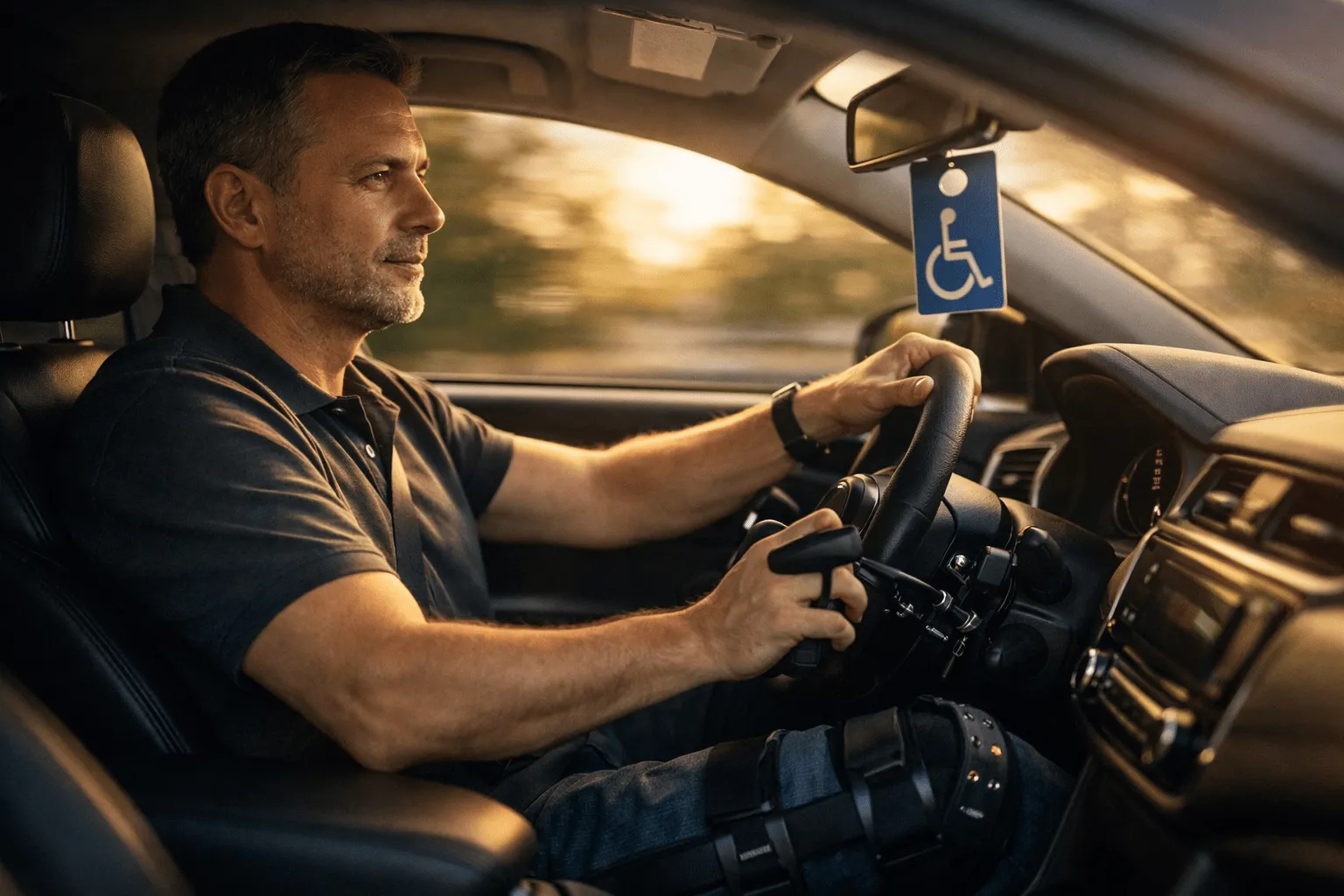
The placard must be displayed by hanging it from the rearview mirror only while the vehicle is parked. It must be removed before driving to avoid obstructing the driver’s sightlines. If the vehicle has no rearview mirror, the placard should be placed face-up on the dashboard, visible through the windshield.
Your parent must be present in the vehicle whenever the placard is displayed. This requirement is universal across every state. Willful misuse can lead to cancellation of the permit, significant fines for the permit holder or the person using it, or both, and community service in some cases. It is not advisable to let family members use the placard to get preferred parking at any location, or even to run an errand on the holder’s behalf when the holder is not in the vehicle. The Zebra
The placard may be used in any vehicle your elderly parent is traveling in, whether that is your personal car, a sibling’s car, a rental vehicle, or a rideshare. This portability is one of the placard format’s most valuable practical advantages over disability license plates.
Make sure personal details match when submitting the application. A common DMV rejection occurs when personal information on the certification form does not exactly match the applicant’s driver’s license or state ID. Double-check names, addresses, and ID numbers before submitting. ParkingMD
Renewing Your Elderly Parent’s Handicap Placard
Renewal is an important step that many families overlook until the permit has already expired. Renewal requirements vary by state and permit type, but planning ahead prevents your parent from losing accessible parking access during any administrative gap.
Most permanent placards require renewal every two to four years depending on the state. Some states send automatic renewal notices in advance; others require proactive action from the permit holder or their caregiver. For permanent disabilities, renewal often requires a new application form but may not require fresh medical certification at every renewal cycle.
Most states require permit holders to renew their placards every few years, and this process typically involves providing additional documentation from a physician to verify that the disability is ongoing. For temporary placards issued to elderly parents recovering from surgery or a short-term condition, renewal requires new medical certification confirming that the limitation continues.
If your parent’s condition has changed since their last application, whether it has worsened or new qualifying conditions have developed, updating their certification through a current evaluation ensures the permit accurately reflects their present needs. An online telehealth service like ParkingMD makes this renewal evaluation easy to schedule without requiring another trip to a doctor’s office.
Frequently Asked Questions
Is a handicap placard for an elderly parent issued in the parent's name or the caregiver's name?
The placard is always issued in the name of the person with the qualifying disability, meaning your elderly parent. A caregiver's name does not appear on the permit. You handle the paperwork on their behalf, but the permit legally belongs to your parent.
Can I use my elderly parent's placard in my own car when I drive them somewhere?
Yes. The placard can be used in any vehicle your parent is riding in as a passenger or driving themselves. You hang it from your rearview mirror when parked and remove it before driving. Your parent must be present in the vehicle every time the placard is displayed.
What if my elderly parent cannot attend a doctor's appointment for the evaluation?
Online telehealth evaluations are a practical solution. Through services like ParkingMD, your parent can complete the evaluation from home via a phone or video call. You can assist them through the process, and no in-person visit is required at any stage.
My parent was recently diagnosed with dementia. Do they still qualify?
Dementia alone may not meet all states' mobility-based eligibility standards, but if it is accompanied by physical limitations such as difficulty walking, poor balance, or fall risk, those functional impairments can support eligibility. A physician will evaluate both the cognitive and physical dimensions of your parent's situation.
Does the placard work in every state when we travel?
Yes. State-issued handicap placards are honored in all 50 states under federal accessibility standards for designated disabled parking spaces. Some extra local benefits, such as free metered parking, may not carry over across state lines, but the core parking privileges apply nationwide regardless of where the placard was issued.
How long does it take to receive the placard after applying?
Processing time varies by state. Some states issue placards within days of receiving a completed application; others take two to four weeks. Using an online service like ParkingMD to obtain your signed physician certification quickly eliminates delays on the documentation side, leaving only the standard DMV processing time.

Meet the author
Nida Hammad
With over 5 years of experience in accessibility content, I create clear resources on handicap parking permits, state requirements, and applications.
Get an Accessible Parking Permit Evaluation in Minutes.