
Can You Really Get a Handicap Placard Online? Your Questions Answered Honestly
 by Alisha Shabbir
Last updated:


According to the CDC’s 2024 disability report, more than 70 million adults in the United States report living with a disability. Among adults aged 65 and older, that number climbs to nearly 1 in 2.
Many of these individuals qualify for a disability parking placard. A significant number have never applied.
The most common reason for delaying isn’t eligibility. It’s uncertainty about the process: whether getting certified online is legitimate, whether the DMV will accept it, and whether sharing medical information online is safe. If your regular doctor has been slow, dismissive, or booked out for months, an online certification service may have come up in your search. Here’s everything you need to know about getting a disability parking permit online.

Is Getting a Handicap Placard Online Legitimate?
Yes. Telehealth laws in all 50 states permit licensed physicians to evaluate patients remotely and sign official state certification forms., provided the physician holds a valid license in the patient’s state. This isn’t a workaround. It’s the same legal framework that allows your own doctor to prescribe medication over a video call.
A legitimate service meets all of the following:
-
A licensed, state-credentialed physician reviews each case individually
-
The physician signs your state’s official DMV form, not a generic letter
-
The evaluation is a real clinical assessment, not an automated approval
-
The service operates under HIPAA and handles your records securely
What makes a service illegitimate is the absence of actual physician involvement. Some platforms offer instant approvals with no clinical review. Others generate letters that aren’t on the correct state form. Those submissions get rejected by the DMV, and the patient is left with nothing.
ParkingMD uses only licensed physicians. Every certification involves a real clinical evaluation. The physician signs the exact form your state DMV requires, identical to what a physician’s office would produce.
Will My DMV Accept an Online Handicap Placard Certification?
Your DMV doesn’t ask how a physician certification was obtained. Their only requirement is that the correct state form was used, completed accurately, and signed by a licensed provider.
Most rejections have nothing to do with telehealth. They come from preventable form errors:
-
Outdated form versions the DMV no longer accepts
-
Missing dates or incomplete provider license information
-
Wrong credential type selected (temporary vs. permanent)
-
Personal details that don’t match the applicant’s driver’s license
One patient from California experienced this firsthand. Ed Hatz’s HMO filled out his placard paperwork incorrectly the first time around. When he used ParkingMD the following year, the outcome was different.
“Process was so much easier than when I processed my temporary placard last year. Because ParkingMD specializes in handicap placards, the paperwork was filled out properly, unlike the paperwork from my HMO last year.”
- Ed Hatz, Verified Trustpilot Review
ParkingMD physicians specialize in disability parking certification and laws by state. Those errors are caught before the paperwork reaches you. After receiving your completed certification, you submit it to your DMV by mail, online upload, or in person depending on your state.
| Factor | ParkingMD (Online) | Traditional Doctor Visit |
|---|---|---|
| Time to certification | 24-72 hours | 1-4 weeks |
| Convenience | From home, any time | Office hours, appointment required |
| State-specific forms | Yes, current versions | Varies by office |
| DMV acceptance | Yes, all 50 states | Yes |
Which Medical Conditions Qualify for a Disability Parking Permit?
Eligibility isn’t about whether your disability is visible or whether you receive government benefits. It’s about function: whether your condition limits your ability to walk safely and independently.
The standard medical condition that qualify for a handicap placard in most states is straightforward. Can you walk 200 feet without stopping to rest? If not, you may qualify.
Mobility and musculoskeletal conditions
-
Arthritis or joint conditions causing significant pain with walking
-
Post-surgical recovery affecting walking ability
-
Any condition requiring a cane, walker, crutch, or brace
Arthritis alone qualifies more patients than most realize. The arthritis and handicap parking eligibility guide covers which types qualify and how severity is assessed.
Cardiac and pulmonary conditions
-
Heart disease meeting Class III or IV cardiac criteria under American Heart Association standards
-
COPD, emphysema, or conditions requiring portable oxygen
-
Arrhythmias causing exertional fatigue or dizziness
Neurological conditions
-
Multiple sclerosis, Parkinson’s disease
-
Neuropathy with fall risk
-
Stroke with lasting mobility effects
Other qualifying conditions
-
Legal blindness
-
Cancer treatment causing significant fatigue
-
Diabetes with severe walking-related complications
-
Chronic pain that meaningfully limits safe walking distance
You don’t need a wheelchair. If walking across a parking lot causes pain, breathlessness, or fall risk, it’s worth finding out whether you qualify.

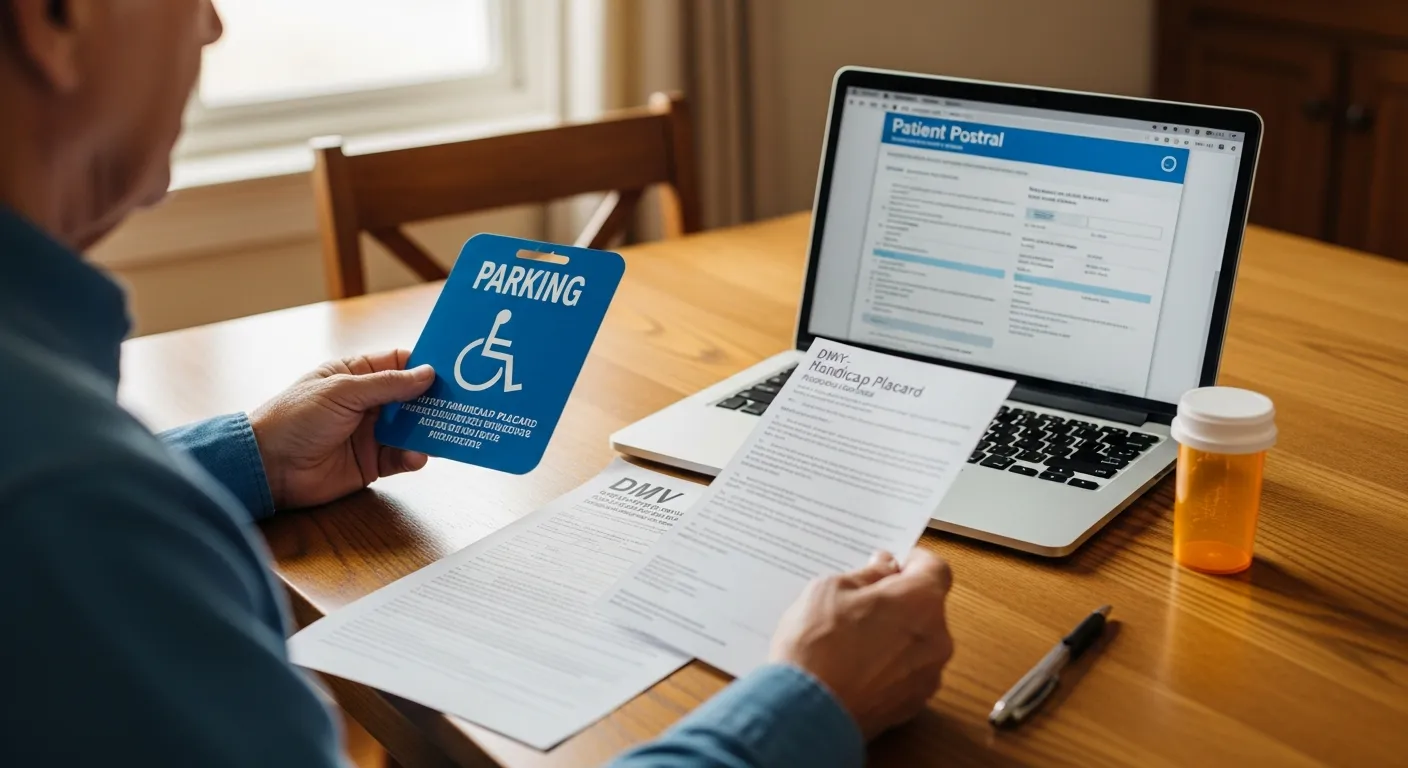
What Documents Do I Need Before the Online Medical Evaluation?
Having the right records ready before you start makes the process faster and reduces back-and-forth with the reviewing physician.
At minimum, you will need:
-
Medical records or a diagnosis letter from a treating provider
-
A government-issued photo ID
-
Your driver’s license information
Having supporting documents and medical records for disability permit strengthens your case and speeds up the physician review. This includes imaging reports, prescription history, physical therapy notes, or specialist letters that document your condition and its functional impact.
The most common reason applications slow down after intake is incomplete documentation. Not because the condition doesn’t qualify, but because the records submitted don’t clearly establish functional limitation. A diagnosis name alone is rarely enough. What the physician needs to see is evidence of how the condition affects your ability to walk safely.
If your records aren’t easily accessible, ParkingMD can help you retrieve them from your existing provider as well.

Is My Medical Information Safe With an Online Doctor?
ParkingMD operates under the federal HIPAA privacy standards that govern your doctor’s office, your hospital, and your health insurer.
Your information is encrypted, stored securely, and never sold to third parties. Only the licensed physician reviewing your case has access to it. Nothing is shared with employers, insurers, or any third party outside the scope of your evaluation.
If you’ve ever used a patient portal, completed intake forms online, or had records transferred between providers, you’ve already trusted a HIPAA-covered platform with sensitive health information. This is no different.
Temporary vs. Permanent Handicap Placard: What Is the Difference?
Temporary placards cover conditions with a defined recovery window: post-surgical recovery, a fracture, or a short-term mobility impairment. Most are valid for three to six months and renewable with updated physician certification if the condition continues.
Permanent placards are for ongoing conditions not expected to significantly improve. Most are valid for four years, with validity periods varying by state.
The evaluating physician determines which type fits your documented condition. Choosing the wrong type is one of the most common causes of DMV processing delays. It’s not a decision the patient should make alone, which is why it belongs to the physician.
| Temporary Placard | Permanent Placard | |
|---|---|---|
| For | Recovery, short-term impairment | Ongoing, long-term condition |
| Typical validity | 3-6 months | 4 years |
| Renewable | Yes, with updated certification | Yes |
| Who determines it | Evaluating physician | Evaluating physician |
What Does ParkingMD Process Look Like?
Our medical certification for handicap placard process runs in five steps.
1. Complete the intake form.
Describe your condition and mobility limitations in plain language. No medical jargon required. This gives the physician context before your evaluation begins.
2. Upload your documentation.
Medical records, a prior diagnosis letter, prescription history, or imaging reports. The more clearly your condition is documented, the smoother the review. ParkingMD can assist if you need help retrieving records from your provider.
3. Physician evaluation.
A licensed physician reviews your documentation and conducts a one-on-one phone or video consultation. They ask follow-up questions if needed before making any clinical determination.
4. Receive your completed certification.
If approved, the physician completes your state’s official DMV form and delivers it to you, typically within 24 to 72 hours of your evaluation.
5. Submit to your DMV.
By mail, online upload, or in person depending on your state. ParkingMD provides the state-specific instructions you need.

What Happens If I Am Not Approved for a Handicap Placard?
If the physician determines your condition doesn’t meet your state’s eligibility criteria, you won’t be charged.
A “no” from your regular doctor is also not the final word. Many patients come to ParkingMD after their primary care physician declined to complete the certification. This happens often for reasons that have nothing to do with whether the patient actually qualifies: full appointment schedules, unfamiliarity with the DMV form, or documentation that wasn’t organized at the time of the visit.
A physician who specializes in disability parking evaluations frequently reaches a different outcome when the same condition is reviewed with complete documentation.
Handicap Placard Rules: How to Use It Correctly
Every state enforces the same core rules. Knowing them upfront prevents issues at the DMV and at the parking space.
-
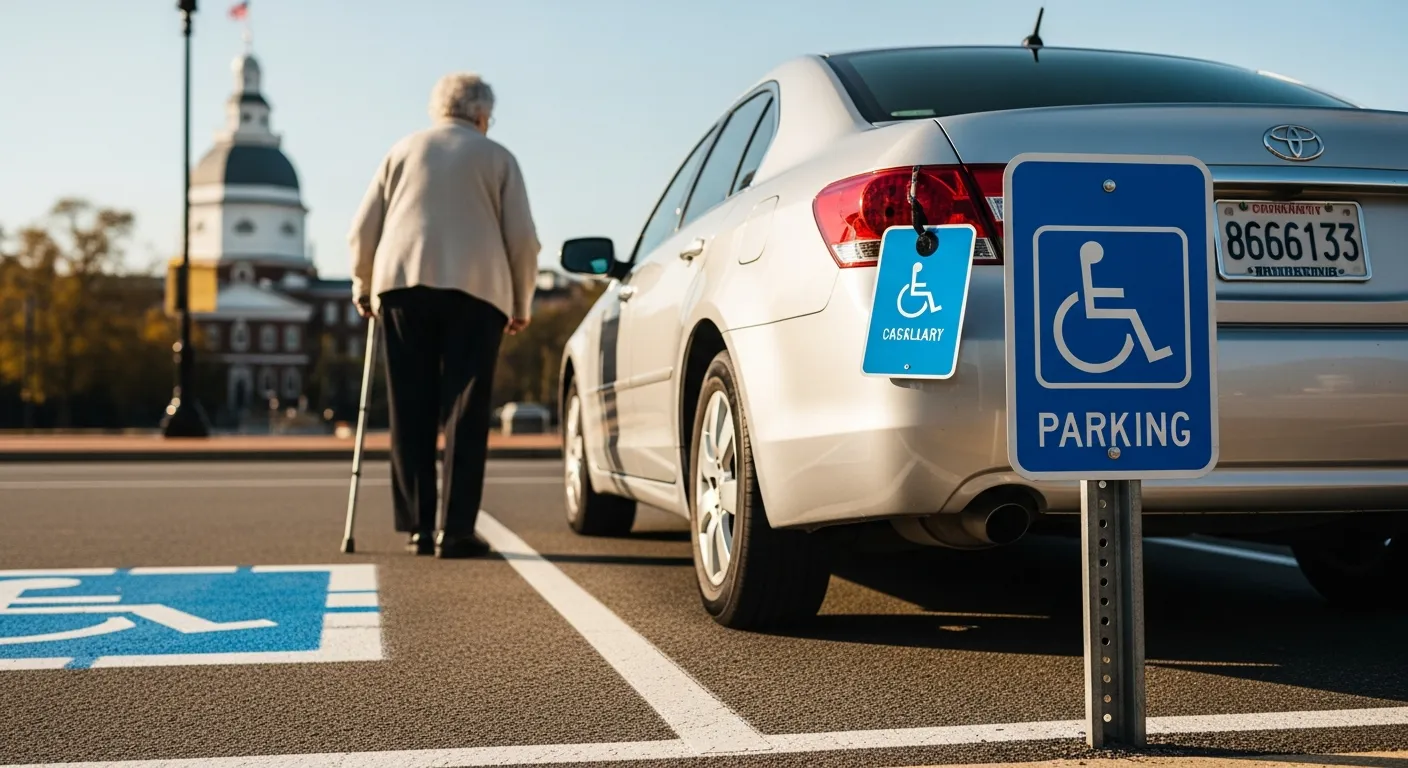
The holder must be present. A placard can be used in any vehicle, but only while the person it was issued to is the driver or a passenger. A caregiver or family member cannot use it independently, even for errands on the holder’s behalf.
-
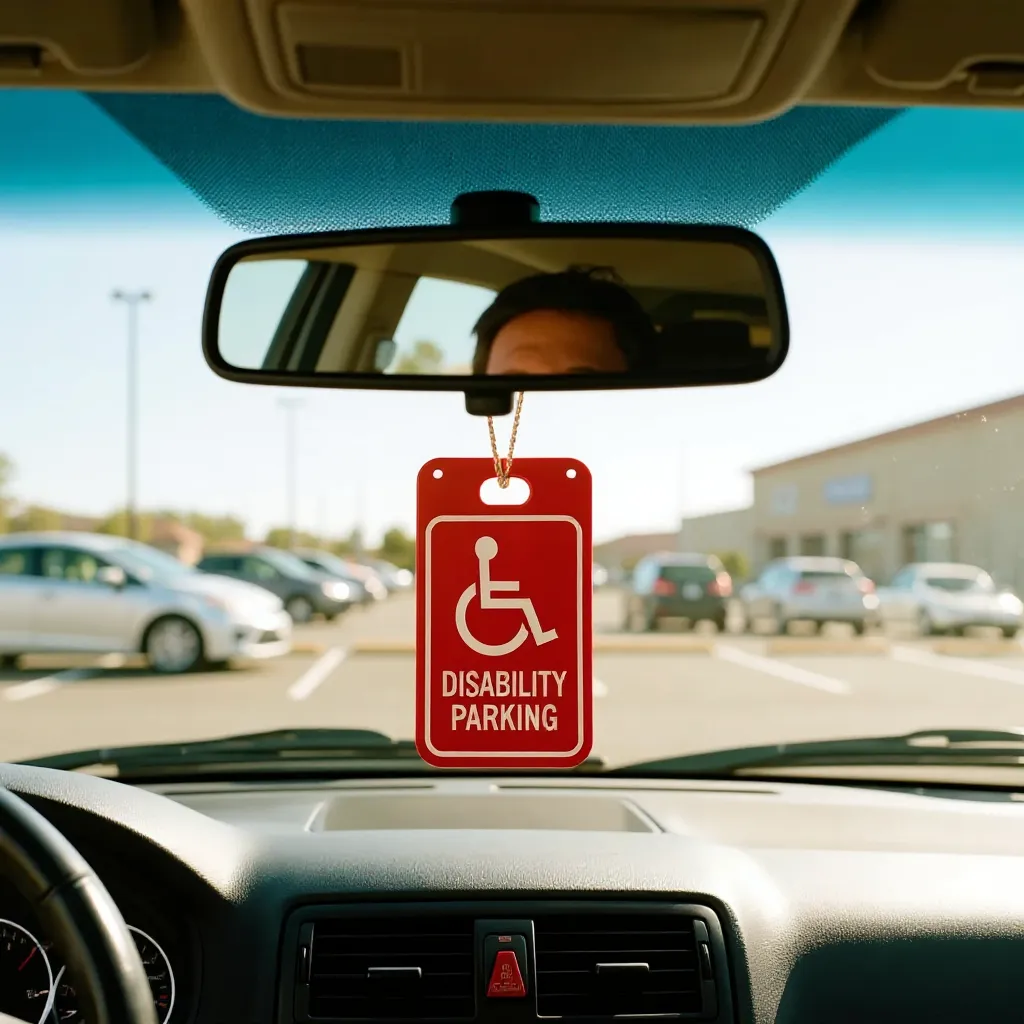
Display it correctly. Hang it from your rearview mirror only while parked. Remove it before driving. If your vehicle has no rearview mirror, place it face-up on the dashboard so it’s visible through the windshield.
-
Misuse carries real consequences. Using a placard without the holder present violates state law in every state. Fines range from $250 to $1,250, with possible community service and permanent revocation.
-
Make sure your details match. A common DMV rejection happens when personal information on the certification form doesn’t exactly match the applicant’s driver’s license. Double-check names, addresses, and ID numbers before submitting.
-
Lost or stolen? Contact your state DMV. Most states require a short replacement form and a small fee. A new physician certification is not required for a standard replacement.
Apply for Your Handicap Placard Certification Online Today
If you came to this article skeptical, that’s fair. Getting a handicap placard online sounds like it shouldn’t work as smoothly as it does. But the process is legitimate, the DMV accepts it, and the physician review is real.
ParkingMD connects patients with licensed physicians who specialize in disability parking certification across all 50 states. Your state’s official DMV form is used throughout. Your information is handled under HIPAA. And if the physician does not approve your certification, you are not charged.
If your regular doctor has been unavailable, slow with paperwork, or unfamiliar with the DMV certification process, ParkingMD was built specifically for this situation.
Frequently Asked Questions
Can you get a handicap placard online?
Yes. Telehealth laws in all 50 states allow licensed physicians to complete the physician certification section of your state's official DMV form remotely. The placard is still issued by your state DMV after you submit the completed paperwork. The online process covers the physician certification step only.
Do you have to be in a wheelchair to get a handicap placard?
No. Most placard holders don't use a wheelchair. You may qualify if you use a cane, walker, or brace, or if you experience significant pain, breathlessness, or fall risk while walking, even without any visible mobility aid.
Will my DMV accept an online doctor's certification?
Yes. The DMV reviews the form, not how the physician signature was obtained. As long as the correct current state form is used, completed accurately, and signed by a licensed provider, it's processed identically to any other application. Rejections come from form errors, not telehealth.
How long does it take to get a handicap placard?
Most ParkingMD patients receive physician certification within 24 to 72 hours of their evaluation. After submitting to the DMV, processing typically takes two to six weeks depending on your state.
Can I use my handicap placard in another state?
Yes in most cases. Disability parking placards are recognized across U.S. states through widely practiced reciprocity. The placard you receive travels with you. That said, specific privileges like free meter parking vary by city and state, so it's worth checking local rules at your destination before assuming full equivalency.
Can I get a handicap placard for a family member?
Yes. A caregiver or family member can submit the intake and documentation on a patient's behalf. The evaluation and certification are based on the patient's condition and identity, not the applicant's. The placard itself is issued to the patient and can only be used when the patient is present in the vehicle.

Meet the author
Alisha Shabbir
Hey, I'm Alisha and I help people understand disability parking laws and medical services. At ParkingMD, I write about state regulations, patient rights, and healthcare access to make confusing processes straightforward. I believe good information should be easy to find and understand. When I'm not researching state laws or writing guides, you'll find me reading and practicing mindfulness.
Get an Accessible Parking Permit Evaluation in Minutes.