Need Your Medical Records Fast? Here's How to Get Them the Same Day
 by Alisha Shabbir
Last updated:


According to the federal government’s 2024 Health Information National Trends Survey, the share of Americans who accessed their online medical records has more than doubled in the past decade, from 25 percent in 2014 to 65 percent in 2024. That still means more than one in three people with online access have never used it. And for a handicap placard application, not having records ready is the single most common reason evaluations slow down.
The good news: getting your records doesn’t have to take weeks. Under federal law, you already have the right to them. This guide tells you exactly how to request them quickly, what to upload, and what to do when records are hard to find.
Why Medical Records Speed Up Your Handicap Placard Application
A licensed physician can certify your condition and sign your DMV form without records at all. But having documentation ready makes the review faster, cleaner, and less likely to need follow-up.
When a physician reviews your case, they are looking for two things: confirmation of your diagnosis, and evidence that it affects your ability to walk or get around. A document that shows both of those things clearly means your evaluation can be completed in a single pass.
The most useful records are:
-
Recent visit notes (within the last one to two years) that mention your condition and how it limits mobility
-
Specialist letters from an orthopedic doctor, cardiologist, neurologist, or other relevant provider
-
Imaging reports such as X-rays, MRI results, or CT scans
-
Prescription records showing ongoing treatment for your qualifying condition
-
A discharge summary from a hospital stay or surgery related to your condition
You don’t need your full medical history. One relevant, recent document is usually all it takes. Conditions including chronic pain, arthritis, heart disease, and neurological disorders commonly qualify, and the full list of qualifying conditions by state is broader than most applicants expect.
Your Legal Right to Request Medical Records From Any Provider
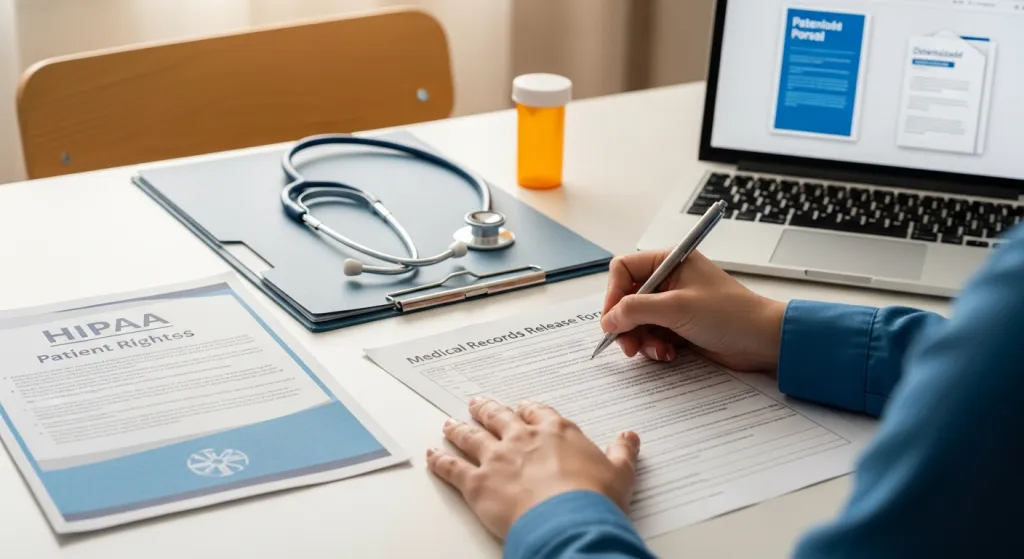
Many people don’t realize this: you have a federally protected right to your own medical records, and your provider cannot unreasonably delay or refuse your request.
As the U.S. Department of Health and Human Services explains, the HIPAA Privacy Rule gives you the right to inspect and receive copies of your records from any covered health care provider. A covered entity may not impose unreasonable measures on an individual requesting access that serve as barriers to or unreasonably delay the individual from obtaining access.
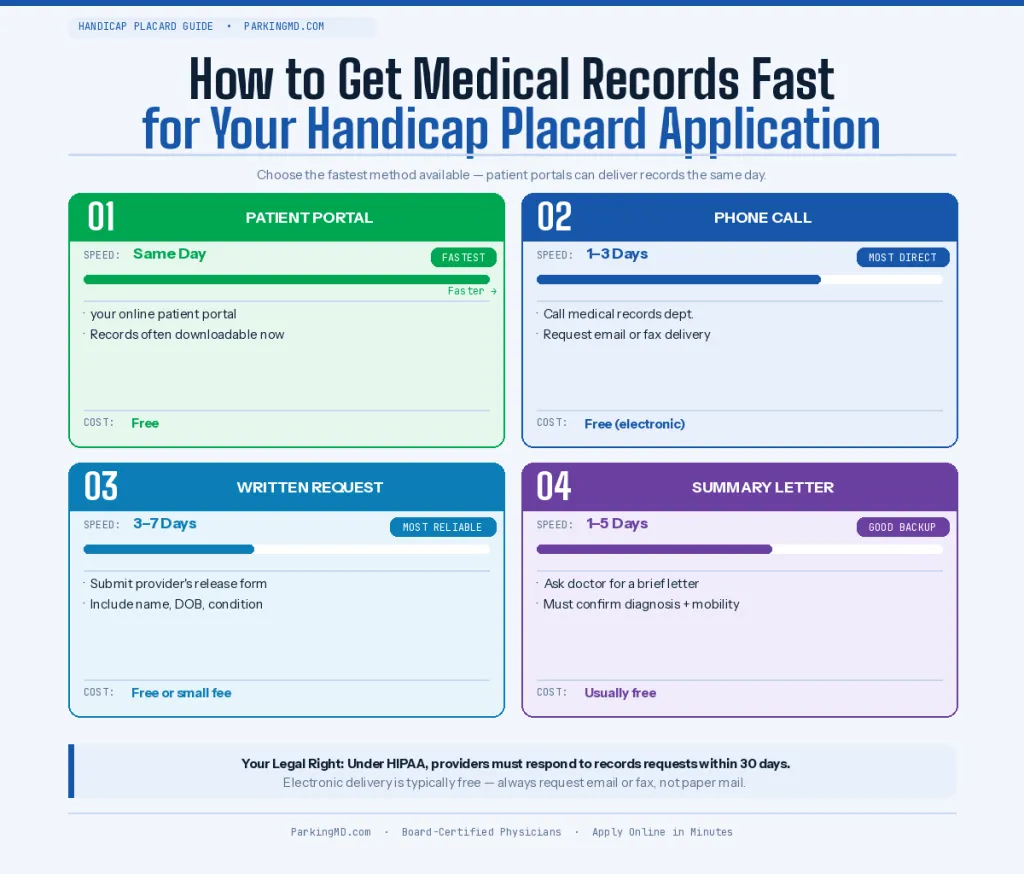
The legal deadline is 30 days. Getting records electronically, through a patient portal or by email, will likely be free. Paper copies may carry a small fee, but electronic delivery is almost always faster and costs nothing.
If a provider tells you HIPAA prevents them from releasing your records to you, that is incorrect. HIPAA requires it. If 30 days pass with no response, you can file a complaint with the HHS Office for Civil Rights at hhs.gov.
How to Get Medical Records Fast: 4 Methods That Work
Method 1: Patient Portal (Same day, free)
This is the fastest route and where to start every time. About 8 in 10 individuals who used their online patient portal found it helpful and easy to understand. If your provider uses online platforms, your visit notes and test results may already be downloadable right now.
In many cases, notes are posted within 24 to 48 hours of an appointment. A downloaded PDF can be uploaded to your ParkingMD intake immediately.
Method 2: Phone Call (1 to 3 days, free)
Call the office and ask to speak with the medical records or health information department. Be specific about what you need:
-
The condition the records relate to
-
The timeframe you need (last 12 to 24 months)
-
How you want them delivered (email or fax, not mail)
Mention that you need the records for a pending medical application. That detail tends to speed things up. The fastest way to find out whether your provider accepts requests over the phone is to call and ask to be connected to the billing or medical records department.
Method 3: Written Request (3 to 7 days)
If calling doesn’t move quickly, submit the provider’s medical records release form. Most practices have one on their website or will email it to you on request. Fill it out with your name, date of birth, the specific records needed, and your preferred delivery method.
A doctor may not require an individual who wants a copy of her medical record mailed to her home address to physically come to the doctor’s office to make that request. You do not have to appear in person just to ask for your own records.
Method 4: Summary Letter (1 to 5 days, usually free)
When full records are difficult to pull together quickly, ask your treating physician for a brief written letter that confirms your diagnosis and describes how it affects your mobility. Many doctors can produce this faster than releasing a full chart. For a placard evaluation, a clear summary letter carries real weight and is often just as effective as a complete set of records.
Which Documents Work Best for a Disability Parking Permit Review
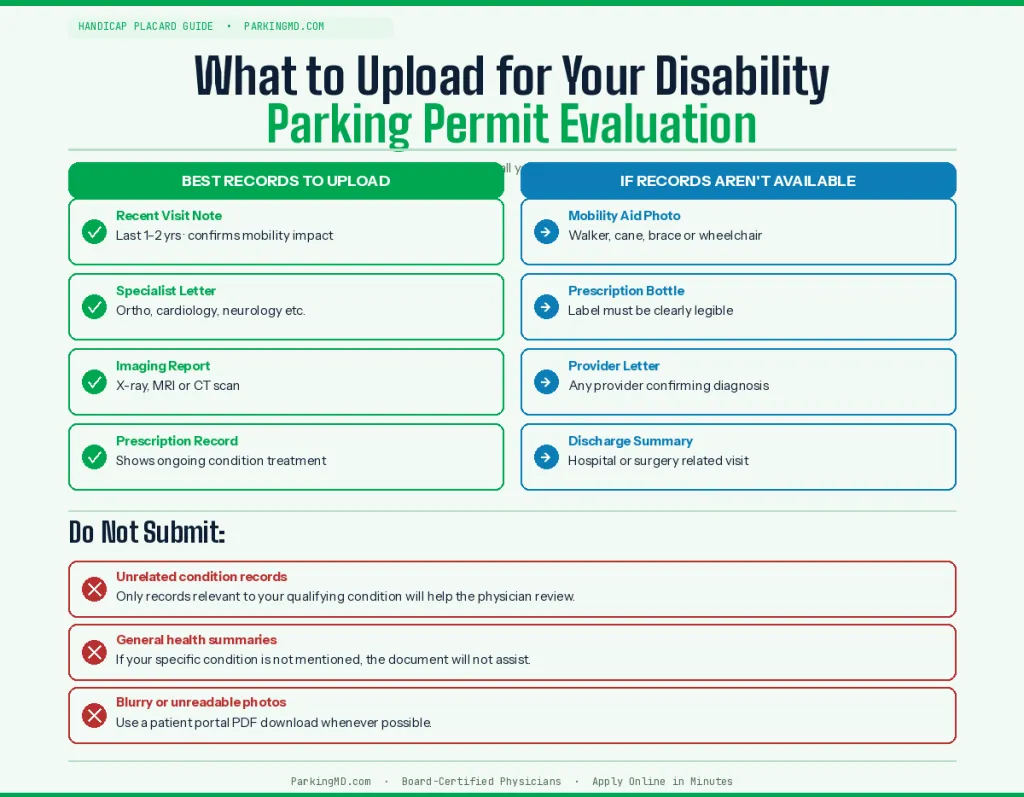
Not all records help equally. Here is what to prioritize and what to skip:
Upload these:
-
Visit notes that name your condition and describe its functional impact
-
Specialist letters (ortho, cardiology, neurology, pain management)
-
Imaging reports related to your qualifying condition
-
Prescription records showing current treatment
These work as alternatives if records aren’t available:
-
A photo of your walker, cane, wheelchair, or knee brace
-
A prescription bottle with a legible label
-
A letter from any treating provider, even a brief one
Do not upload these:
-
Records for unrelated conditions
-
General health summaries that don’t mention your qualifying condition
-
Blurry photos of documents (use a portal PDF instead)
Patients who uploaded a single specialist letter or recent imaging report consistently reported faster approvals at their ParkingMD evaluation than those who arrived without any documentation.
When Your Doctor Is Slow to Send Handicap Placard Records
This is a common frustration, especially with smaller practices. A few things that help:
Give a specific deadline. “I need these by Friday for a pending medical application” moves faster than an open-ended request.
Ask only for what you need. A targeted request for one condition’s records over the past 12 months is processed faster than a full file request going back years.
Follow up in writing. If you called and heard nothing within five business days, send a written request and note the date of your original call. A paper trail helps.
Escalate after 30 days. If a provider has not responded within the legal window, file a complaint at hhs.gov/ocr. Providers respond quickly to these.
Applying for a Handicap Placard Without Full Medical Records
Missing records are common and won’t necessarily stop your application.
Many applicants have conditions that developed gradually, or have seen several providers and aren’t sure where their records currently sit. If that’s your situation, contact every provider you’ve seen for your qualifying condition and request a single relevant visit note from each. You only need one good document.
If records genuinely aren’t accessible, alternatives that support your evaluation include:
-
A photo of any mobility aid you use (walker, cane, wheelchair, brace)
-
A prescription bottle showing current medication for the condition
-
A brief letter from any treating provider confirming your diagnosis
Understanding how the DMV placard process works in your state can also help you understand what documentation the certifying physician needs to complete your specific state form, which tells you what’s worth prioritizing.
How the ParkingMD Records Review Process Works
ParkingMD connects you with board-certified physicians who evaluate your condition and complete the physician-signed DMV forms required for a handicap placard in your state. The evaluation is done entirely from home by phone or video.
Maryland residents can start on the Maryland handicap placard page.
Kentucky residents can start on the Kentucky handicap placard page.
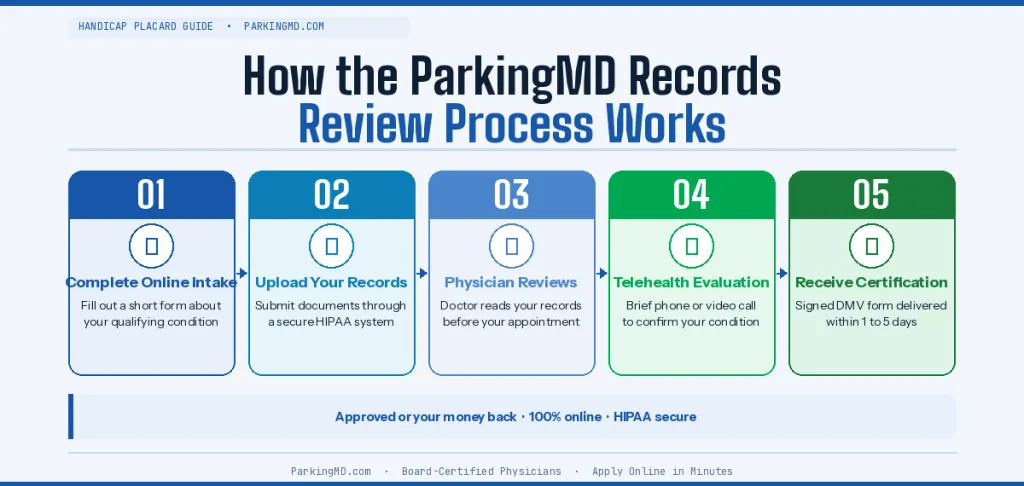
Here is how records fit into the process:
-
You complete a short online intake form
-
You upload supporting documentation through a secure, HIPAA-compliant system
-
The reviewing physician reads your records before your appointment begins
-
During the evaluation, the physician confirms your qualifying condition
-
If approved, your signed certification is sent to you, typically within one to five days
Uploading records before your appointment means your physician arrives prepared. That removes delays and eliminates the most common reason for follow-up requests. If you don’t have records, the ParkingMD team works through alternatives with you during intake.
Summing Up
Your medical records belong to you, and getting them fast is simpler than most people expect. Start with your patient portal, call the records department if needed, and upload what you have before your evaluation begins. One clear, relevant document is usually enough to keep your application moving without delays.
Ready to get started? Apply at ParkingMD and our board-certified physicians will guide you through everything from documentation to your signed DMV form.
Frequently Asked Questions
How long does a provider have to send my records?
Up to 30 days under HIPAA. In practice, electronic records are often available within one to three business days. Calling the records department directly and explaining the reason usually speeds things up.
What if my records are several years old?
Older records are still useful for long-standing conditions. If your most recent documentation is several years old, ask your treating physician for a brief current summary to accompany it.
Can a family member request records on my behalf?
Yes. A legally authorized personal representative such as a spouse or adult child has the same right under HIPAA. You may need to provide documentation of that representative status when making the request.
What records does ParkingMD's physician actually look at during the evaluation?
The physician looks for anything that confirms your qualifying condition and shows how it affects your mobility. A recent visit note, specialist letter, or imaging report is ideal. Unrelated health records don't need to be included.
What happens after the physician signs my DMV form?
ParkingMD sends you the completed, physician-signed state certification form, typically within one to five days of approval. You then submit it to your local DMV or issuing authority to receive your placard. The physician certification step is usually the fastest part of the process.

Meet the author
Alisha Shabbir
Hey, I'm Alisha and I help people understand disability parking laws and medical services. At ParkingMD, I write about state regulations, patient rights, and healthcare access to make confusing processes straightforward. I believe good information should be easy to find and understand. When I'm not researching state laws or writing guides, you'll find me reading and practicing mindfulness.
Get an Accessible Parking Permit Evaluation in Minutes.


![Handicap Placard in Maryland: Complete Guide [2026]](/_astro/t9b1cqsnhkeyjuhp8cnfr.CmyUYx2C_2gj1BS.webp)