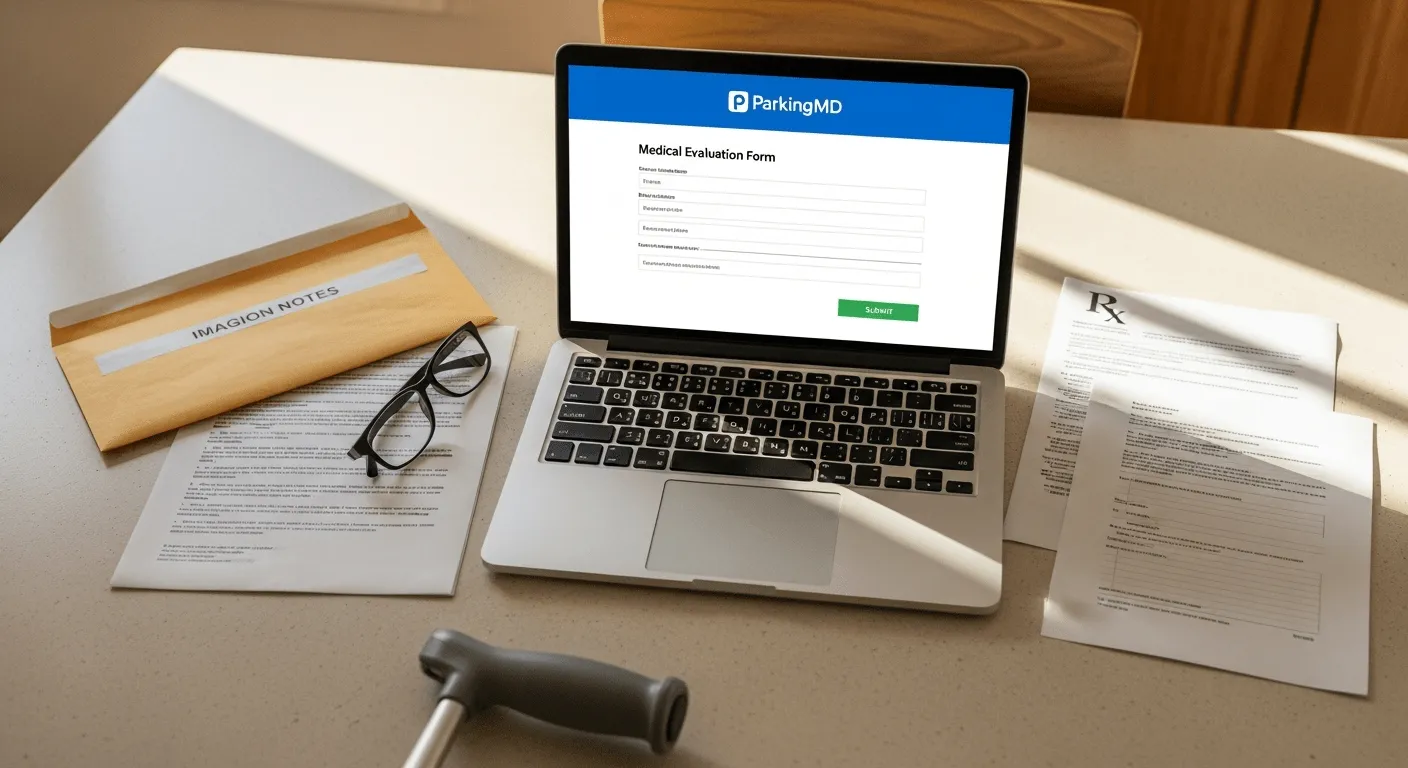
Handicap Placard Evaluation: What to Prepare
 by Alisha Shabbir
Last updated:


If you’re preparing for a disabled parking permit evaluation, you probably have one practical question before anything else: what do I actually need to have ready?
Most guides focus on eligibility and process steps. Few address the preparation question directly, which is why patients who aren’t ready end up adding days to a process that should take 24 to 48 hours.
Rather than answer this question ourselves, we pulled responses directly from patients who have been through it. Every quote below is from a verified ParkingMD patient. Their answers cover the preparation question from every angle, medical records, VA documentation, medications, scheduling, and what to expect when everything goes right.
If you’re still unsure whether your condition qualifies, conditions that qualify for a handicap placard include mobility limitations, cardiovascular conditions, pulmonary disease, and more.
”What medical records do I actually need?”
This is the first question most patients ask, and the one that determines how quickly the evaluation moves once it begins. The physician reviewing your case needs clinical evidence: a diagnosis, documentation of how your condition affects your mobility, and records that establish the ongoing nature of what you’re managing.
Steve from Florida put it the most directly of any patient we’ve heard from:
“Just make sure you have all your proof from your doctor’s to upload — whether they are x-rays, MRI scans or notes from your doctor about your conditions showing that it came from the doctor and it is about you. Get all your ducks in a row and everything will be fine.”
— Steve, Verified Patient Review
Most patients have records spread across a primary care office, a specialist, and a hospital or imaging center. Before you begin your intake, confirm you can access and download records from each provider. A phone call requesting records in advance saves the most time.
What to gather before starting:
-
Physician notes documenting your diagnosis
-
Imaging results — X-rays, MRI, CT scans — if applicable
-
Specialist reports from orthopedic, cardiac, neurological, or pulmonary providers
-
Any recent lab results relevant to your qualifying condition
Most patients don’t realize how many steps the DMV placard process involves until they’re already in the middle of it.
”What’s the hardest part of getting ready?”
Christine from California went through the ParkingMD process and described it accurately, the evaluation itself is simple. The only variable is the preparation step.
“The process is simple, the most difficult part is obtaining and uploading the supporting doctors notes and xray results.”
— Christine, Verified Patient Review
Christine’s observation applies across every state. The intake form takes under 10 minutes. The physician evaluation moves quickly once it begins. The one step that’s entirely in the patient’s hands, and the one most likely to add time, is gathering and uploading the documentation before the evaluation starts. Plan for that step first, and the rest of the process follows quickly behind it.
The Americans with Disabilities Act National Network provides a useful reference on the kinds of conditions and limitations that typically meet accessibility accommodation criteria, helpful context if you’re building your documentation before the intake.
”What if my records come from multiple doctors?”
This is more common than most patients realize, a primary care physician managing an overall condition, a specialist handling a specific diagnosis, and an imaging center holding the relevant scans. Steve Meyer from California went through this exact situation and described what made it work:
“This is a great way to do it. It allows you to get all your medical records from multiple doctors in one place for the doctor’s review and write a detailed reason for your placard need. I found it to be a simple process and the doctor was great.”
“All your medical records from multiple doctors in one place” is the key phrase. ParkingMD’s intake is built to consolidate documentation from multiple providers into a single review, the physician sees the full clinical picture rather than a partial one. Patients with complex medical histories or conditions managed across several specialists often find the evaluation more thorough than a single-provider certification, precisely because all the documentation is present at once. ParkingMD’s intake is designed to handle the full placard process from a single platform, regardless of how many providers are involved.
”Do I need to include my medications?”
Yes, and this is a detail patients frequently overlook. Prescription history establishes the ongoing, treated nature of your condition in a way that physician notes alone sometimes don’t. It also helps the reviewing physician understand the full clinical picture without needing to request additional records mid-evaluation.
Higinio R. from Texas flagged this specifically:
“Just have a few things together like prescription medication and dosage together. To make the process easier.”
— Higinio R., Verified Patient Review
A current medication list with dosages, particularly for conditions that directly affect your mobility, is one of the easiest things to prepare in advance and one of the most useful additions to your intake. You don’t need a formal document. A printed list from your pharmacy portal or a photo of your current prescription labels both work.
This is especially relevant for patients managing conditions like diabetes, cardiovascular disease, or pulmonary conditions, where the medication history directly reflects the severity and duration of the diagnosis. The American Diabetes Association outlines how diabetes complications, including neuropathy and circulatory issues, can substantially impair mobility, which is the threshold most states apply to qualify a patient for a placard. Most states apply the same mobility threshold when determining eligibility, and disability parking permits cover a broader range of conditions than most patients expect.

“I’m a veteran. Can I use my VA records?”
Yes. VA records are accepted as supporting documentation and are often among the most thorough a patient can provide, detailed diagnostic histories, imaging, treatment records, and service-connection documentation all in one place. The challenge for some veterans isn’t the quality of the records. It’s retrieving them before the intake begins.
Paul A. from Michigan went through this process with VA documentation:
“Took time to explain the process. Took awhile to get medical information through the VA but it all worked out good.”
— Paul A., Verified Patient Review
Paul’s experience reflects something worth planning for: VA records can take longer to retrieve than records from a civilian provider, particularly if you’re requesting through a VA facility that processes records manually. If you know your VA records will take time, request them before starting your intake rather than during it.
Veterans managing service-connected conditions that affect mobility, cardiovascular function, or orthopedic stability often have extensive documentation already on file. That documentation is exactly what the reviewing physician needs. Once those records are in hand, the evaluation can move quickly.
”Is there anything about scheduling I should know?”
Yes, one practical detail that catches some patients off guard. Jonathan from Indiana discovered a specific sequencing note worth knowing before you start:
“It was a very positive experience. I only had a little bit of issue when I tried to schedule the appointment immediately after uploading the documents — you need to wait at least a night.”
— Jonathan, Verified Patient Review
After uploading your records, allow time for ParkingMD’s team to review your documentation before scheduling the physician evaluation. Attempting to book immediately after uploading can create a gap where the records haven’t been processed yet. Upload your records first, then schedule your evaluation, giving the team time to review everything before the physician call means the evaluation moves faster and requires fewer follow-up questions.

“What does it look like when everything goes right?”
Mike Caretti from Ohio describes the end of the process when preparation is done correctly:
“I just received the Ohio forms as well as a separate prescription. The form was already filled out for me. All I had to do was sign. I went up to the BMV and there was no question. It took about a week start to finish.”
— Mike Caretti, Verified Facebook Review
“The form was already filled out for me. All I had to do was sign.” That’s the outcome preparation delivers. No corrections. No return trips. No calls to the BMV asking why the form was sent back. The physician completes the certification correctly, the patient signs where indicated, and the submission goes through without friction.
”What if I still have questions before I start?”
Ernie Terlizzi’s experience captures what’s available when preparation questions don’t have a clear answer:
“Professional and attentive — they will take time to answer questions and help walk you through the process. I would definitely recommend them.”
— Ernie Terlizzi, Verified Facebook Review
ParkingMD’s support team is available throughout the process, not just during the evaluation. If you’re unsure which records to gather, whether your condition qualifies, or how your state’s submission process works, those questions can be answered before you commit to anything.
Your Disability Parking Permit Pre-Application Checklist
Before starting your intake, confirm you have the following:
| What to Prepare | Why It Matters |
|---|---|
| Physician notes documenting your diagnosis | Establishes the clinical basis for your evaluation |
| Imaging results (X-rays, MRI, CT scans) | Supports the severity and functional impact of your condition |
| Specialist reports (orthopedic, cardiac, neurological, etc.) | Provides additional clinical detail for complex conditions |
| Current medication list with dosages | Establishes the ongoing, treated nature of your condition |
| Valid photo ID matching your state driver’s license | Required for your state’s certification form — name must match exactly |
| VA records (veterans only) | Request via MyHealtheVet in advance — allow extra retrieval time |
How ParkingMD’s Medical Evaluation Works Once You’re Ready
Once your records are gathered, the process moves in four steps:
Step 1 — Complete the intake form.
Answer questions about your qualifying condition and upload your supporting documentation through ParkingMD’s secure platform. Most patients finish in under 10 minutes.
Step 2 — Allow time for record review.
After uploading, give ParkingMD’s team time to process your documentation before scheduling your physician evaluation. Schedule after uploading, not immediately after.
Step 3 — Attend your online evaluation.
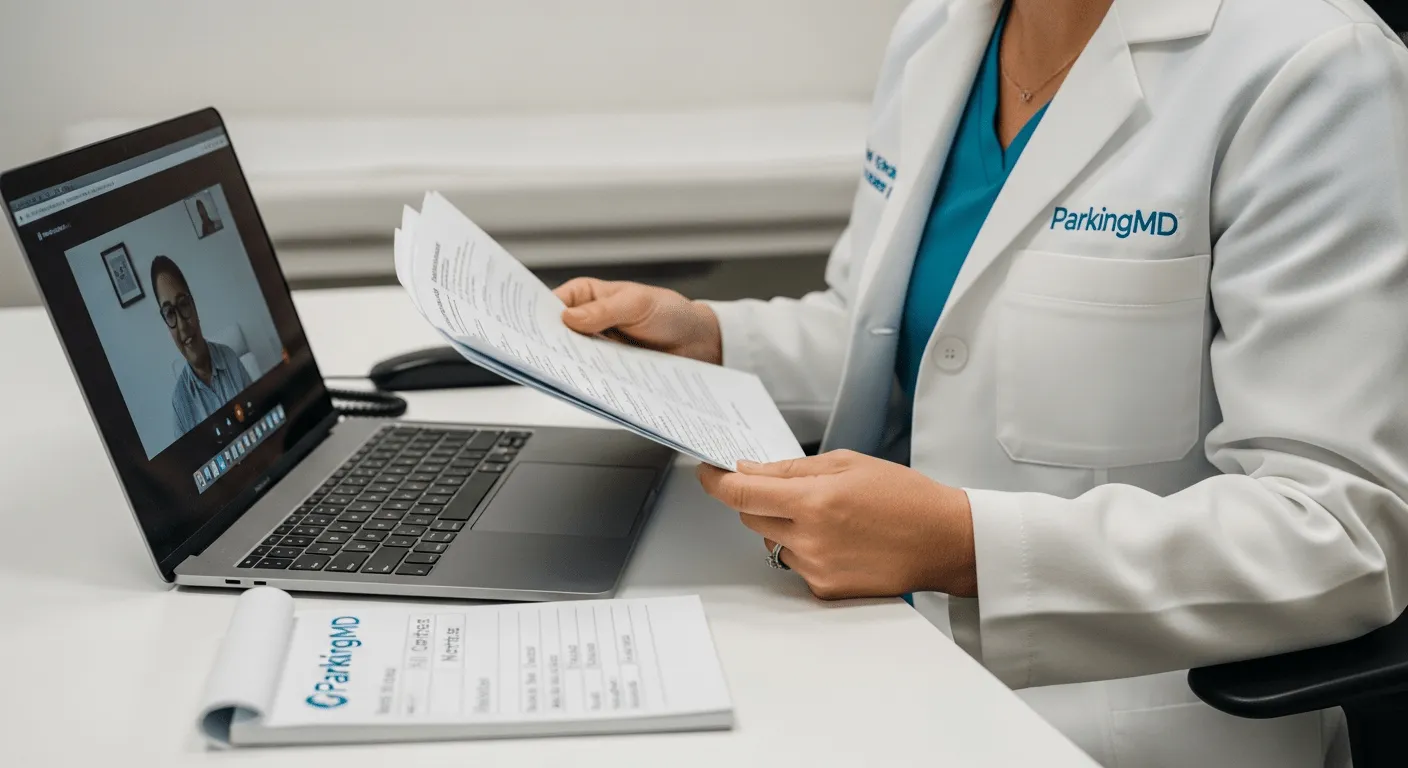
A licensed physician reviews your records, asks any follow-up questions, and makes the clinical determination from your home, on your schedule.
Step 4 — Receive your signed certification.
If approved, your completed, physician-signed state form is delivered to you, ready to submit to your state DMV, county tax assessor-collector, or authorized submission partner. Most patients receive their signed form within 24 to 48 hours.
Start Your Disabled Parking Permit Evaluation
The preparation questions are the only ones worth asking before your intake begins. Eligibility is confirmed during the process — you don’t need to resolve that before starting. What you need is your records, your medication list, and a few minutes to complete the intake form.
Most patients who arrive prepared receive their signed certification within 24 to 48 hours.
Frequently Asked Questions
How far in advance should I gather my records before starting?
Ideally, have your records ready before you begin the intake. The evaluation cannot proceed until documentation is submitted and reviewed. If you're requesting VA records or records from a provider without an online portal, allow a few extra days for retrieval before starting your intake.
Can I submit records that are more than a year old?
Older records can be helpful for establishing a diagnosis history, but recent records, particularly physician notes and imaging from the past 12 to 24 months, carry more weight in confirming the condition is current and ongoing. Include the most recent records you have, supplemented by older records where relevant.
What if I don't have imaging results?
Imaging isn't required for every qualifying condition. Physician notes, specialist reports, and medication history can establish eligibility for many diagnoses without imaging. ParkingMD's intake process will indicate if additional documentation is needed after your records are reviewed.
Does my medication list need to be an official document?
No. A printed list from your pharmacy portal, a photo of current prescription labels, or a typed list with medication names and dosages all work. The physician needs to understand what you're currently prescribed and at what dosage, the format is secondary.

Meet the author
Alisha Shabbir
Hey, I'm Alisha and I help people understand disability parking laws and medical services. At ParkingMD, I write about state regulations, patient rights, and healthcare access to make confusing processes straightforward. I believe good information should be easy to find and understand. When I'm not researching state laws or writing guides, you'll find me reading and practicing mindfulness.
Get an Accessible Parking Permit Evaluation in Minutes.